Hand Sewing vs. Machine Sewing: When to Use Each (2026)
Hand sewing and machine sewing are not rivals. Each is better at different jobs, and most finished projects use both. Here is how they compare and how to choose.
In This Article
The Short Answer
- Choose hand sewing for small repairs, invisible stitches, buttons and delicate fabrics.
- Choose a machine for long seams, garments, quilts, bags and anything that must be strong and even.
- Use both on most projects: machine for the structure, hand for the finishing.
For almost all of human history, every stitch was made by hand. The sewing machine, which spread into homes and factories from the 1850s, changed how fast clothing could be made but did not make the needle obsolete. Today's sewists choose between the two methods job by job, and the right choice depends on what you are sewing.
Hand Sewing: The Advantages
- It needs almost nothing. A needle, thread and scissors are enough, which makes hand sewing the cheapest and easiest way to start.
- It is portable. You can sew on a train, on the sofa or in a waiting room.
- It gives the most control. You decide exactly where each stitch goes, which matters on curves, corners and visible details.
- It can be invisible. Stitches such as the slip stitch and blind hem stitch disappear into the fold of the fabric.
- It is gentle. Delicate, sheer and vintage fabrics avoid the pressure and pull of a machine's feed.
- It is calm and quiet. Many people find slow hand stitching relaxing.
Hand Sewing: The Drawbacks
- It is slow. A long seam that takes minutes on a machine can take an hour or more by hand.
- It is less even. Even skilled hand stitches vary slightly in length and tension.
- Big projects are tiring. Side seams, curtains and quilt backings are hard work by hand.
Machine Sewing: The Advantages
- Speed. A machine sews long seams in a fraction of the time.
- Consistency. Every stitch is the same length, which looks crisp and professional, especially for topstitching.
- Strength. Tight, even lockstitches stand up to stress and repeated washing.
- Versatility. Zigzag, stretch and decorative stitches, plus automatic buttonholes on many machines, handle jobs that are tedious by hand.
- Heavy materials. Denim, canvas and multiple layers are much easier to sew by machine.
Machine Sewing: The Drawbacks
- Cost. A machine is an upfront expense, and extras such as sergers add more.
- Learning curve. Threading, bobbins, tension and feet take practice and a careful read of the manual.
- Less fine control. Placing stitches exactly on tight curves or in tiny areas is harder.
- Not portable. A machine needs a table, power and space.
Side-by-Side Comparison
| Factor | Hand Sewing | Machine Sewing |
|---|---|---|
| Startup cost | Very low | Moderate to high |
| Speed | Slow | Fast |
| Stitch evenness | Varies with skill | Very even |
| Seam strength | Good with backstitch | Excellent |
| Precision on small areas | Excellent | Good |
| Invisible stitching | Excellent | Limited (blind hem foot) |
| Delicate fabrics | Excellent | Possible with care |
| Heavy fabrics | Hard work | Excellent |
| Portability | Excellent | Poor |
Which Jobs Suit Which Method
Best Done by Hand
- Sewing on buttons, hooks and eyes, and snaps
- Small repairs, such as a split seam or a fallen hem
- Blind hems on trousers, skirts and dresses
- Closing the turning gap in a cushion or lined bag
- Attaching linings and facings invisibly
- Hand-finishing quilt bindings
- Appliqué with tight curves and points
- Embroidery and decorative stitching
- Basting slippery fabrics such as silk or rayon before machine stitching
Best Done by Machine
- Garment seams, especially side seams and inseams
- Piecing quilts with consistent quarter-inch seams
- Long, straight seams on curtains, bedding and home décor
- Topstitching and edge stitching that must look uniform
- Buttonholes, on machines that make them
- Bags, straps and heavy fabrics
- Seams on knits, using a stretch or zigzag stitch
Five Hand Stitches Worth Knowing
Our full guide to hand sewing stitches covers more, with illustrations.
Even if most of your sewing ends up on a machine, these hand stitches cover nearly every job a machine cannot do well.
| Stitch | What It Looks Like | Use It For |
|---|---|---|
| Running stitch | Even dashes in and out of the fabric | Basting, gathering and quick, light seams |
| Backstitch | A continuous line, like machine stitching, on the right side | Strong seams and repairs by hand |
| Slip stitch (ladder stitch) | Almost invisible, hidden inside folds | Closing turning gaps and attaching linings |
| Blind hem stitch | Tiny catches on the right side, barely visible | Hems on skirts, trousers and dresses |
| Whipstitch (overcast stitch) | Diagonal stitches wrapping over an edge | Joining edges, appliqué and stopping fraying |
A sewing machine handles most of these jobs differently: a straight stitch replaces running and backstitches, a zigzag or overlock stitch replaces whipstitching over raw edges, and a blind hem foot can imitate a hand hem on many fabrics, though usually less invisibly.
Most Projects Use Both
In practice, sewists mix methods. A typical dress is machine-sewn at the seams and darts, then finished by hand at the hem, lining and fastenings. A quilt is often machine-pieced and hand-bound. Tricky areas, such as set-in sleeves, are often hand-basted first so the fabric stays in place, then machine-stitched for strength.
Which Should You Learn First?
If you are new to sewing, learn a few hand stitches first or alongside the machine. Hand sewing shows you how a stitch locks fabric together, it costs almost nothing, and you will need it for buttons and finishing anyway. Start with our guide to threading a needle and tying a knot.
When you start making garments, quilts or bags, a basic machine saves enormous amounts of time; our sewing machine guides explain how to choose and use one. The machine you use descends from a long line of inventors, a story told in who invented the sewing machine. For an overview of everything else to learn, go back to our Learn to Sew guide.
Sources
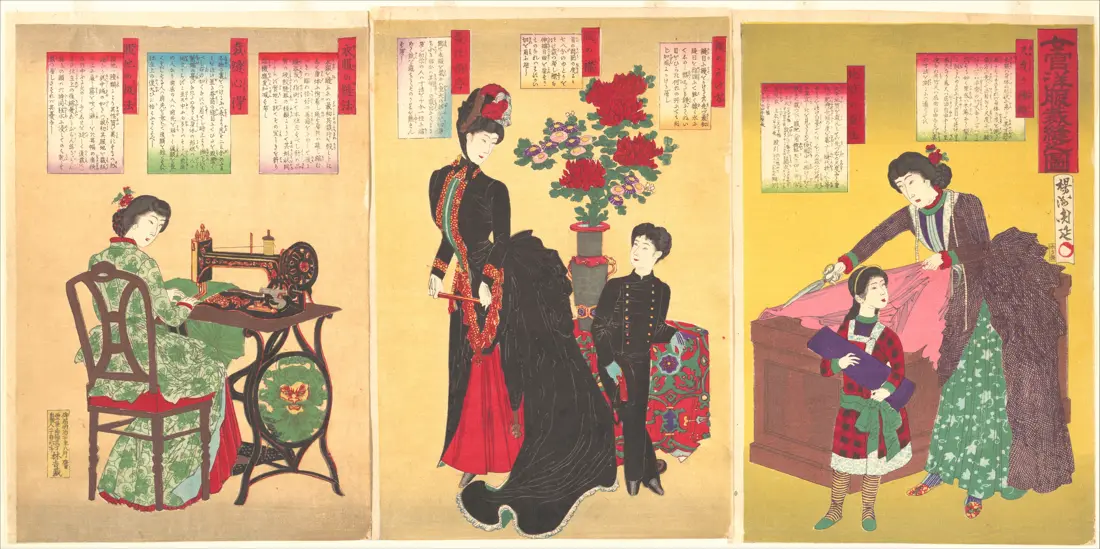
- Yōshū Chikanobu, Court Ladies Sewing Western Clothing, The Metropolitan Museum of Art
Frequently Asked Questions
Is hand sewing as strong as machine sewing?
A well-made backstitch is strong enough for most seams, but machine stitching is more even and generally stronger for seams under heavy stress, such as jeans inseams and bag straps.
Should a beginner learn hand sewing first?
Learning a few hand stitches first is useful because it shows how stitches and seams work, and you will need hand sewing for finishing and repairs anyway. You can learn both at the same time.
Can you make clothes entirely by hand?
Yes. All clothing was sewn by hand before the sewing machine spread in the 1850s, and some sewists still hand-sew entire garments. It simply takes much longer.
What should always be sewn by hand?
Jobs that need invisible or very precise stitches: blind hems, closing a lining or turning gap, attaching buttons, hooks and snaps, and delicate or heirloom fabrics.
Keep Reading
Learn to Sew
Tools, first stitches, beginner fabrics and first projects.
How to Thread a Needle and Tie a Knot
Thread length, threading tricks, three knots and how to finish off.
Who Invented the Sewing Machine?
Saint, Thimonnier, Hunt, Howe or Singer? The inventors and who deserves the credit.
History of the Sewing Needle
From Denisovan bird bone to Redditch steel, the tool behind every stitch.