Right Side or Wrong Side? 7 Ways to Tell Fabric Apart (2026)
Sewing patterns constantly tell you to place fabric right sides together, but some fabrics hide which side is which. These checks will tell you almost every time.
In This Article
- Quick Checks
- Why It Matters
- 1. Look at the Print or Color
- 2. Check the Texture and Finish
- 3. Read the Selvedge
- 4. Feel for the Pinholes
- 5. Look at a Knit's Structure
- 6. Watch Which Way Jersey Curls
- 7. Check How It Was Folded on the Bolt
- Quick Reference by Fabric Type
- When You Still Cannot Tell
- Next Steps
- Sources
- Frequently Asked Questions
Quick Checks
- Prints: the right side is brighter and crisper
- Selvedge text: printed brand names usually read correctly on the right side
- Selvedge holes: raised bumps often face the right side
- Knits: small V shapes or vertical ribs show on the right side
- No difference? pick a side and mark the wrong side
Fabric has two faces. The right side (RS) is the one meant to show on the finished item. The wrong side (WS) faces inward, toward the body or the inside of a cushion or bag. Patterns are written around this distinction, so knowing which is which is one of the first things every sewist learns. Usually it is obvious; sometimes it takes a closer look.
Why It Matters
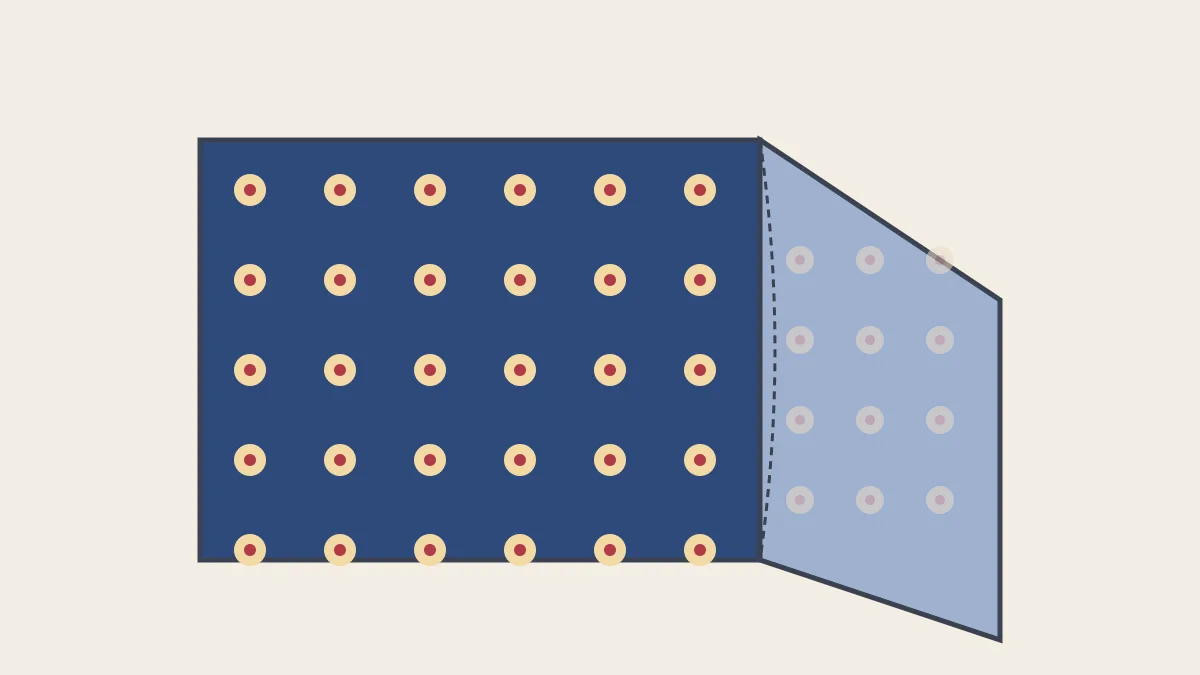
Most seams are sewn with the fabric right sides together (RST), so that when the piece is turned out the raw edges are hidden inside. If you mix up the sides, a sleeve can end up with its dull side showing, or one panel of a garment can look slightly different from the others. On printed fabrics, napped fabrics such as velvet and corduroy, and anything with a sheen, the difference is easy to spot once the item is finished.
1. Look at the Print or Color
On most printed fabrics, the design is printed onto one face, so that side is brighter and sharper. The wrong side shows a faded or blurry version. On woven patterns such as jacquards and some plaids, the right side usually looks more defined. On solid fabrics, hold the fabric up to a window or lamp and compare the two faces for tone and sheen; the right side is often slightly brighter or smoother.
2. Check the Texture and Finish
Run your fingers over both sides. The right side is usually smoother or more finished. Fabrics with a surface texture, such as brushed cotton, flannel, fleece, terry and velvet, typically carry that texture on the right side. Satin is shiny on the right side and matte on the wrong side, and on twill weaves such as denim the diagonal lines are clearer on the right side.
3. Read the Selvedge
The selvedge is the tightly woven edge that runs along each long side of the fabric as it comes off the bolt. Many fabrics have the manufacturer's name, the designer's name or a row of color dots printed there. That printing usually reads correctly, and the color dots look brightest, on the right side.
4. Feel for the Pinholes
During finishing, many fabrics are held taut on a frame by pins along the selvedge. Run a finger along the selvedge and feel for tiny holes. The holes are usually pushed through from the wrong side, so the raised, bumpy side is often the right side. This is a useful clue, but some mills work the other way, so treat it as a hint rather than a rule.
5. Look at a Knit's Structure
Knit fabrics, such as jersey, show their structure clearly. The right side of a single knit usually shows neat columns of small V shapes, like tiny vertical ribs. The wrong side shows horizontal loops that look like little bumps. Sweatshirt fleece and French terry make it even easier: the soft brushed or looped side is the wrong side, worn against the skin.
6. Watch Which Way Jersey Curls
Single jersey curls at its edges, and the curl gives the sides away. Cut across the fabric at a right angle to the selvedge and pull gently: the cut edge tends to roll toward the right side. The lengthwise edges, along the selvedges, tend to roll toward the wrong side.
7. Check How It Was Folded on the Bolt
Many fabrics are folded on the bolt with the right side facing inward to protect it from dust and fading. This is only a clue, since practices vary between mills and stores, but if other checks disagree it can tip the balance.
Quick Reference by Fabric Type
| Fabric | Right Side | Wrong Side |
|---|---|---|
| Printed cotton | Bright, crisp print | Faded or blurry print |
| Satin | Shiny | Matte |
| Denim and twill | Clear diagonal lines, deeper color | Lighter, less distinct |
| Velvet and corduroy | Pile or wales | Flat woven back |
| Jersey knit | Columns of small Vs | Rows of horizontal loops |
| Sweatshirt fleece and French terry | Smooth knit face | Brushed fleece or loops |
| Fusible interfacing | Smooth side, which faces up toward the iron | Bumpy, shiny glue side, which fuses to the fabric's wrong side |
When You Still Cannot Tell
Some fabrics, such as many plain-weave solids, linens and some double-knit fabrics, look the same on both sides. In that case, there is no wrong answer: choose the side you like better. The important thing is consistency. Mark the wrong side of every cut piece with a small chalk X or a W, and keep the fabric oriented the same way as you cut so that all the pieces match.
Next Steps
Once you can tell the sides apart, the pattern shorthand starts to make sense. See our list of sewing abbreviations for RS, WS, RST, WST and more, or head back to the Learn to Sew guide.
For how fabrics are constructed, see woven vs. knit vs. nonwoven and fabric weaves.
For the directions in woven fabric and why they matter, see grain, bias and selvage.
Sources
- Selvage, Wikipedia
- Knitted fabric, Wikipedia
Frequently Asked Questions
What does right side of fabric mean?
The right side, often abbreviated RS, is the side meant to show on the outside of the finished item. It is usually the brighter, smoother or more finished side. The wrong side (WS) faces inward.
What does right sides together mean?
RST means placing two pieces of fabric with their right sides facing each other before sewing. When the seam is turned out, the seam allowance is hidden inside and the right sides show.
What if my fabric looks the same on both sides?
Then it is effectively double-sided. Choose the side you prefer, mark the other side with chalk or a washable pen, and use the same side for every piece of the project.
Which way does jersey curl?
Cut across the grain, jersey tends to roll toward the right side. Along the lengthwise edges, it tends to roll toward the wrong side.
Keep Reading
Learn to Sew
Tools, first stitches, beginner fabrics and first projects.
Sewing Abbreviations
RST, WOF, SA, FBA, HST, UFO and dozens more explained.
Hand Sewing vs. Machine Sewing
Speed, strength, control and cost compared, plus when to use each.
Sewing Glossary A–Z
450+ sewing terms explained in plain English, from appliqué to zipper foot.