How to Thread a Needle and Tie a Knot That Holds (2026)
Every hand-sewing project starts the same way: a thread through an eye and a knot at the end. These steps and tricks make both quick and reliable, even with a tiny needle.
In This Article
The Essentials
- Thread length: about 18–20 inches (45–50 cm)
- Cut: a fresh, clean cut at a slight angle
- Single thread: fine fabrics and invisible stitches
- Double thread: buttons and strong repairs
- Finish: always secure the end with small backstitches or a knot
Threading a needle is the very first skill in sewing, and one of the oldest. People have pushed thread through the eyes of needles for at least 40,000 years, as our history of the needle explains. The good news is that a few small habits make it easy every time.
What You Need
- A hand-sewing needle. For general sewing, "sharps" are the standard all-purpose needle. If threading is hard, try an embroidery (crewel) needle, which has a longer eye.
- Thread. All-purpose polyester thread suits most fabrics. Match the color to your fabric unless the stitches are meant to show.
- Sharp scissors or snips for a clean cut.
- Optional: a needle threader, beeswax or thread conditioner, and good light.
How to Thread a Needle Step by Step
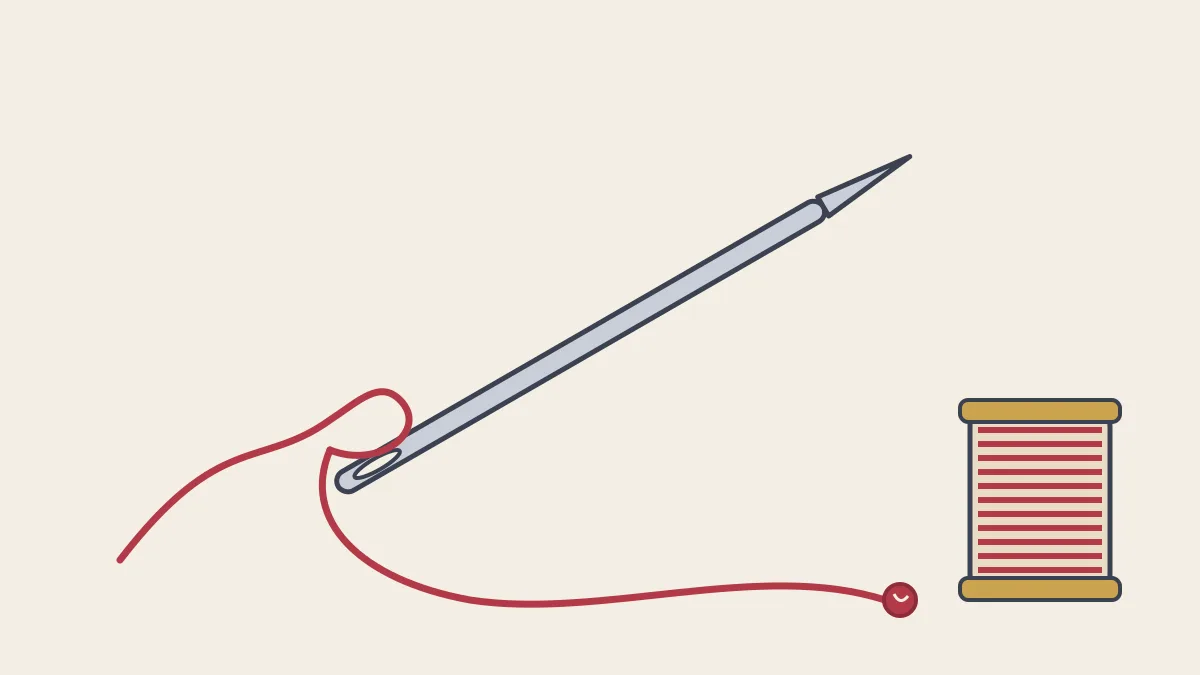
- Cut the right length. Pull about 18 to 20 inches (45 to 50 cm) of thread from the spool. Longer thread tangles and wears thin as it passes through the fabric again and again.
- Thread the leading end. Many sewists find thread tangles less if they thread the end that came off the spool first and tie the knot in the end they cut.
- Make a fresh cut. Snip the end cleanly at a slight angle with sharp scissors. A clean, pointed tip slides through the eye far more easily than a frayed one.
- Stiffen the tip. Moisten it slightly or run it across beeswax so the fibers hold together.
- Find the bigger side of the eye. Needle eyes are punched from one side, so one side of the eye is often slightly larger. If the thread will not go in, turn the needle around.
- Use contrast and light. Hold the needle against a background that contrasts with the thread color, such as white paper behind dark thread.
- Push the thread through. Hold the thread very close to its tip, about a quarter inch (6 mm), and guide it into the eye. Once a little pokes through, pinch it and pull it through.
- Choose single or double. For a single thread, pull through a tail of a few inches. For a double thread, pull until the two ends are even.
Threading Tricks That Help
| Trick | How It Works |
|---|---|
| Needle threader | Push the fine wire loop through the eye, put the thread through the loop, then pull the threader back out, taking the thread with it. |
| Self-threading needle | These needles have a slot at the top; press the thread into the slot and it snaps into the eye. |
| Fold method | Loop the thread tightly over the needle, pinch the fold flat between your fingers, slide the needle out, and push the flat fold through the eye. |
| Pinch method | Hold the thread so only the tiniest tip shows between finger and thumb, then press the needle's eye down onto it. |
| Bigger eye | Switch to an embroidery or tapestry needle if your fabric allows it. |
Single vs. Double Thread
With a single thread, you knot only one end and leave a free tail at the needle. It makes finer, less visible stitches and is easy to undo, so it suits garment sewing, hems, fine fabrics such as silk and chiffon, and most general work.
With a double thread, you pull the ends level and knot them together. It is twice as strong but bulkier, and knots are harder to untangle. Use it for sewing on buttons, repairing bags or heavy fabrics, and anywhere strength matters more than looks.
Three Ways to Tie a Knot
Simple Loop Knot
Best for beginners and double thread.
- Hold the thread end and form a small loop about 1 to 2 inches from the end.
- Pass the end through the loop and pull tight.
- For a bigger knot that will not pull through loose fabric, tie a second knot on top of the first.
- Trim the tail to about a quarter inch (6 mm).
Finger-Roll Knot
A quick, traditional method.
- Wrap the thread end once or twice around the tip of your index finger.
- Roll the thread off your fingertip with your thumb, twisting the wraps together.
- Slide the twist to the end of the thread between your thumb and finger, and pull to tighten it into a knot.
Quilter's Knot
The neatest and most reliable knot, popular with quilters because it is small and tidy.
- Hold the needle and lay the thread end alongside it, pointing toward the eye.
- Wrap the thread around the needle two or three times near the point.
- Pinch the wraps between finger and thumb.
- Pull the needle through the wraps, keeping them pinched, until they slide down the thread and form a neat knot at the end.
Starting Without a Knot
Knots are not always the best start. On fine fabrics, or where a knot might show or leave a bump, you can begin with two or three tiny backstitches on top of each other in the seam allowance or on the wrong side. This anchors the thread invisibly.
How to Secure the End of Your Thread
When you reach the end of your stitching, or have about 4 inches (10 cm) of thread left, secure it:
- On the wrong side, take a tiny stitch through a few fabric threads, but do not pull it tight, so a small loop remains.
- Pass the needle through the loop and pull firmly to form a knot against the fabric.
- Repeat once more for security.
- Run the needle under the fabric for a short distance, bring it out and trim the thread close, so the tail is hidden.
Common Problems and Fixes
| Problem | Likely Cause | Fix |
|---|---|---|
| Thread will not go through the eye | Frayed end or eye too small | Recut the end at an angle, try the other side of the eye, or use a larger-eyed needle |
| Thread tangles and knots | Too long or twisted | Use a shorter length and let the needle dangle to untwist |
| Knot pulls through the fabric | Knot too small for the weave | Tie a double knot or use a quilter's knot |
| Thread unthreads while sewing | Tail too short on single thread | Leave a tail of at least 3–4 inches |
| Thread breaks or frays | Thread worn from long use | Use shorter lengths and a good-quality thread |
Next Steps
With a threaded needle and a secure knot, you are ready for your first stitches. Our Learn to Sew guide lists the skills to learn next, and hand sewing vs. machine sewing explains when hand stitching is the right choice.
Sources
- Sewing needle, Wikipedia
Frequently Asked Questions
How long should thread be for hand sewing?
About 18 to 20 inches (45 to 50 cm), roughly from your fingertips to your elbow and a bit more. Longer thread tangles, knots and wears thin from being pulled through the fabric repeatedly.
Should I use a single or double thread?
Use a single thread for fine fabrics, invisible stitches and most garment sewing. Use a double thread for extra strength, such as sewing on buttons or repairing heavy fabric.
Why does my thread keep tangling?
Usually because the thread is too long or has become twisted. Use a shorter length, let the needle dangle occasionally so the thread untwists, and try threading the end that came off the spool first. Running thread over beeswax or a thread conditioner also helps.
How do you thread a needle without a threader?
Cut the thread cleanly at an angle, moisten or flatten the tip, hold it very close to the end, and push it through the eye against a contrasting background. Or fold the thread over the needle, pinch the fold flat and push the fold through the eye.
Keep Reading
Learn to Sew
Tools, first stitches, beginner fabrics and first projects.
Hand Sewing vs. Machine Sewing
Speed, strength, control and cost compared, plus when to use each.
History of the Sewing Needle
From Denisovan bird bone to Redditch steel, the tool behind every stitch.
Right Side vs. Wrong Side of Fabric
Simple checks for prints, solids, selvedges, knits and double-sided cloth.