Beginner, Intermediate or Advanced? Sewing Skill Levels Decoded (2026)
Almost every sewing pattern carries a difficulty label, but there is no official standard behind them. Here is what the common levels usually mean, the skills each one expects, and how to tell when you are ready for the next.
In This Article
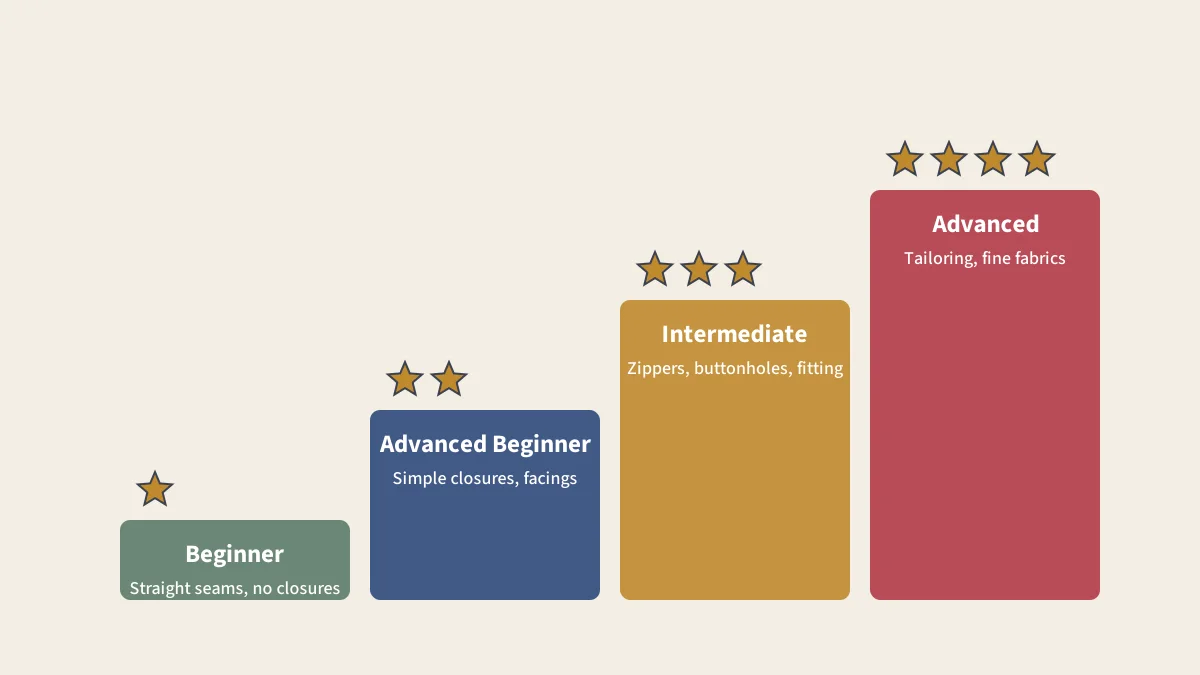
The Levels in Brief
- Beginner: few pieces, straight seams, simple shapes, often no closures
- Advanced beginner (confident beginner): adds simple closures, facings and pockets
- Intermediate: zippers, buttonholes, collars, set-in sleeves and fitting
- Advanced: tailoring, linings, difficult fabrics and complex construction
- The catch: each pattern company sets its own definitions
Pattern envelopes and websites label their designs with words such as "easy," "beginner," "intermediate" or "advanced," sometimes with stars, dots or a small pie chart. These labels are useful, but they are not a test you pass. They describe the techniques a pattern uses, and each company decides for itself what counts as which level.
Why Skill Labels Vary
There is no governing body for sewing pattern difficulty. Skill levels are assigned by the designer or pattern company, and every designer teaches differently and assumes a different level of knowledge. Some brands use three levels, others four or five, shown as words, stars, dots or a small pie chart. In-between labels such as "advanced beginner," "confident beginner" and "advanced intermediate" are common. Older commercial patterns often used phrases such as "very easy" or "easy" on the envelope.
Many pattern companies say their levels are based on the techniques required to sew each pattern rather than on the person sewing it. That is the most useful way to read any label: as a list of skills, not a verdict on you.
What Each Level Usually Means
| Level | Typical Techniques | Typical Projects |
|---|---|---|
| Beginner | Straight seams, simple hems, casings, few pattern pieces; often no zippers or buttons | Tote bags, pillowcases, elastic-waist skirts and pants, simple tops |
| Advanced beginner (confident beginner) | Facings, pockets, simple buttons, gathering, basic darts | Shift dresses, button-front tops with few pieces, shorts with pockets |
| Intermediate | Zippers, buttonholes, collars, set-in sleeves, plackets, more precise fitting | Shirts, fitted dresses, trousers with fly fronts |
| Advanced | Tailoring, linings, interfacing structure, difficult fabrics, extensive fitting | Tailored jackets, coats, lined evening wear, bias-cut garments, swimwear and lingerie |
A "confident beginner" pattern, for example, is usually aimed at beginners willing to learn one new skill, such as a zipper, buttons or facings, while "advanced intermediate" patterns often focus on specialty sewing such as swimwear, lingerie, bias-cut garments and lined outerwear. Labels overlap from brand to brand, which is why the table above shows typical rather than fixed definitions.
A Skill Ladder You Can Follow
Rather than chasing a label, it helps to collect techniques in a sensible order. Each step adds one or two new skills to what you already know.
- Foundations: threading, straight seams with a consistent seam allowance, pressing, hems. See our Learn to Sew guide.
- Edges and shaping: seam finishes, casings for elastic, gathering, simple darts.
- Openings: facings, patch and in-seam pockets, sewing on buttons.
- Closures: centered and lapped zippers, then invisible zippers; machine buttonholes.
- Garment structure: collars, cuffs, set-in sleeves, waistbands and plackets.
- Fit: making a test garment (a toile or muslin) and adjusting length, width and bust or hip shaping.
- Specialist work: knits, linings, tailoring, couture finishes and difficult fabrics.
How to Judge a Pattern Before You Buy
The label is a starting point. These clues tell you more:
- Number of pattern pieces. Fewer pieces usually mean simpler construction.
- Closures. Zippers, buttonholes and fly fronts add difficulty.
- Fit. Loose, boxy or elastic-waist designs forgive fitting errors; close-fitting designs do not.
- Recommended fabrics. Stable cottons are easier than slippery silks or stretchy knits.
- Instructions. Patterns with step-by-step illustrations, sew-alongs or video support help you learn new techniques.
- Abbreviations and terms. If the instructions use shorthand you have never seen, look it up first in our sewing abbreviations list.
When to Sew Above Your Level
Many pattern companies actively encourage sewists to try patterns above their comfort zone, especially when the instructions teach each technique. A good strategy is to take on one new skill per project: practice it on scraps first, and choose an inexpensive fabric so mistakes feel low-stakes. If a pattern adds three or four new techniques at once, it may be worth waiting.
Levels Are a Guide, Not a Gate
Skill labels exist to help you choose projects you will enjoy finishing. They are inconsistent between brands, and they change as you learn. Treat them as a description of techniques, pick projects that stretch you a little, and keep a short list of the skills you want to learn next. Our history of sewing patterns shows how much the instructions themselves have changed: the earliest tissue patterns had no printed instructions at all.
Sources
- Pattern (sewing), Wikipedia
Frequently Asked Questions
Who decides a sewing pattern's skill level?
The designer or pattern company. There is no industry-wide standard, so a pattern labeled intermediate by one brand may feel easy or hard compared with another brand's intermediate.
What skills does an intermediate sewing pattern need?
Usually zippers, buttons and buttonholes, set-in sleeves, collars, facings, darts and some fitting. Intermediate patterns expect you to follow multi-step instructions and work more precisely.
Can a beginner sew an intermediate pattern?
Often, yes, if the pattern teaches the new technique well and you are willing to practice it on scraps first. Many pattern companies encourage sewists to sew slightly above their level to learn.
What makes a pattern advanced?
Advanced patterns typically involve tailoring, linings, complex construction, tricky fabrics such as silk or bias-cut garments, detailed fitting, or specialist work such as swimwear and lingerie.
Keep Reading
Learn to Sew
Tools, first stitches, beginner fabrics and first projects.
Sewing Abbreviations
RST, WOF, SA, FBA, HST, UFO and dozens more explained.
Hand Sewing vs. Machine Sewing
Speed, strength, control and cost compared, plus when to use each.
History of Sewing Patterns
Butterick, McCall's, Vogue and Simplicity, from 1800s magazines to PDFs.