Snaps, Hooks and Velcro: The Surprising Stories Behind Fasteners (2026)
Buttons and zippers get the attention, but three humbler fasteners hold a great deal of clothing together. One is medieval, one came out of the 1880s, and one was inspired by a walk in the Swiss countryside.
In This Article
Fastener Timeline in Brief
- 14th century: hooks and eyes, then called "crochet and loop," appear in England
- 1885: Heribert Bauer patents a spring-button fastener in Germany
- May 29, 1886: Albert-Pierre Raymond patents a snap fastener in France
- 1941: George de Mestral notices burrs clinging to his dog
- 1955: de Mestral files his hook-and-loop patent
- 1978: the original Velcro patent expires
Every sewing pattern that calls for a closure gives you a choice. Buttons are the oldest answer and zippers the most famous, but snaps, hooks and eyes, and hook-and-loop tape each solved a problem the others could not. Their histories run from medieval England to the space age.
Hooks and Eyes: The Medieval Fastener
The hook and eye is the simplest of the three: a small metal hook sewn to one edge of a garment catches a loop or bar sewn to the other. Hook-and-eye fasteners were in use in England by the fourteenth century, when they were called a "crochet and loop." The word crochet, meaning a small hook, is the same one behind the craft of crochet.
Because they lie flat and hide easily, hooks and eyes became the standard closure for close-fitting bodices, the top of a zipper and the back of a waistband. They were valuable enough that in 1643 a woman in colonial Maryland is recorded paying £10 worth of tobacco for hooks and eyes. For centuries they were bent by hand. Redditch in Worcestershire, England, already famous for needle making, was the first town to manufacture them by machine.
The Hump That Sold Millions
Ordinary hooks had one weakness: they could slip out of the eye as the wearer moved. In 1889 the Richardson & DeLong Hook and Eye Company of Philadelphia patented a hook with a small hump in its shank, designed so the eye stayed caught until the wearer chose to release it. Improvements kept coming, including E. C. Beecher's hook-and-eye patent of June 1900, and hooks and eyes became the standard closure for brassieres in the early twentieth century.
Snap Fasteners: A Patent Race in the 1880s
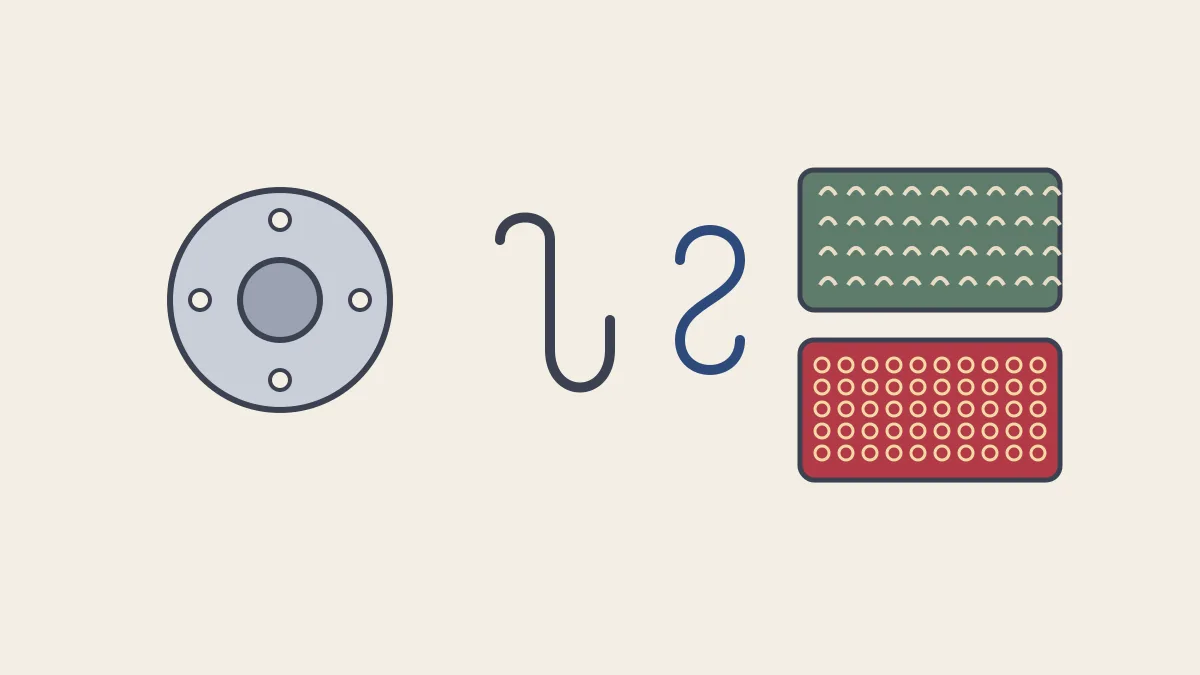
A snap fastener is two interlocking discs: a "ball" (stud) and a "socket" that grips it with a spring. Press the halves together and they click shut; pull and they part.
Two inventors are credited with the early snap. In 1885 Heribert Bauer of Germany patented a spring-button fastener, the Federknopf-Verschluss. On May 29, 1886, Albert-Pierre Raymond of Grenoble, France, patented his own snap design. In Germany the firm of Prym, one of the oldest makers of sewing notions, has produced snap fasteners since 1903.
Early snaps were sewn on by hand, and sew-on snaps are still sold today for dresses, baby clothes and costumes. Later came heavier snaps set with a press or pliers, which are strong enough for workwear, outerwear and bags.
Pearl Snaps and the Western Shirt
Snaps found a famous home on the Western shirt. Rodeo cowboys are said to have adopted them from the 1930s; a snap pulls open if a shirt catches on something, where a button would hold. Jack Weil (1901–2008), founder of Rockmount Ranch Wear in Denver, put snaps on his Western shirts and helped spread the fashion, and in the 1950s faux pearl snaps entered mainstream Western wear through the singing-cowboy style of stars such as Gene Autry and Roy Rogers.
Velcro: Inspired by a Dog Walk
The most recent of the three fasteners has the best origin story. In 1941 the Swiss engineer George de Mestral, born in 1907, came home from a walk in the Alps to find his clothes and his dog, Milka, covered in burdock burrs. Looking at the burrs under a microscope, he saw hundreds of tiny hooks that caught on any loop of fabric or fur.
De Mestral spent years trying to reproduce the effect in fabric. Nylon finally made it work: woven loops that could be cut to form stiff hooks. He filed his patent application in 1955, and the patent was granted in 1958 in the United States. He named his product Velcro, from the French velours (velvet) and crochet (hook).
From Flop to Everywhere
Hook-and-loop tape was not an instant fashion success; the fashion industry found it unattractive at first. Its breakthrough came from practical uses where speed and ease mattered, including aerospace, where it helped astronauts handle equipment in weightlessness, and then skiwear, children's shoes and sportswear. De Mestral's original patent expired in 1978, other manufacturers entered the market, and hook-and-loop fasteners spread into everyday products in the 1980s.
Perhaps its most famous moment came on late-night television around 1984, when David Letterman put on a suit covered in hook-and-loop fabric and leapt onto a wall covered in the matching side, sticking in place.
Which Fastener for Which Job?
| Fastener | Strengths | Common Uses |
|---|---|---|
| Hook and eye | Flat, nearly invisible, holds under tension | Bodices, top of zippers, waistbands, bras |
| Sew-on snap | Discreet, easy to open, no buttonhole needed | Overlapping edges, baby clothes, costumes |
| Press or prong snap | Strong, quick, decorative caps available | Western shirts, jackets, bags, workwear |
| Hook-and-loop tape | Fast, adjustable, easy for small or unsteady hands | Children's clothing, adaptive clothing, straps, outdoor gear |
Each of these fasteners was a response to the same need that produced the button and later the zipper: closing clothing quickly and securely. Their varied histories are one reason a well-stocked notions drawer still holds all of them.
For a practical guide to choosing and attaching closures, see snaps, hooks and other closures.
Sources
- Hook-and-eye closure, Wikipedia
- Snap fastener, Wikipedia
- Hook-and-loop fastener, Wikipedia
- George de Mestral, Wikipedia
Frequently Asked Questions
Who invented the snap fastener?
Heribert Bauer of Germany patented a spring-button fastener in 1885, and Albert-Pierre Raymond of France patented his own snap design on May 29, 1886. Both are credited with the snap's early development.
Who invented Velcro?
Swiss engineer George de Mestral. He was inspired by the burdock burrs that stuck to his dog and clothes after a walk in 1941, and he filed his first patent application in 1955.
Where does the name Velcro come from?
It combines the French words velours (velvet) and crochet (hook). VELCRO is a registered brand; the generic name for the product is hook-and-loop fastener.
How old are hooks and eyes?
Hook-and-eye fasteners were in use in England by the fourteenth century, when they were known as a crochet and loop.
Keep Reading
History of the Zipper
A shoe fastener flop, a Swedish engineer and a pair of rubber boots.
History of the Safety Pin
From Bronze Age fibulae to Walter Hunt's 1849 patent and punk.
History of Ready-to-Wear Clothing
How slop shops, war uniforms and sewing machines created off-the-rack clothes.
History of Sewing
How a bone splinter became a global industry, from the Ice Age to PDF patterns.