The History of Scissors: How Two Blades Changed Sewing (2026)
Scissors are more than 3,000 years old, yet the pivoted pair in your sewing box is a Roman idea refined in eighteenth-century Sheffield. Here is how the cutting tool every sewist relies on came to be.
In This Article
- Scissors Timeline in Brief
- Spring Shears: The First Scissors
- The Romans Add a Pivot
- Where the Word Comes From
- Sheffield and the Birth of Modern Scissors
- The Longest-Running Scissor Makers
- Pinking Shears: A Women's Invention
- Why Scissors Are Handed: Left-Handed Pairs
- The Parts of a Pair of Sewing Shears
- Scissors in Folklore
- Scissors for Sewing Today
- Sources
- Frequently Asked Questions
Scissors Timeline in Brief
- 3,000–4,000 years ago: spring shears appear in Mesopotamia
- c. 1500 BC: bronze spring scissors in Egypt
- c. AD 100: pivoted scissors in the Roman world
- Late 14th century: the word "scissors" enters English
- 1761: Robert Hinchliffe of Sheffield makes cast-steel scissors for the mass market
- 1893: Louise Austin patents pinking shears
Every sewing project starts with a cut. Before the needle goes in, fabric has to be shaped, and for thousands of years people have done that with two blades working against each other. The design has changed surprisingly little. What changed was the metal, the hinge and the people making them.
Spring Shears: The First Scissors
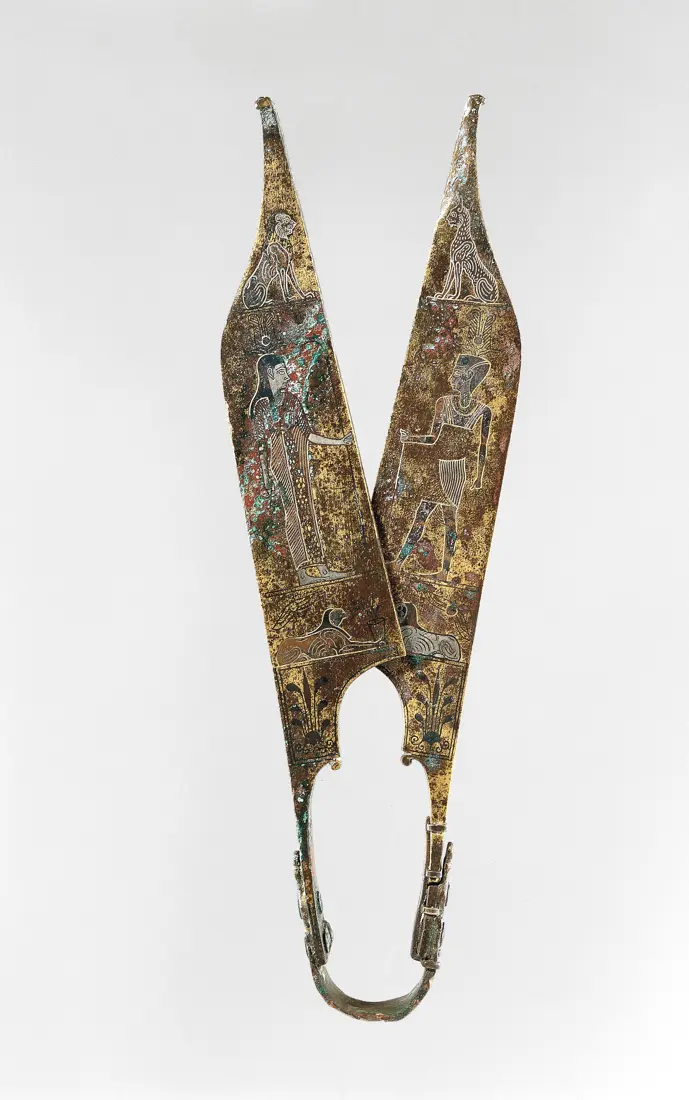
The oldest cutting tools of this kind were not hinged at all. Spring shears, also called bow shears, were made from a single strip of metal bent into a U shape, with a blade at each end. Squeezing the blades together made the cut, and the springy bend opened them again. They look like the pair at the top of this page.
The earliest known spring shears date back 3,000 to 4,000 years in Mesopotamia, and bronze examples from Egypt date to around 1500 BC. In Europe, archaeologists find bow shears from about 1000 BC. The design never disappeared: blade shears for sheep and the small thread snips in many sewing boxes still work on the same spring principle.
The Romans Add a Pivot
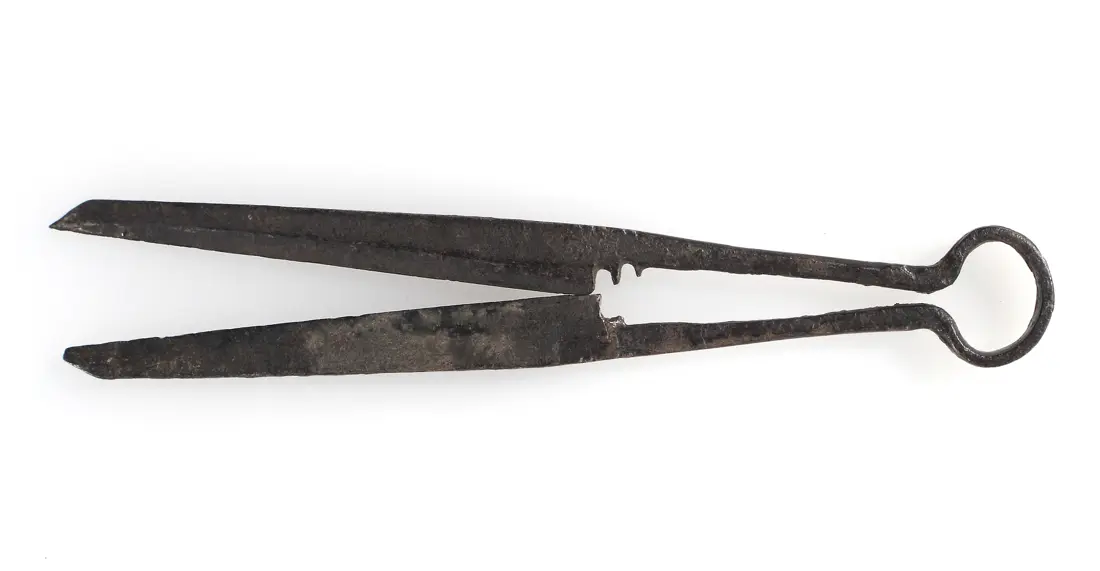
Pivoted scissors, with two separate blades crossing on a pin, appeared in the Roman world around AD 100. The pivot gave better leverage and more precise control than a spring, and it is the basis of almost every pair of scissors made today. Iron scissors also survive from Han dynasty China.
Iron and steel gradually replaced bronze over the following centuries. In north-west Europe, pivoted scissors became common around the thirteenth and fourteenth centuries.
Where the Word Comes From
The English word "scissors" came into use in the late fourteenth century, from the Old French cisoires, meaning shears. It is always plural because the tool has two blades, which is why we say "a pair of scissors" even though it is one object.
Sheffield and the Birth of Modern Scissors
For centuries, scissors were made by hand by specialist smiths. The German city of Solingen had an estimated 300-plus scissorsmiths by the end of the eighteenth century. In England, Sheffield became the great center of the trade.
The turning point came in 1761, when Robert Hinchliffe of Sheffield produced the first cast-steel scissors intended for the mass market. Cast steel held a sharper, longer-lasting edge, and Sheffield's makers built a worldwide reputation on it. By the nineteenth century the city had an estimated 60 steel scissor companies. Only two remain: William Whiteley, founded in 1760, and Ernest Wright, established in 1902.
Sheffield also shaped the dressmaking shears sewists use today. In 1875 Whiteley incorporated the firm of Thomas Wilkinson and Son, whose patented "sidebent" design, with the handle angled so the lower blade can rest flat on the table, is credited as the basis of modern dressmaking shears.
The Longest-Running Scissor Makers
| Maker | Founded | Notes |
|---|---|---|
| Fiskars (Finland) | 1649 | Began as an ironworks; its first plastic-handled scissors, with the famous orange handles, arrived in 1967 |
| Zhang Xiaoquan (Hangzhou, China) | 1663 | Has made scissors continuously since 1663 |
| William Whiteley (Sheffield, England) | 1760 | One of Sheffield's two remaining scissor makers |
| Ernest Wright (Sheffield, England) | 1902 | The other remaining Sheffield maker |
| Kai (Seki, Japan) | 1908 | From Seki, a historic Japanese blade-making city |
| Gingher (North Carolina, U.S.) | 1947 | Known for sewing shears; acquired by Fiskars in 2005 |
Pinking Shears: A Women's Invention
Pinking shears, with saw-toothed blades that cut a zigzag edge to slow fraying, have their own history. In 1874, Eliza P. Welch patented an improved pinking iron, a tool that punched decorative zigzag edges. On January 3, 1893, Louise Austin received a patent for pinking shears that cut the zigzag edge directly, the ancestor of the pinking shears in sewing boxes today.
Why Scissors Are Handed: Left-Handed Pairs
Pivoted scissors are not symmetrical. On a right-handed pair, the upper blade sits on the right, so a right-handed user sees the cutting line clearly and squeezes the blades together as they cut. In a left hand, the same pair pushes the blades apart and hides the line behind the top blade, which is why left-handed sewists often find ordinary scissors chew the fabric instead of cutting it.
Makers answer this in two ways. So-called "semi" left-handed scissors only reshape the handles for the left hand, while the blades stay in the right-handed position. "True" left-handed scissors reverse the blades as well, so the top blade sits on the left and the cutting line stays visible. For long cuts through fabric, true left-handed shears make the bigger difference.
The Parts of a Pair of Sewing Shears
| Part | What It Does |
|---|---|
| Blades | The two cutting edges; dressmaking shears often have one slightly serrated or micro-edged blade to grip slippery fabric |
| Pivot (screw or rivet) | The joint the Romans introduced; an adjustable screw lets the tension be tightened as the pair wears |
| Points | The tips; fine points are for detail work, blunt points for safety |
| Bows (handles) | The finger and thumb loops; a larger lower bow fits several fingers for control |
| Bent handle | On sidebent shears, the angle that lets the lower blade glide flat along the table |
Scissors in Folklore
A tool this sharp gathered superstitions. One of the most widespread holds that giving scissors or knives as a gift can "cut" a friendship, so the person receiving them hands over a small coin, turning the gift into a purchase. It is folklore rather than history, but many people still follow the custom when giving a fine pair of sewing shears.
Scissors for Sewing Today
Most sewists keep a few kinds of scissors, each descended from this long history:
- Dressmaking shears with long blades and a bent handle for cutting fabric flat on the table.
- Embroidery scissors with short, fine points for snipping threads.
- Pinking shears for zigzag edges that reduce fraying.
- Thread snips, small spring-loaded clippers that work on the same principle as ancient bow shears.
The oldest rule in the sewing room still applies: keep your fabric shears for fabric only. Cutting paper dulls the edge that Sheffield's makers spent centuries perfecting. For the tool that follows the cut, see our history of the sewing needle.
For the scissors and shears sewists use today, see our guide to types of sewing scissors.
Sources
- Scissors, Wikipedia
- Shears, perhaps 2nd century CE, The Metropolitan Museum of Art
- Scissors, 15th or 16th century, The Metropolitan Museum of Art
Frequently Asked Questions
Who invented scissors?
No single inventor is known. Spring shears, two blades joined by a bent metal band, date back more than 3,000 years, and pivoted scissors with two blades crossing on a pin appeared in the Roman world around AD 100.
What is the difference between scissors and shears?
Shears usually means a larger, heavier cutting tool. In sewing, dressmaking shears typically have longer blades and a bent handle so the lower blade can rest flat on the table while cutting.
Who invented pinking shears?
Louise Austin received a U.S. patent for pinking shears on January 3, 1893. Earlier, Eliza P. Welch had patented an improved pinking iron in 1874, a tool that punched a zigzag edge rather than cutting it.
Why do people say not to give scissors as a gift?
An old superstition holds that giving a sharp object as a gift can cut a friendship, so the receiver pays a small coin to turn the gift into a purchase. It is folklore, not history, but the custom is still followed in many places.
Keep Reading
History of the Sewing Needle
From Denisovan bird bone to Redditch steel, the tool behind every stitch.
History of the Thimble
Melted for WWI hospitals, used to measure gunpowder, sold for $18,000.
History of Sewing
How a bone splinter became a global industry, from the Ice Age to PDF patterns.
Sewing Glossary A–Z
450+ sewing terms explained in plain English, from appliqué to zipper foot.