Bustles: How Victorian Skirts Moved to the Back (2026)
A bustle is a pad or frame worn under the back of a skirt to hold out its fullness and drapery. It defined the silhouette of the 1870s and 1880s, reaching extreme proportions by 1885.
In This Article
Bustles in Brief
- What: a pad or frame behind the waist
- Ancestors: bum rolls and cork rumps
- Height of fashion: 1870s and 1880s
- Most extreme: about 1885
- Gone: by 1905
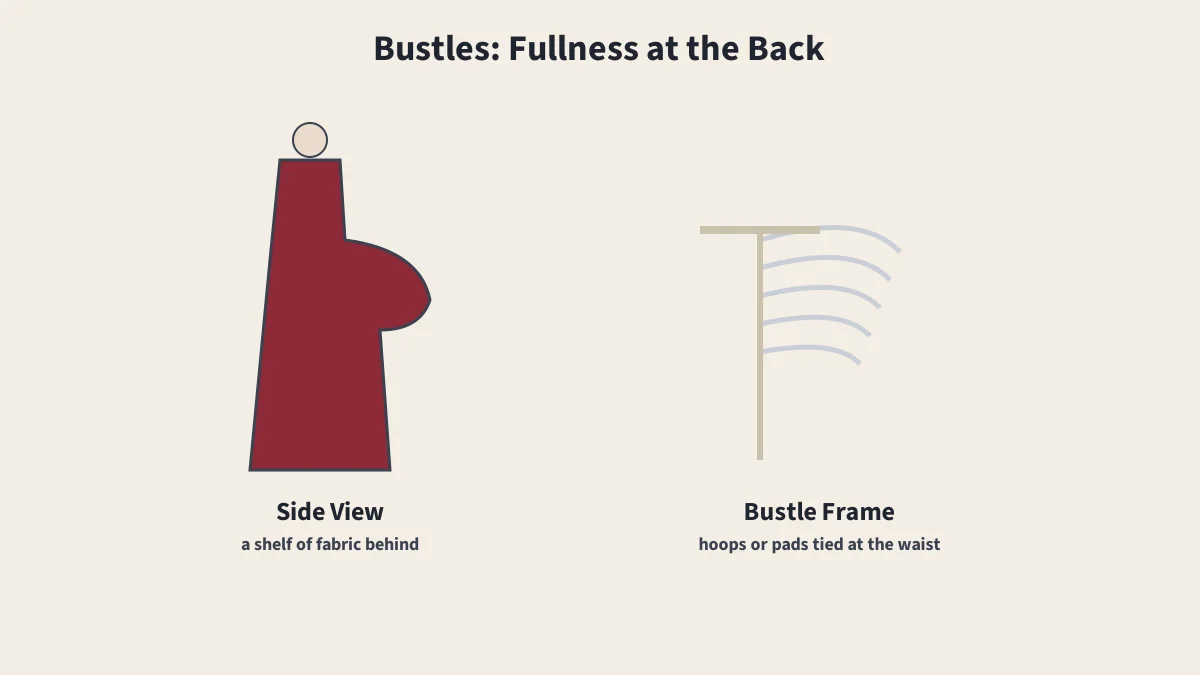
A bustle is a padded undergarment or wire frame worn under the back of a skirt, just below the waist, to add fullness and support drapery so the skirt does not drag or flatten. It was the defining support of the late Victorian silhouette; see Victorian dress.
Before the Bustle
Padded cushions worn at the back of the hips, called bum rolls, bearers or cork rumps, were popular in Europe from the 16th century, with a particular peak in France in the late 18th century.
From Crinoline to Bustle
In the 1860s, the fullness of the crinoline moved toward the back, forming flattened trains, and the crinolette, a half-hoop, created a bustle-like shape; see crinolines and hoop skirts. The bustle developed as an independent fashion in the late 1860s, as overskirts were draped up toward the back.
Bustle Fashions
| Date | Development |
|---|---|
| Late 1860s | Overskirts are draped up behind; the bustle emerges |
| 1870s–1880s | Bustles worn in varying shapes |
| Late 1881 | A new bustle appears |
| 1883 | A horizontal, shelf-like bustle returns |
| By 1885 | Bustles reach extreme proportions |
| 1889 | The fashion for large bustles ends |
| 1890s–1900s | Small pads still support skirts and emphasize the hips |
| By 1905 | The bustle has disappeared |
Construction
Bustles were made either as padded cushions or as wire frames worn beneath the skirt, just below the waist. The skirt and overskirt were then draped over the support.
Sources
- Bustle, Wikipedia
- Victorian fashion, Wikipedia
Frequently Asked Questions
What is a bustle?
A padded undergarment or wire frame worn just below the waist at the back, to add fullness and support the drapery of a skirt.
When were bustles fashionable?
Through most of the 1870s and 1880s, in varying shapes. A new bustle appeared in late 1881, reached extreme proportions by 1885, and the fashion for large bustles ended in 1889.
Were there bustles before the Victorian era?
Yes. Padded cushions called bum rolls, bearers or cork rumps were worn in Europe from the 16th century, especially in late 18th-century France.
Why did bustles disappear?
By 1905 they had gone completely: the long corsets of the early 20th century shaped the body itself to project behind, and more practical dress suited new activities such as cycling.
Keep Reading
Crinolines and Hoop Skirts
Horsehair petticoats and steel cage crinolines.
Victorian Dress
Silhouettes, technology and mourning dress.
Historical Undergarments
Chemises, shifts, stays and petticoats.
Corsets and Stays
Bodies, stays and corsets through the centuries.