Edwardian Dress: The S-Curve, Shirtwaists and Tailor-Mades (2026)
The early 1900s brought a distinctive S-shaped silhouette, with a full, low bosom and the hips pushed back. At the same time, working women and the New Woman adopted practical shirtwaists and tailored suits.
In This Article
Edwardian Dress in Brief
- Dates: about 1900–1910
- Silhouette: the S-curve
- Corset: straight-front "health corset"
- Working dress: shirtwaists and tailor-mades
- 1908: a new, narrow high-waisted line
Edwardian fashion, roughly 1900 to 1910, is named after King Edward VII. Its look was set by a new corset and by changing lives: women were entering higher education, offices and outdoor sports, and favored simpler, less constricting clothes, a trend encouraged by the campaign for women's suffrage.
The S-Curve
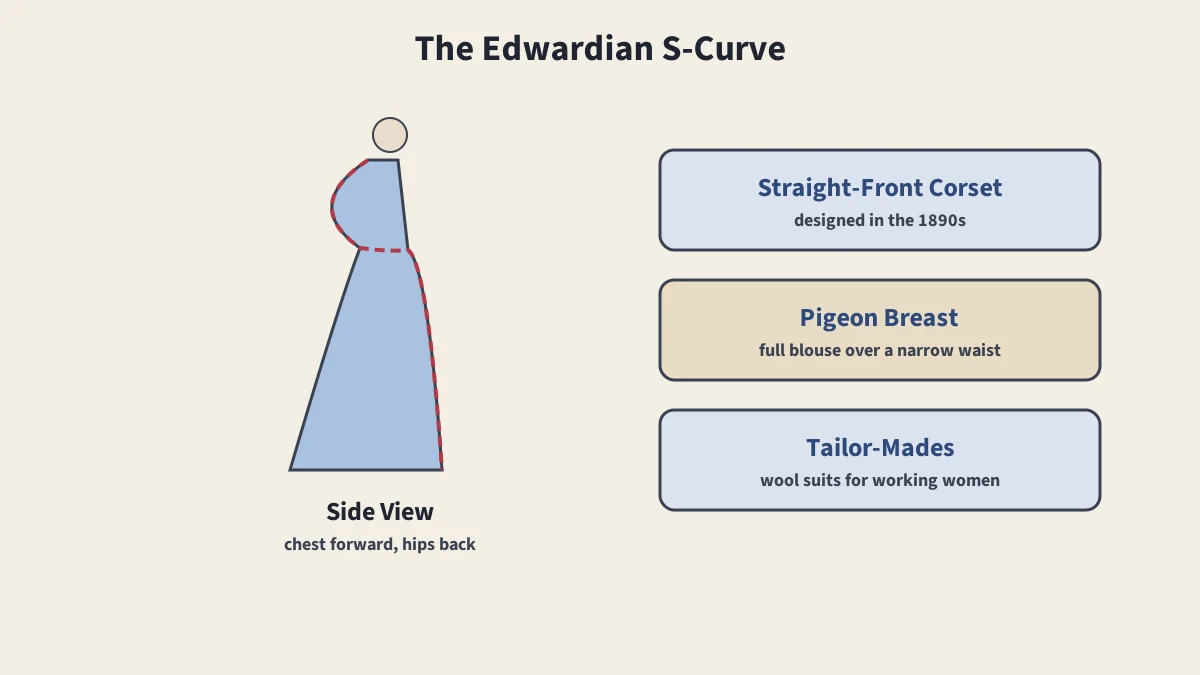
The straight-front "health corset," designed in the 1890s by Inès Gaches-Sarraute, was meant to remove pressure from the abdomen. Instead, it pushed the bust forward and the hips back, creating the S-curve silhouette; see corsets and stays. Blouses and bodices were full in front and puffed out over a narrow waist sloping from back to front, a look called the "pigeon breast."
What Women Wore
| Garment | Description |
|---|---|
| Shirtwaist | A blouse tailored like a man's shirt, with a high collar; the uniform of working women and college girls; see shirt and blouse styles |
| Tailor-made (tailleur) | A wool or tweed suit with an ankle-length skirt and matching jacket |
| Skirts | Brushing the floor, often with a train, mid-decade; near the ankle by its end |
| Hats | Broad-brimmed and trimmed with feathers, ribbons or flowers mid-decade; smaller, drooping brims by 1909 |
| Lingerie-style trims | Lace and embroidery, also seen on girls' dresses |
The Gibson Girl, with her full hair and broad hats, defined the early-1900s ideal; see the Gibson Girl blouse.
A New Line From 1908
In 1908, Paris couturiers Callot Soeurs, Madeleine Vionnet at the house of Doucet, and Paul Poiret introduced high-waisted, narrow, ankle-length styles. They required a "straight line" corset and signaled the approaching end of the corset as an essential garment, leading toward 1920s dress.
Sources
- 1900s in Western fashion, Wikipedia
- Corset, Wikipedia
Frequently Asked Questions
What is the Edwardian S-curve?
A silhouette of the early 1900s in which the bust was pushed forward and the hips back, created by the straight-front 'health corset'.
What was a pigeon breast?
The early-1900s fashion for blouses and bodices full in front, puffing out over a narrow waist that sloped from back to front.
What were tailor-mades?
Women's suits of wool or tweed with an ankle-length skirt and matching jacket, popular with working women.
When did the Edwardian silhouette change?
From about 1908, Paris couturiers including Callot Soeurs, Madeleine Vionnet at Doucet and Paul Poiret introduced high-waisted, narrow, ankle-length styles that needed a straight-line corset.
Keep Reading
Victorian Dress
Silhouettes, technology and mourning dress.
Corsets and Stays
Bodies, stays and corsets through the centuries.
Shirt and Blouse Styles
Dress shirts, polos, shirtwaists and blouse styles.
1920s Dress Construction
Dropped waists, hemlines, rayon and beading.