Types of Quilts: An Illustrated Guide to Quilting Traditions (2026)
Quilts vary as much as the people who make them. Some are defined by technique, some by community, and some by a single region or decade. Here are the main types and how to recognize them.
In This Article
Quilt Types in Brief
- Technique: whole cloth, pieced, appliqué, crazy
- American traditions: Amish, Baltimore Album, Hawaiian
- Worldwide: kantha, ralli, boutis, sashiko
- Display: art quilts
- Today: modern quilts
Quilts can be grouped by how the top is made, by the community or region they come from, or by their purpose. Many belong to more than one group. For the history behind them, see the history of quilting.
By Technique
| Type | Description |
|---|---|
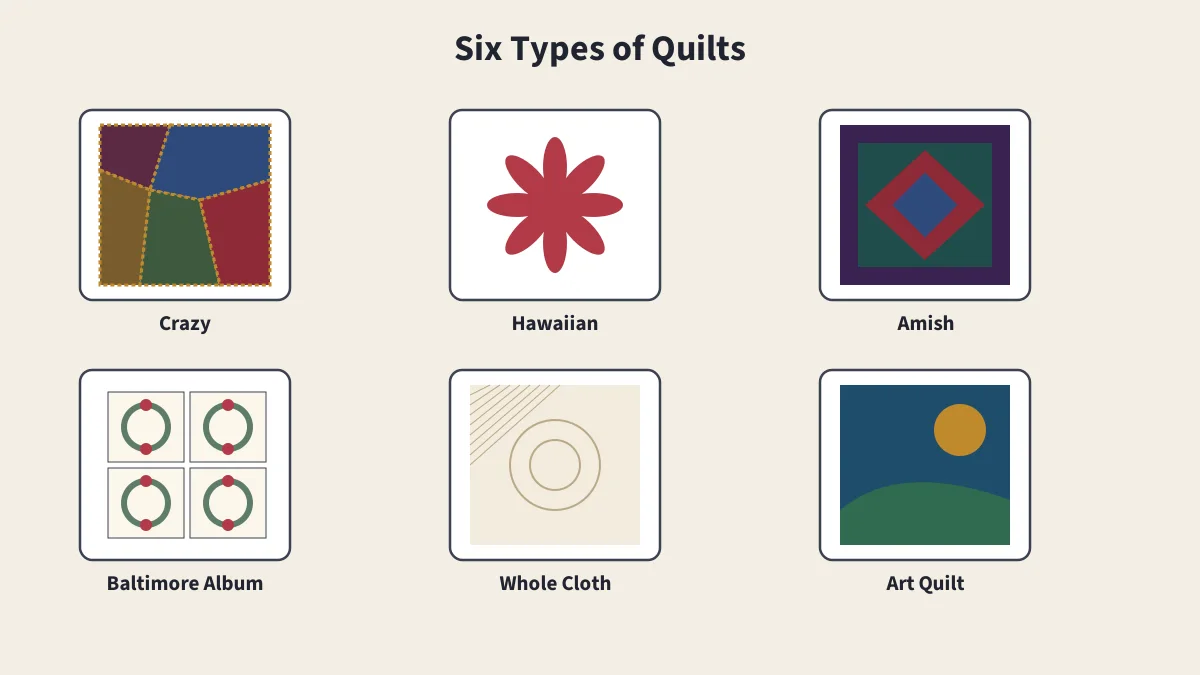
| Whole cloth | A single piece of fabric as the top, decorated only by the quilting stitches |
| Medallion | A central panel surrounded by a series of borders |
| Pieced (patchwork) | Small pieces of fabric joined into a top, usually in blocks; see quilt block names |
| Appliqué | Fabric shapes stitched onto a background |
| Foundation-pieced | Fabric sewn onto paper or fabric foundations for precise points |
| Crazy quilt | Irregular patches with embroidered seams, usually without batting |
| Summer quilt | No batting, for cool evenings rather than warmth |
American Traditions
Crazy Quilts
Crazy quilts became popular in the late 1800s, spreading quickly among urban, upper-class women. They were luxury show pieces rather than bedding, made from small irregular pieces of velvet, satin, tulle and silk, embellished with embroidery, buttons, lace, ribbons and beads. Japanese art shown at the Philadelphia Centennial Exposition inspired some of their web-like and fan-like stitching.
Amish Quilts
Amish quilts use solid colors and geometric designs in community-approved styles, traditionally hand-sewn and without appliqué. Early quilts from Lancaster, Pennsylvania were lightweight wool, while Midwestern Amish quilts were mostly cotton.
Baltimore Album Quilts
Baltimore Album quilts originated around Baltimore, Maryland, in the 1840s. Each square block carries a different appliquéd design, often floral, with wreaths, baskets, birds, eagles or landmarks, usually in reds, greens and blues on white. Most were signed, with indelible ink allowing makers to add poetry or sayings to their blocks.
Hawaiian Quilts
Quilting may have reached Hawaii with missionaries and Western fabrics in the 1820s, building on the kapa moe, a bed cover made from tree bark. Hawaiian quilts feature a large, radially symmetric appliqué, cut from a single folded piece of fabric, often a stylized plant in a bold color on white, with quilting that follows the design's contours. Many flag quilts made after the overthrow of the monarchy were a form of silent resistance.
Other American Traditions
- Star quilts: a Native American form from the late 19th century, especially associated with Plains tribes, including the Lakota.
- Seminole piecing: strip-based patterns from the Florida Everglades.
- Story quilts: narrative quilts such as those of Harriet Powers and Faith Ringgold.
Traditions From Around the World
| Tradition | Where | Description |
|---|---|---|
| Kantha | Bangladesh and India | Two or three layers of cloth, often worn saris, sewn with decorative running stitch |
| Ralli | Pakistan and India | Scrap cotton in patchwork, appliqué or embroidery |
| Boutis | Provence, France | Raised, stuffed designs, made since the 17th century |
| Sashiko | Japan | White running stitches on indigo fabric; see visible mending |
| North Country (Durham) | Northeast England | A regional quilting tradition, also called Durham quilts |
Art and Modern Quilts
Art quilts are made for display rather than use. The Whitney Museum's 1971 exhibition Abstract Design in American Quilts helped shift quilts from domestic craft toward art. Modern quilts are made for use but draw on modern design: bold colors, minimalism, asymmetry and negative space.
For appliqué techniques used in many of these quilts, see types of appliqué.
Sources
- Quilt, Wikipedia
- Crazy quilting, Wikipedia
- Hawaiian quilt, Wikipedia
- Baltimore album quilt, Wikipedia
Frequently Asked Questions
What are the main types of quilts?
By technique: whole-cloth, pieced (patchwork), appliqué, foundation-pieced and crazy quilts. By tradition: Amish, Hawaiian, Baltimore Album, Seminole, star quilts, kantha, ralli and boutis. And by purpose: art quilts and modern quilts.
What is a crazy quilt?
A type of patchwork with irregular pieces, no repeating motif, heavily embellished seams, and usually no batting. Crazy quilts became popular in the late 1800s and used rich fabrics such as velvet, satin and silk.
What makes a quilt Amish?
Solid colors, geometric shapes and community-approved styles, traditionally hand-sewn without appliqué. Early Lancaster, Pennsylvania quilts were made of lightweight wool.
What is a Hawaiian quilt?
A quilt with a large, radially symmetric appliqué design cut from a single folded piece of fabric, often a stylized plant in a bold color on white, quilted along the contours of the design.
Keep Reading
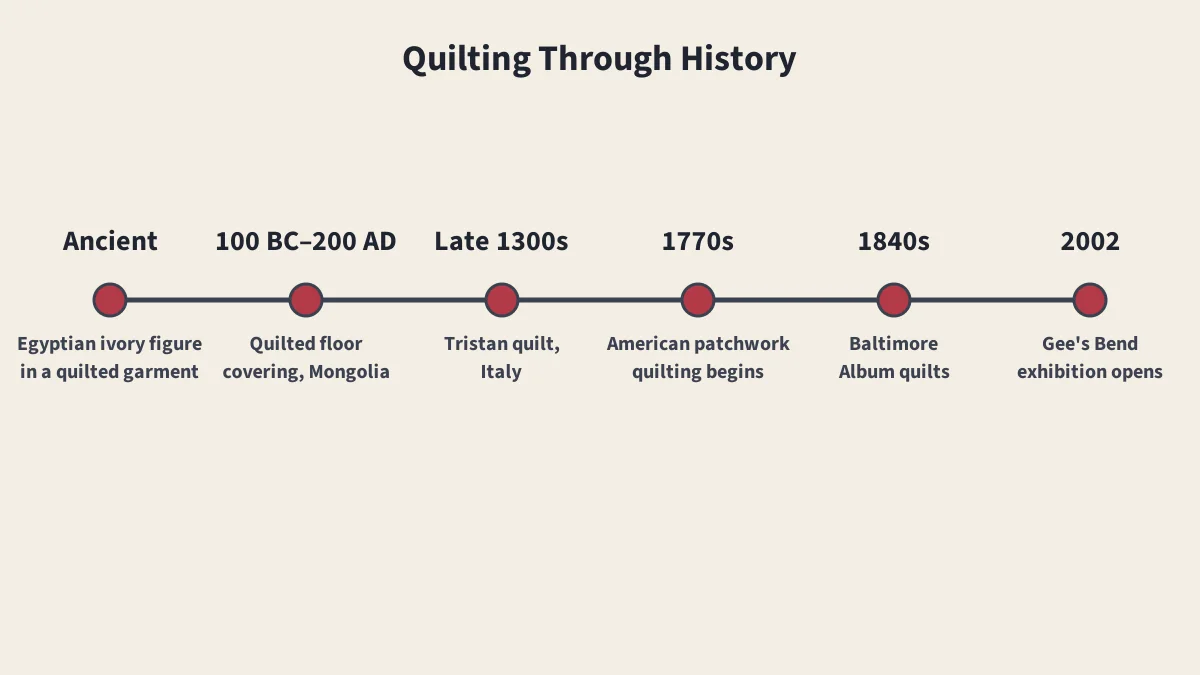
History of Quilting
From ancient quilted clothing to modern quilts.
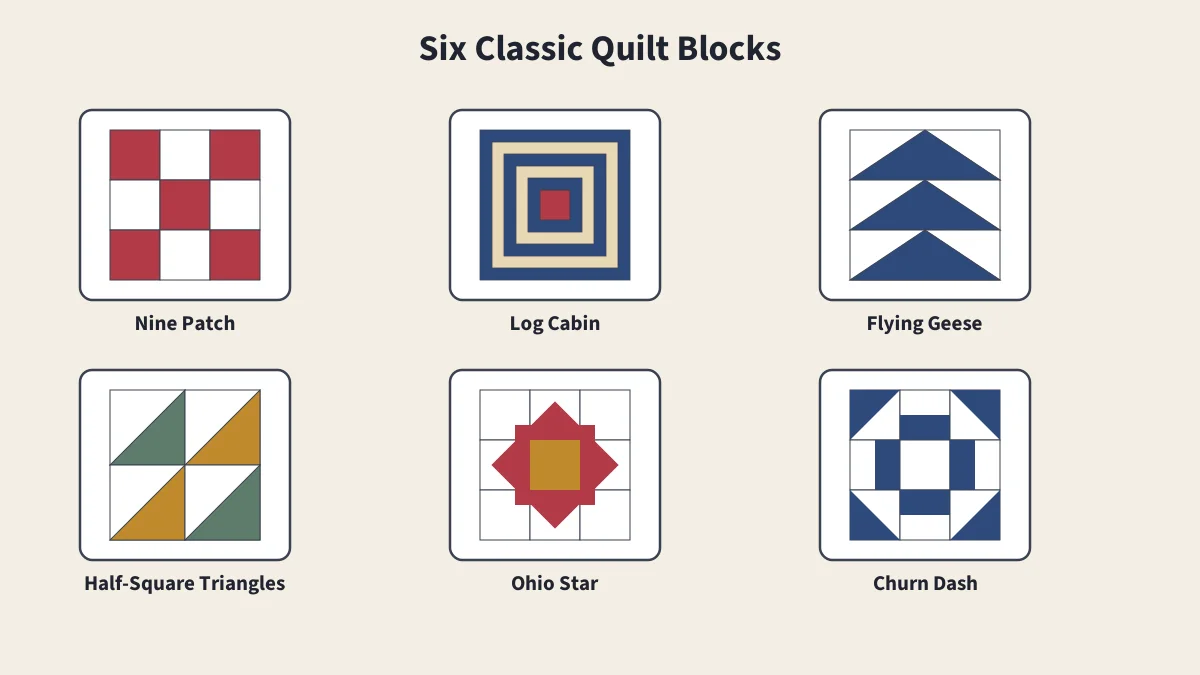
Quilt Block Names
Log cabin, nine patch, flying geese and more.
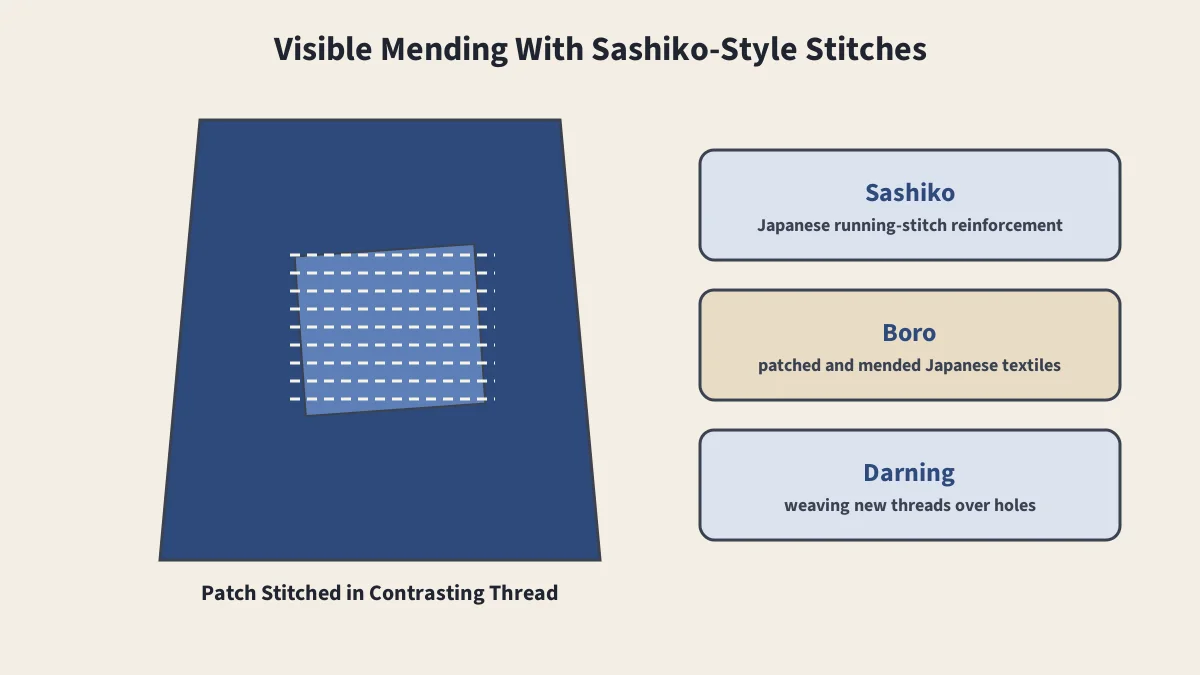
Patching and Visible Mending
Patching methods, sashiko, boro and visible mending.
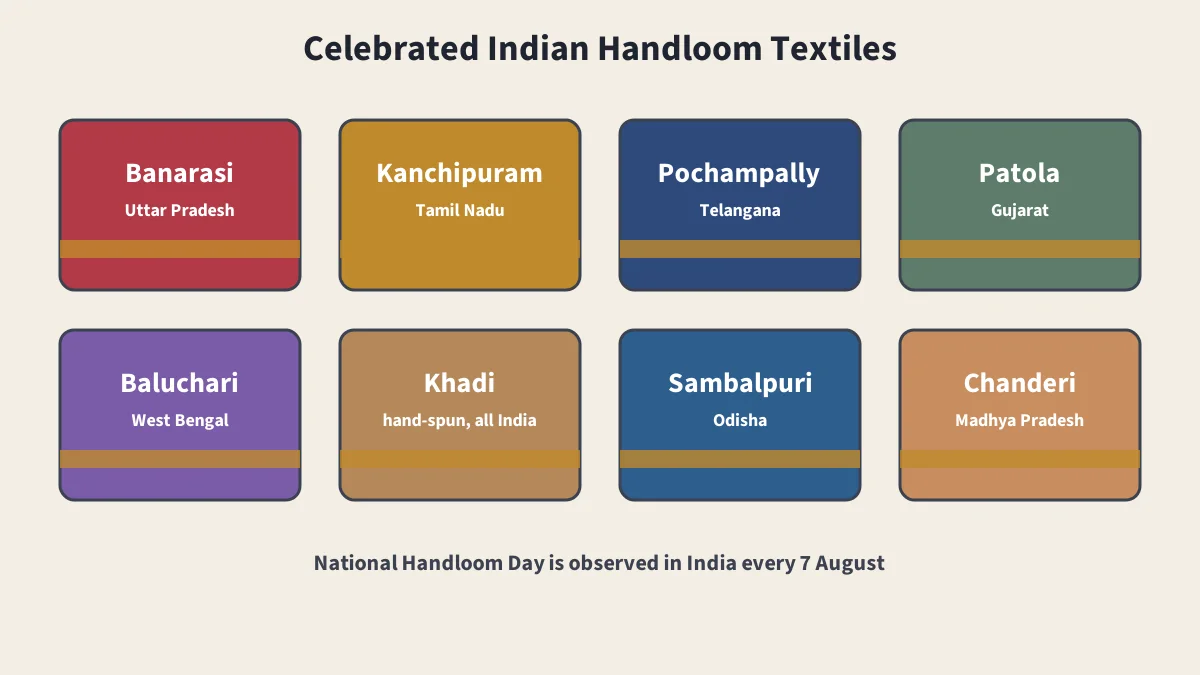
Indian Handloom Textiles
Banarasi, Kanchipuram, Pochampally, Patola, Jamdani and khadi.