Patching and Visible Mending: From Hidden Repairs to Sashiko (2026)
A patch can be invisible or the most striking part of a garment. Visible mending turns repairs into decoration, drawing on traditions such as Japanese sashiko and boro and Bengali kantha.
In This Article
Patching in Brief
- Inside patches: subtle, stitched through the hole
- Outside patches: quick and decorative
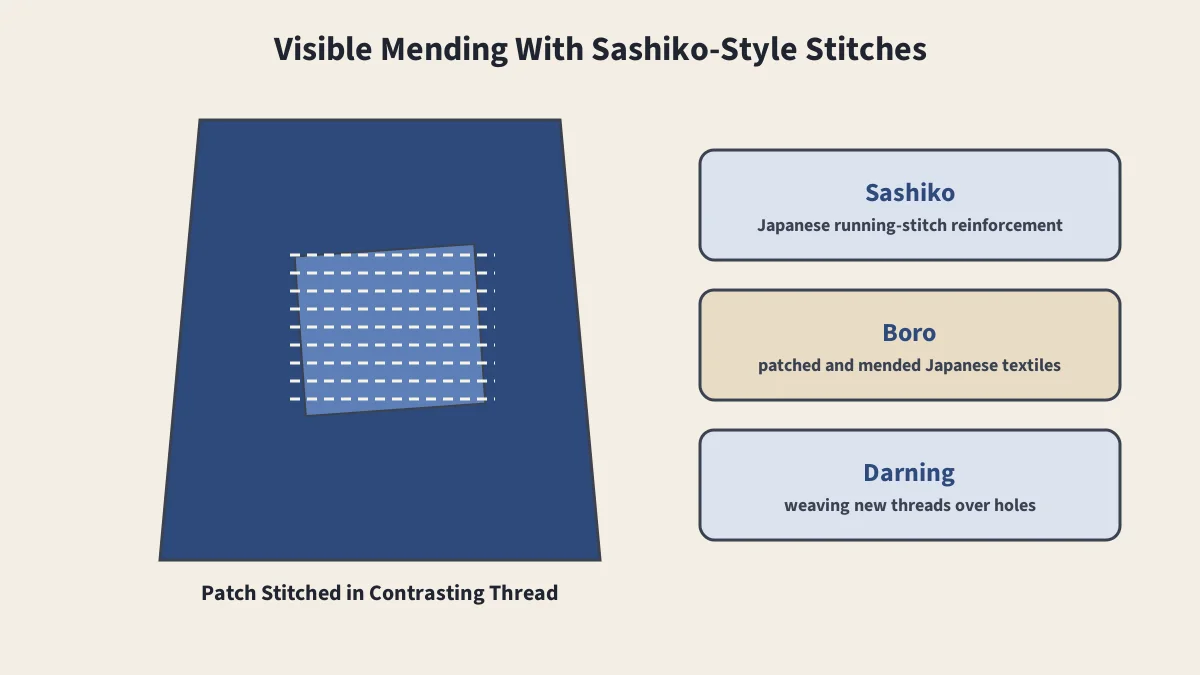
- Sashiko: Japanese running-stitch reinforcement
- Boro: patched and mended Japanese textiles
- Kantha: Bengali layered running stitch
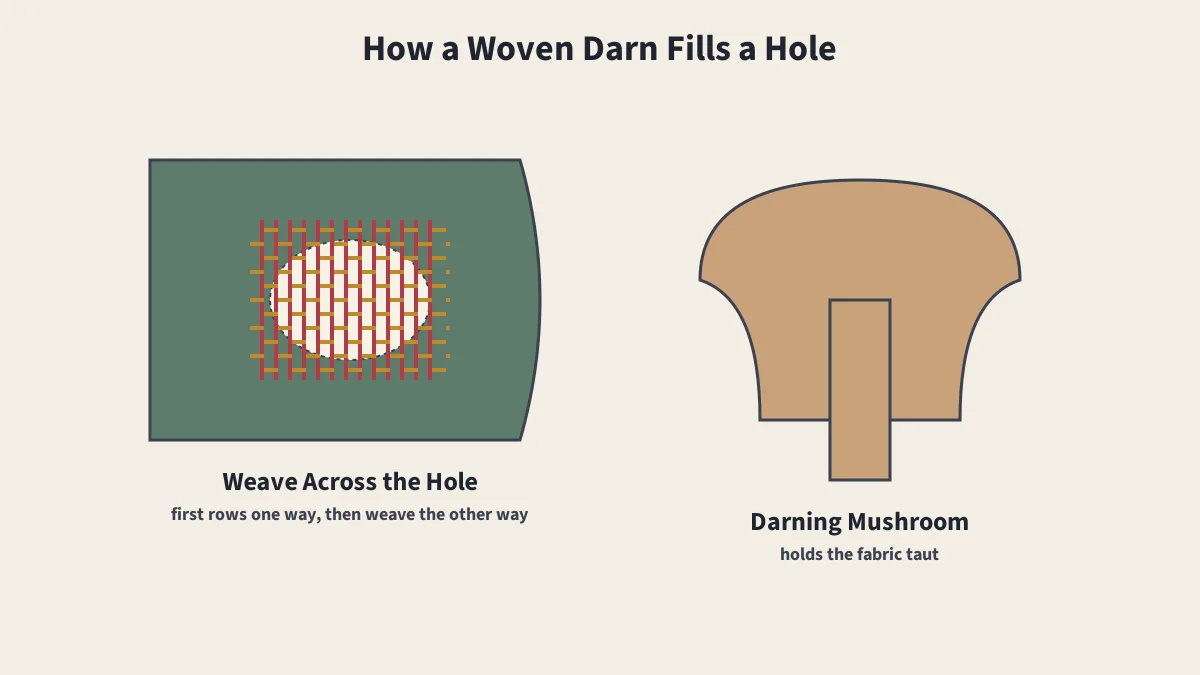
Patching covers a hole or worn area with a new piece of fabric. Visible mending is repair work left deliberately on show, often to decorate the item and to make a point about repairing rather than replacing. For filling holes with woven thread instead of fabric, see darning.
Choosing a Patch
- Use a fabric of similar weight and stretch; for jeans, use denim or another sturdy twill.
- Pre-wash the patch so it doesn't shrink later; see fabric shrinkage.
- Cut the patch at least 1–2 cm larger than the worn area on every side, reaching sound fabric.
- Round the corners of outside patches so they don't lift.
Inside Patch (Subtle)
- Trim loose threads around the hole without enlarging it.
- Place the patch on the wrong side and pin or baste it, or hold it with a light fusible web; see fusible web.
- From the right side, stitch back and forth over the hole and the worn area with a short straight stitch or narrow zigzag, or with rows of hand running stitch.
- Trim the patch edges on the inside.
Outside Patch (Visible)
- Turn under the patch edges and press, or leave them raw to fray deliberately.
- Pin it over the hole on the right side.
- Stitch around the edge by hand or machine, then add rows of running stitch across it for strength and decoration.
Visible Mending Traditions
| Tradition | Where | What It Is |
|---|---|---|
| Sashiko | Japan | Running-stitch reinforcement, often white thread on indigo, with geometric patterns |
| Boro | Japan | Layered, patched and mended cotton, linen and hemp cloth, typically indigo-dyed |
| Kantha | Bengal | Worn garments layered and stitched together with running stitch |
| Kheta | Bihar | Geometric repair-quilting |
| Darning samplers | Western Europe | Decorative darns in contrasting stitches, from the early 18th century |
Sashiko
Sashiko is often translated as "little stabs", after its running stitch. It emerged in the Edo period (1603–1867) as a practical way to strengthen worn cloth, attach patches and layer thin fabric for warmth; it was also used for absorbent firefighters' coats. Kogin-zashi, a style with rows of diamond patterns, developed in Aomori Prefecture.
Boro
Boro, from "boroboro" (tattered or repaired), were made largely by peasant farmers and working-class families who reused worn cloth. Indigo was the usual dye: cheap, easy to grow and said to repel moths. The folklorist Chuzaburo Tanaka collected over 20,000 pieces. Cheap ready-to-wear clothing made boro largely unnecessary by the early 20th century; see resist dyeing for indigo traditions.
The Modern Revival
Vivienne Westwood's 1970s punk designs used patches and safety pins, and punk and grunge made ripped and repaired clothing a form of protest. Interest grew again during COVID-19 lockdowns. Some see visible mending as anti-consumerist or craftivist; critics note that it has been commercialized and that it can romanticize repairs long made out of necessity.
For sashiko patterns and the history of boro in more depth, see sashiko and boro.
Sources
- Visible mending, Wikipedia
- Sashiko, Wikipedia
- Boro (textile), Wikipedia
Frequently Asked Questions
What is visible mending?
Repair work, usually on textiles, that is deliberately left visible rather than hidden, so the repair becomes decoration. Techniques include embroidery, darning, patching with contrasting fabric and sashiko-style stitching.
What is sashiko?
A Japanese running-stitch technique, often translated as "little stabs", that emerged in the Edo period (1603–1867) to reinforce clothing. The classic look is white cotton thread on indigo-dyed cloth.
What is boro?
Japanese textiles that have been mended or patched together, from "boroboro", meaning tattered or repaired. Most were made by working-class people, and surviving pieces are often dated between about 1850 and 1950.
Should a patch go on the inside or outside?
Either. An inside patch with stitching through the hole gives a subtler repair; an outside patch is quicker and can be decorative. For jeans, an inside patch stitched over densely is common.
Keep Reading
Darning
The woven darn, darning tools, machine darning and history.
Make Do and Mend
Coupons, blackout-curtain dresses and Mrs Sew and Sew in wartime Britain.
Resist Dyeing
How batik, ikat, shibori and tie-dye block the dye.
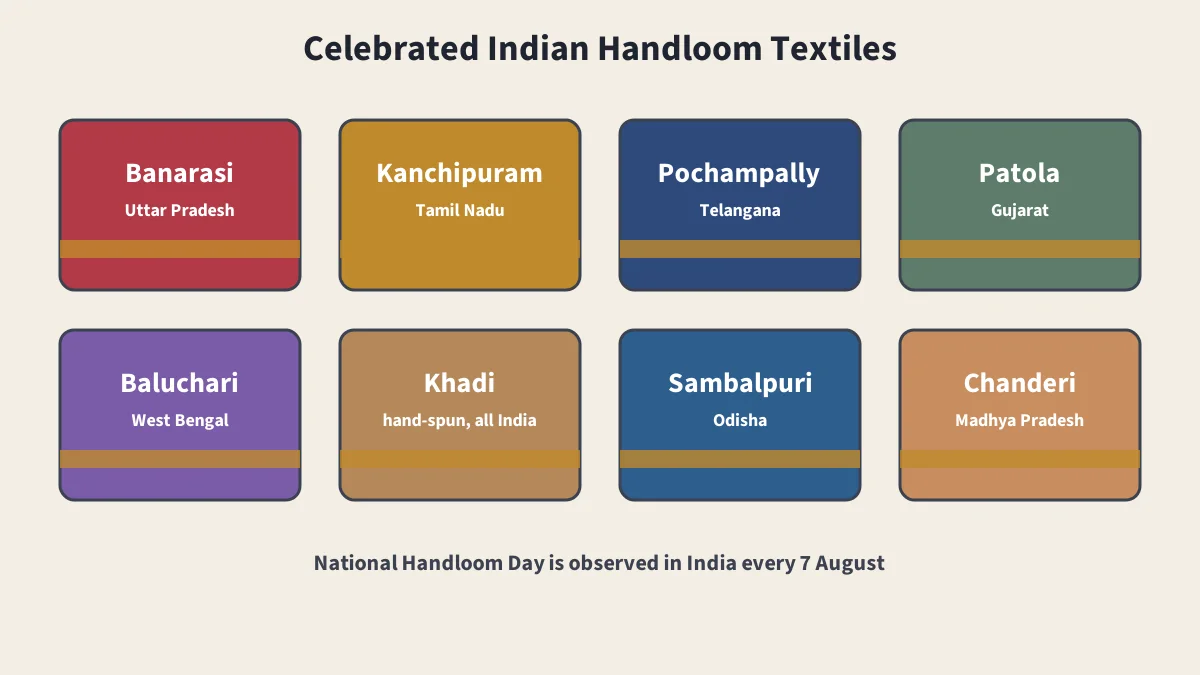
Indian Handloom Textiles
Banarasi, Kanchipuram, Pochampally, Patola, Jamdani and khadi.