Indian Handloom Textiles: A Living Weaving Tradition (2026)
India's handlooms produce some of the world's most celebrated textiles, from gold-brocaded Banarasi silks to double-ikat Patola and Gandhi's khadi. Here is a guide to the best-known traditions and where they come from.
In This Article
Indian Handlooms in Brief
- Scale: about 22% of the country's cloth
- Livelihood: described as the second-largest economic activity after agriculture
- Protected names: many hold Geographical Indication status
- National Handloom Day: 7 August
- Symbol: khadi, promoted by Mahatma Gandhi
Handloom weaving has deep roots in India, and it remains a major part of the country's textile economy. According to Wikipedia, the handloom sector produces about 22% of the country's cloth and is described as the second-largest economic activity after agriculture; the 2009 to 2010 handloom census counted 4.33 million people in the sector. Many regions have their own famous weaves, several of them protected by Geographical Indication (GI) status.
Famous Handloom Traditions
| Textile | Region | Known For |
|---|---|---|
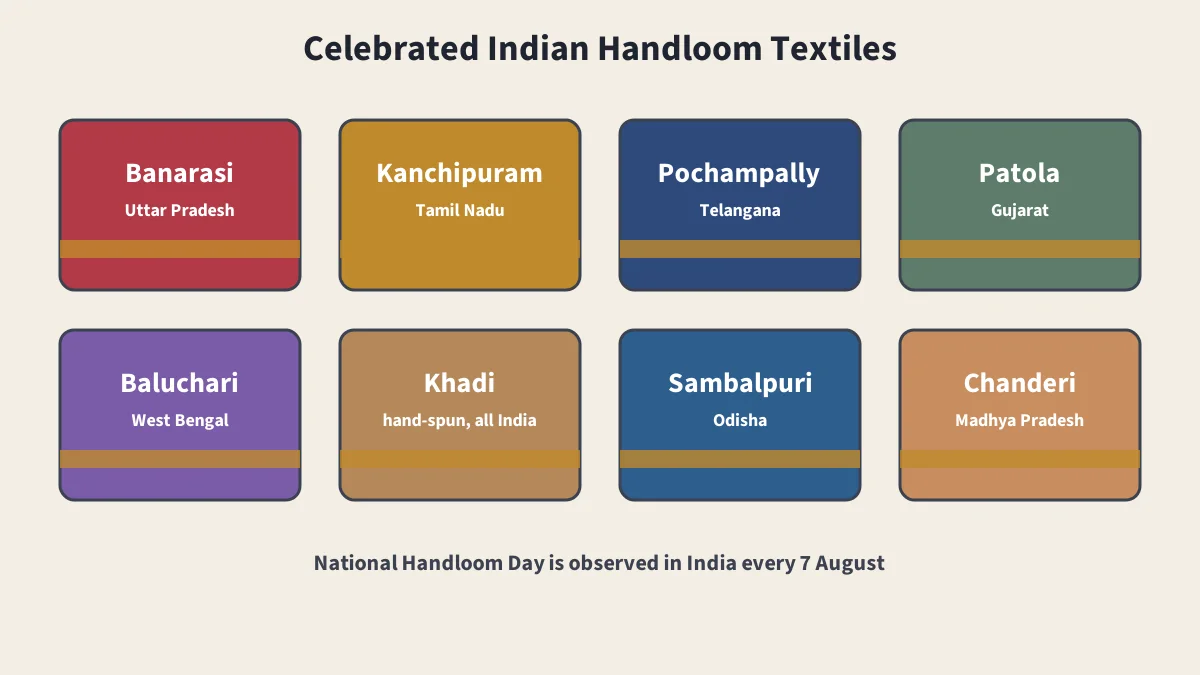
| Banarasi | Varanasi, Uttar Pradesh | Silk with gold and silver brocade or zari; GI in 2009 |
| Kanchipuram | Tamil Nadu | Mulberry silk with zari; body and border interlocked; GI in 2005–06 |
| Pochampally | Telangana | Double ikat; GI in 2005 |
| Patola | Gujarat | Double ikat silk |
| Baluchari | West Bengal | Scenes from the Ramayana and Mahabharata |
| Jamdani | Bengal (around Dhaka) | Fine muslin with hand-inserted supplementary weft motifs |
| Narayanpet | Telangana | Checked bodies and temple borders; GI in 2015 |
| Chanderi, Maheshwari, Sambalpuri | Madhya Pradesh, Odisha | Further regional sari traditions |
Banarasi and Kanchipuram
Banarasi saris, woven in Varanasi, are known for gold and silver brocade or zari and fine silk, and they are usually heavy and worn at festivals and weddings. Depending on the design, one can take from 15 days to a month to weave, and sometimes up to six months. Kanchipuram saris from Tamil Nadu are made from pure mulberry silk with zari. Their body and border are woven separately and interlocked, so the border will not come away even if the sari tears; two people work each sari, one at each side of the loom.
Ikat: Pochampally and Patola
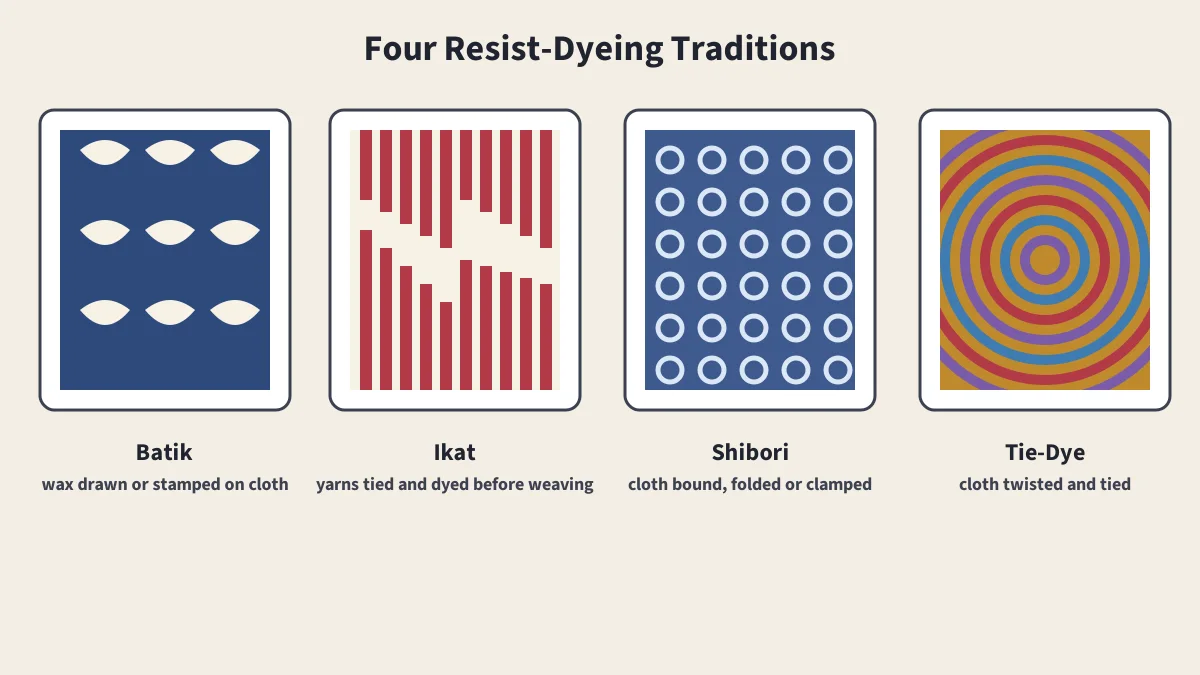
Pochampally saris, from the village of Bhoodan Pochampally in Telangana, use double ikat, with designs dyed into both warp and weft threads before weaving. Patola, double ikat silks associated with Gujarat, are among the most prized. Double ikat is made in only three countries; see resist dyeing.
Jamdani
Jamdani is a fine muslin, traditionally woven around Dhaka in Bengal, with ornamental motifs added by hand using a supplementary weft technique. It is considered one of the finest varieties of muslin, and in 2013 UNESCO recognized the Jamdani weaving tradition as Intangible Cultural Heritage of Humanity. Today it is recognized as a product of Bangladesh.
Khadi
Khadi is hand-spun and hand-woven natural fiber cloth. During the independence struggle, Mahatma Gandhi promoted it as swadeshi, "of the homeland," and it is spun on the charkha, or spinning wheel. Khadi became closely tied to the Swadeshi movement's boycott of foreign cloth.
Caring for Handloom Textiles
- Follow the maker's advice; many fine silks need dry cleaning.
- Store zari pieces wrapped in soft cotton, refolding them occasionally to avoid permanent creases.
- Expect small irregularities: they are a sign of handwork, not a flaw.
For India's embroidery traditions, see Indian embroidery styles.
Sources
- Handloom saree, Wikipedia
- Banarasi sari, Wikipedia
- Kanchipuram silk sari, Wikipedia
- Pochampally Saree, Wikipedia
- Jamdani, Wikipedia
- Khadi, Wikipedia
- National Handloom Day, Wikipedia
Frequently Asked Questions
What is a handloom textile?
Cloth woven on a loom operated by hand rather than by power. In India, handloom weaving remains an important source of livelihood, with distinctive regional traditions.
When is National Handloom Day?
India observes National Handloom Day every year on 7 August. It commemorates the launch of the Swadeshi movement on 7 August 1905 and was first celebrated in 2015.
What is khadi?
Khadi is hand-spun and hand-woven natural fiber cloth. Mahatma Gandhi promoted it as swadeshi, 'of the homeland,' during India's independence struggle, spun on the charkha, or spinning wheel.
What makes Pochampally saris special?
They use double ikat, in which both warp and weft threads are resist-dyed before weaving. Pochampally saris received Geographical Indication protection in 2005.
Keep Reading
Resist Dyeing
How batik, ikat, shibori and tie-dye block the dye.
Types of Silk Fabric
Charmeuse, crêpe de chine, organza, dupioni, taffeta and more.
Brocade vs. Damask vs. Jacquard
How the three woven-pattern terms differ, and how to spot each.
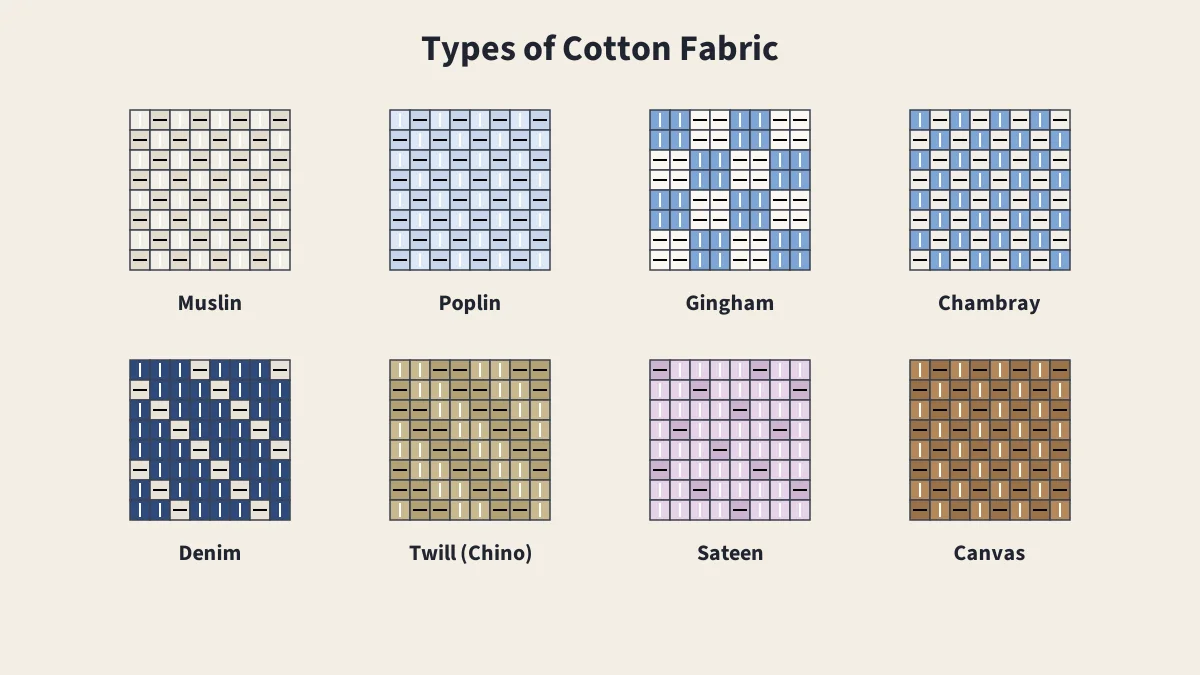
Types of Cotton Fabric
Muslin, poplin, gingham, chambray, denim, corduroy and more.