Sewing Machine Stitches Explained: Which One to Use When (2026)
Even a basic machine offers a dozen stitches, and computerized models offer hundreds. In practice, a handful do almost all the work. Here is what each utility stitch is for and how to set it.
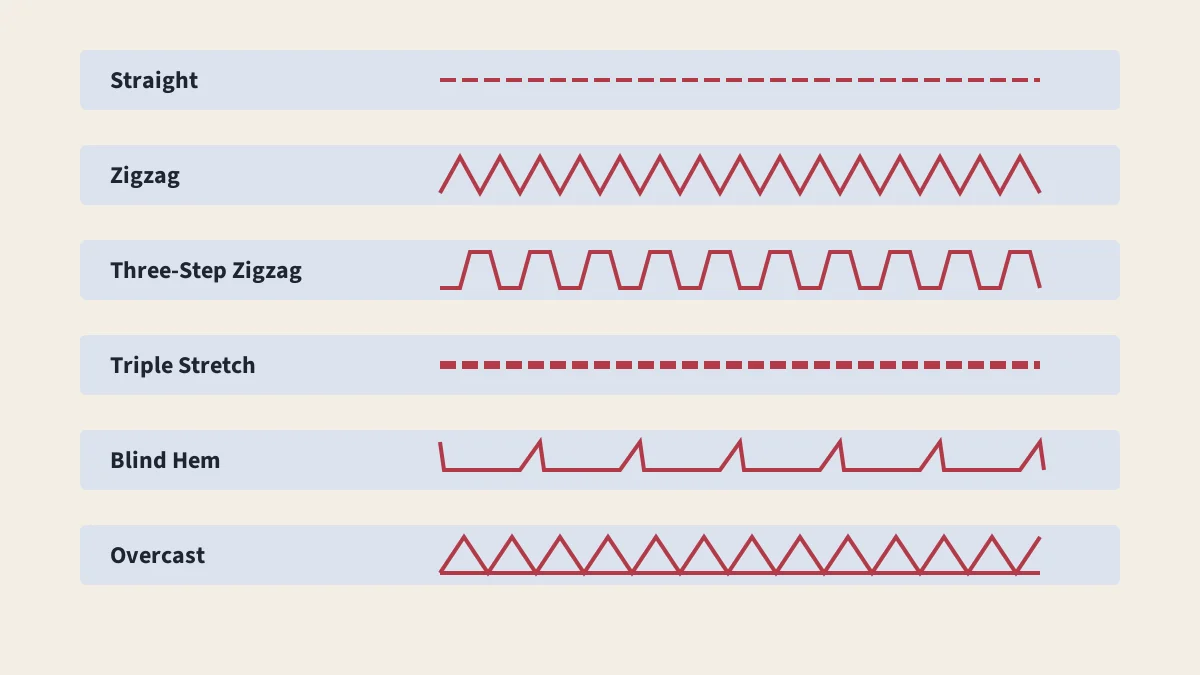
In This Article
The Essential Machine Stitches
- Straight stitch: most seams, topstitching, basting
- Zigzag: edges, appliqué, stretch, satin stitch
- Three-step zigzag: flat edge finishing, elastic, mending
- Stretch stitches: seams in knits
- Blind hem, overcast and buttonhole: special jobs
Every stitch on a home sewing machine is a variation of the lockstitch: the needle thread and bobbin thread interlock in the fabric. What changes is how the needle swings and how the fabric is fed. Straight stitches feed forward only; zigzags swing the needle side to side; stretch stitches move the fabric backward and forward to build in extra thread.
Straight Stitch
The straight stitch is the default on almost every machine and the stitch used for most seams in woven fabric. Common lengths:
- About 2.5 mm: general seams.
- 1.5–2 mm: fine fabrics, tight curves and reinforcing corners.
- 3–3.5 mm: topstitching and heavier fabrics.
- 4–5 mm: basting and gathering.
Our guide to stitch length and tension explains the settings in detail.
Zigzag Stitch
The zigzag swings the needle from side to side. It is one of the most versatile stitches:
- Finishing raw edges to stop fraying (medium width and length).
- Sewing knits with a narrow zigzag that stretches.
- Appliqué around shapes.
- Satin stitch: a very short stitch length makes the zigzags sit side by side in a solid band, used for appliqué edges and monograms.
- Bar tacks: a short, wide, dense zigzag reinforces pocket corners and belt loops.
Three-Step Zigzag (Multi-Stitch Zigzag)
Instead of one stitch per zig, this stitch makes three small stitches on each diagonal. It lies flatter than a regular zigzag and does not tunnel or curl the fabric edge.
- Finishing edges on lightweight and fraying fabrics
- Attaching elastic, which it holds securely while stretching
- Mending tears and patching
- Joining edges side by side, for example on batting
Stretch Stitches
Knit fabrics stretch; a straight lockstitch does not, so it can break when the fabric is pulled. Stretch stitches move the fabric back and forth to build extra thread into each stitch.
| Stitch | What It Looks Like | Use It For |
|---|---|---|
| Lightning bolt (narrow stretch) | A very narrow zigzag that looks almost straight | Seams in knits that should look like straight seams |
| Triple straight stitch | A heavy straight line; each stitch sewn three times | Strong stretch seams, crotch seams, bold topstitching |
| Overlock-look stretch stitch | Straight line with zigzag on the edge | Sewing and finishing a knit seam in one pass |
| Honeycomb / smocking stitch | Decorative mesh pattern | Decorative stretch seams and elastic |
Blind Hem Stitch
A blind hem stitch sews several straight stitches in the hem allowance, then one sideways bite into the fold. Used with a blind hem foot, the bite catches just a thread or two of the garment so only tiny dots show on the right side. It is a fast way to hem trousers, skirts and curtains; see the presser feet guide.
Overcast Stitch
Overcast or "overedge" stitches are designed to wrap the raw edge of the fabric, imitating a serger. Used with an overcast foot, which has a small bar or brush to keep the edge flat, they finish seam allowances neatly on a regular machine. See seam finishes and serger vs. sewing machine.
Buttonhole Stitches
A buttonhole is two parallel rows of dense zigzag with a bar tack at each end. Machines make them in one of two ways:
- Four-step buttonhole: you turn the dial to sew each side and end in turn. Common on mechanical machines.
- One-step buttonhole: the button goes in a holder on the foot, and the machine sizes and sews the whole buttonhole automatically. Common on computerized machines.
Many machines also offer keyhole buttonholes for coats and jackets and rounded-end buttonholes for knits.
Decorative Stitches
Computerized machines often include hundreds of decorative stitches: scallops, vines, hearts, cross-stitch imitations, heirloom stitches and alphabets. They are used for borders, crazy quilting, children's clothes and personalizing gifts. A stabilizer under the fabric helps dense decorative stitches lie flat.
Which Stitch for Which Job
| Job | Stitch |
|---|---|
| Seams in woven fabric | Straight, about 2.5 mm |
| Seams in knits | Lightning bolt, narrow zigzag, or overlock-look stretch stitch |
| Finishing raw edges | Zigzag, three-step zigzag or overcast |
| Topstitching | Straight, 3–3.5 mm, or triple straight for bold lines |
| Basting and gathering | Longest straight stitch |
| Hems on trousers and skirts | Blind hem |
| Attaching elastic | Three-step zigzag |
| Appliqué | Satin stitch or small zigzag |
| Reinforcing stress points | Bar tack |
For stitches made by hand, see our guide to hand sewing stitches. For how stitches combine into seams, see types of seams.
Sources
- Sewing machine, Wikipedia
- Zigzag stitch, Wikipedia
Frequently Asked Questions
What stitch should I use for most sewing?
A straight stitch at about 2.5 mm long for most seams in woven fabric. It is the default stitch on almost every machine.
What stitch should I use on stretchy fabric?
Use a stretch stitch (often a lightning-bolt or triple straight stitch), a narrow zigzag, or a three-step zigzag, with a ballpoint or stretch needle. A plain straight stitch can pop when knit fabric is stretched.
What is a three-step zigzag used for?
The three-step (multi-stitch) zigzag makes three small stitches on each zig and zag. It is flatter and more secure than a regular zigzag, which makes it good for finishing edges, sewing elastic, mending tears and finishing edges without curling the fabric.
What is the difference between a zigzag and an overcast stitch?
A zigzag swings evenly side to side. An overcast stitch combines a straight or zigzag pattern designed to wrap over the raw edge, imitating a serger, and is often used with an overcast foot that keeps the edge flat.
Keep Reading
Hand Sewing Stitches
Every essential hand stitch, what it is for and how to sew it.
Stitch Length and Tension Explained
What the dials mean, common settings, and how to balance tension.
Types of Seams
Plain, French, flat-felled, lapped, bound and other seams compared.
Presser Feet Guide
What each presser foot does and how to check it fits your machine.