How a Sewing Machine Works: Inside the Lockstitch (2026)
A sewing machine does not copy hand sewing. Its needle never passes all the way through the fabric. Instead, it pushes a loop of thread down for a spinning hook to catch. Here is the clever mechanism behind every home machine.
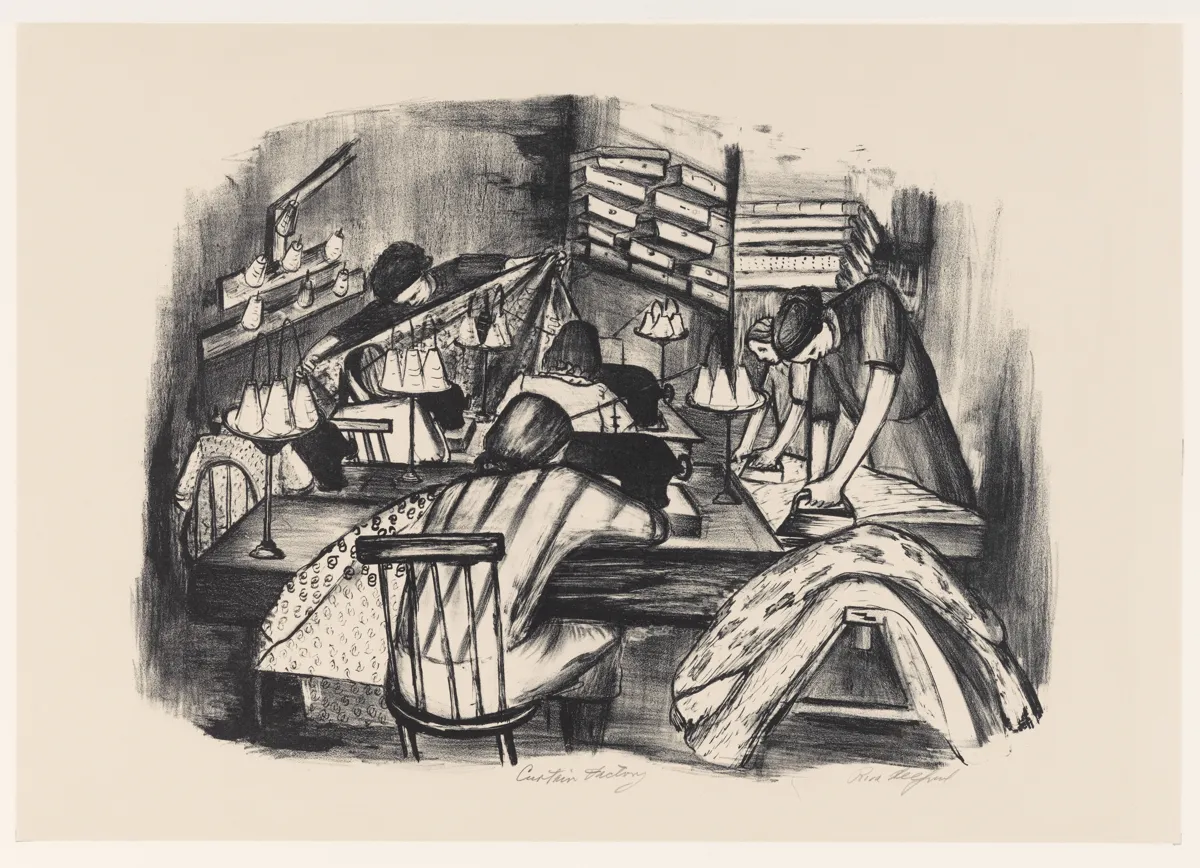
In This Article
The Lockstitch in Four Moves
- 1. Down: the needle carries the top thread through the fabric
- 2. Loop: as the needle starts to rise, the thread forms a loop
- 3. Catch: the hook grabs the loop and wraps it around the bobbin thread
- 4. Tighten and feed: the take-up lever pulls the stitch tight and the feed dogs move the fabric
Watch a sewing machine run and it seems almost magical: two threads, one above the fabric and one below, locking together hundreds of times a minute. Early inventors struggled for decades because they tried to copy the human hand. The breakthrough came when they stopped. A machine needle does not pull thread all the way through the cloth. It carries a loop down and lets a hook underneath do the rest.
Two Threads, One Stitch
Almost every home machine makes the lockstitch. It is the stitch used by most household machines and most single-needle industrial machines, and it uses two threads: one passing through the needle and one coming from a bobbin. Each thread stays on its own side of the fabric, and the two interlace at every needle hole. Because nothing needs to wrap around the edge, a lockstitch can be formed anywhere on the fabric, not just near an edge.
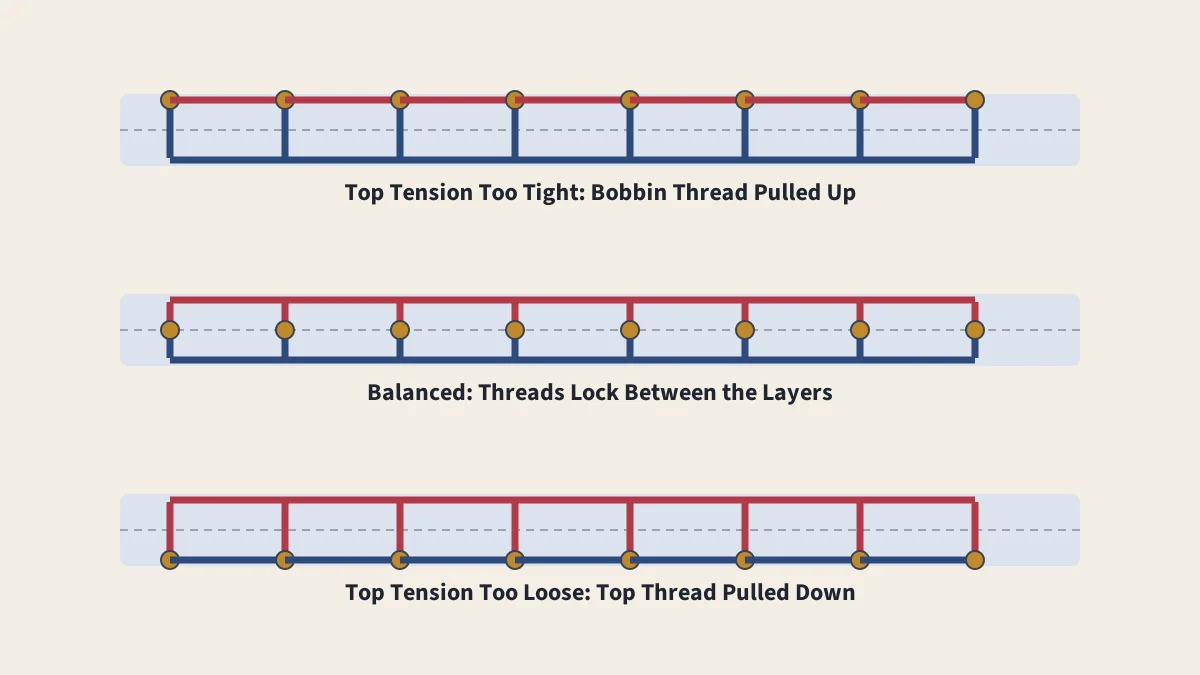
Get the tension right and the point where the threads interlock sits hidden inside the fabric, so the stitch looks the same on both sides. Our guide to stitch length and tension explains how to achieve that balance.
Step by Step: How One Stitch Forms
- The needle goes down. The needle bar drives the needle through the fabric and the hole in the needle plate, carrying the upper thread with it. The eye is at the point, so only a short length of thread passes below the fabric.
- A loop forms. As the needle begins to rise, friction with the fabric holds back the thread on one side, and a small loop opens up beside the needle. A shallow dip in the back of the needle, called the scarf, gives the hook room to reach that loop.
- The hook catches the loop. The sharp point of the hook passes through the loop and carries it around the bobbin case, so the upper thread wraps all the way around the bobbin and its thread.
- The take-up lever tightens the stitch. The take-up lever rises and pulls the slack upper thread back up, drawing the loop tight around the bobbin thread so the two threads lock in the fabric. At the same time, the tension discs let just enough fresh thread off the spool for the next stitch.
- The feed dogs move the fabric. While the needle is out of the fabric, the feed dogs rise through the needle plate, grip the fabric against the presser foot, move it back by one stitch length, then drop away. Then the cycle repeats.
Shuttles and Rotary Hooks
The part that carries the loop around the bobbin has changed over time. Early machines carried the bobbin inside a boat-shaped shuttle that moved back and forth under the needle. Isaac Singer's early machine used a "falling shuttle," while Allen B. Wilson developed the rotary hook, which spins continuously and runs more quietly and smoothly than other methods.
| System | How It Moves | Where You Find It |
|---|---|---|
| Vibrating or oscillating shuttle | Rocks or swings back and forth carrying the bobbin | Many 19th- and early 20th-century machines |
| Oscillating hook | Swings back and forth around a stationary bobbin case | Many front-loading home machines |
| Rotary hook | Spins continuously in one direction | Many top-loading home machines and industrial machines |
How the Fabric Moves
Feeding fabric evenly is as important as forming the stitch. Almost all household machines use drop feed, where the feed dogs rise, move the fabric and lower again while the needle passes through. Some machines add other systems:
- Walking foot, which moves with the feed dogs to grip the top layer, good for heavy materials and many layers such as quilts.
- Differential feed, on sergers and some other machines, with two independent sets of feed dogs that can stretch or compress the fabric, useful for stretchy material.
- Needle feed, used in industrial machines, where the needle moves with the fabric while it is in it.
- Manual feed, used mainly for free-motion embroidery and quilting, where you move the fabric yourself and control stitch length and direction.
Zigzag and Other Stitches
A zigzag stitch is still a lockstitch. The only difference is that the needle bar swings from side to side between stitches. Decorative and stretch stitches combine side-to-side swings with forward and backward feeding. Computerized machines control both movements with stepper motors, which is why they can sew hundreds of patterns and alphabets.
Why the Machine Took Decades to Invent
Inventors spent decades trying to mechanize hand sewing, with needles that passed all the way through the cloth. The eye-pointed needle combined with a second thread from below solved the problem, and it led to the patent battles described in who invented the sewing machine and the Sewing Machine War. The other early solution, the single-thread chain stitch, is compared in lockstitch vs. chain stitch.
Sources
- Sewing machine, Wikipedia
- Riva Helfond, Curtain Factory, The Metropolitan Museum of Art
Frequently Asked Questions
How does a sewing machine make a stitch?
The needle carries the upper thread down through the fabric. As it starts to rise, the thread forms a small loop. A rotating hook catches the loop and carries it around the bobbin, wrapping it around the lower thread. The take-up lever then pulls the thread tight, locking the two threads together inside the fabric, and the feed dogs move the fabric forward for the next stitch.
Why does a sewing machine needle have its eye at the point?
Because the needle does not pass through the fabric. It only pushes a loop of thread through and pulls back out, so the eye has to be near the point. Hand-sewing needles, which pass completely through the fabric, have the eye at the opposite end.
What is the difference between a shuttle and a rotary hook?
Early machines carried the bobbin in a boat-shaped shuttle that moved back and forth. A rotary hook spins continuously around a stationary bobbin. Allen B. Wilson introduced the rotary hook, which runs more quietly and smoothly.
Why does a sewing machine need two threads?
The standard lockstitch interlocks a needle thread and a bobbin thread at each needle hole. This is what makes it secure: unlike a single-thread chain stitch, it does not unravel when pulled from one end.
Keep Reading
Lockstitch vs. Chain Stitch
How the two machine stitches differ, and where each is still used.
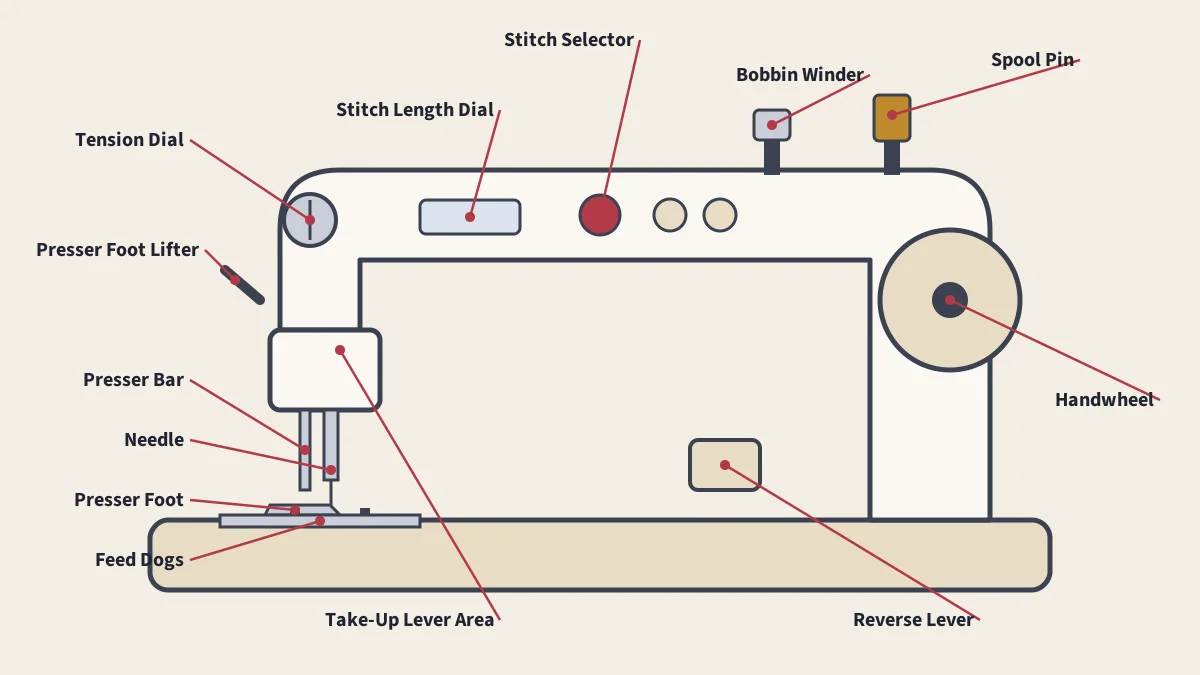
Parts of a Sewing Machine
A labeled diagram and what every part of the machine does.
Who Invented the Sewing Machine?
Saint, Thimonnier, Hunt, Howe or Singer? The inventors and who deserves the credit.
Stitch Length and Tension Explained
What the dials mean, common settings, and how to balance tension.