Seam Finishes: How to Stop Raw Edges From Fraying (2026)
Cut woven fabric and its edges start to unravel. A seam finish stops that, makes the inside of a garment neat and helps it survive the wash. Here are the main methods, with and without a serger.
In This Article
Seam Finishes in Brief
- Quickest: pinking, zigzag
- Most professional on knits and wovens: serging
- Neatest without a serger: turned and stitched, bound, Hong Kong
- Self-enclosed: French and flat-felled seams need no separate finish
- Choose by: how much the fabric frays and whether the inside shows
Woven fabric is made of threads crossing at right angles, and a cut edge leaves those threads free to slip out. Without a finish, seam allowances fray in the wash, seams weaken and the inside of the garment looks untidy. A seam finish protects the raw edges, and in unlined garments it becomes part of the design.
Do You Always Need a Seam Finish?
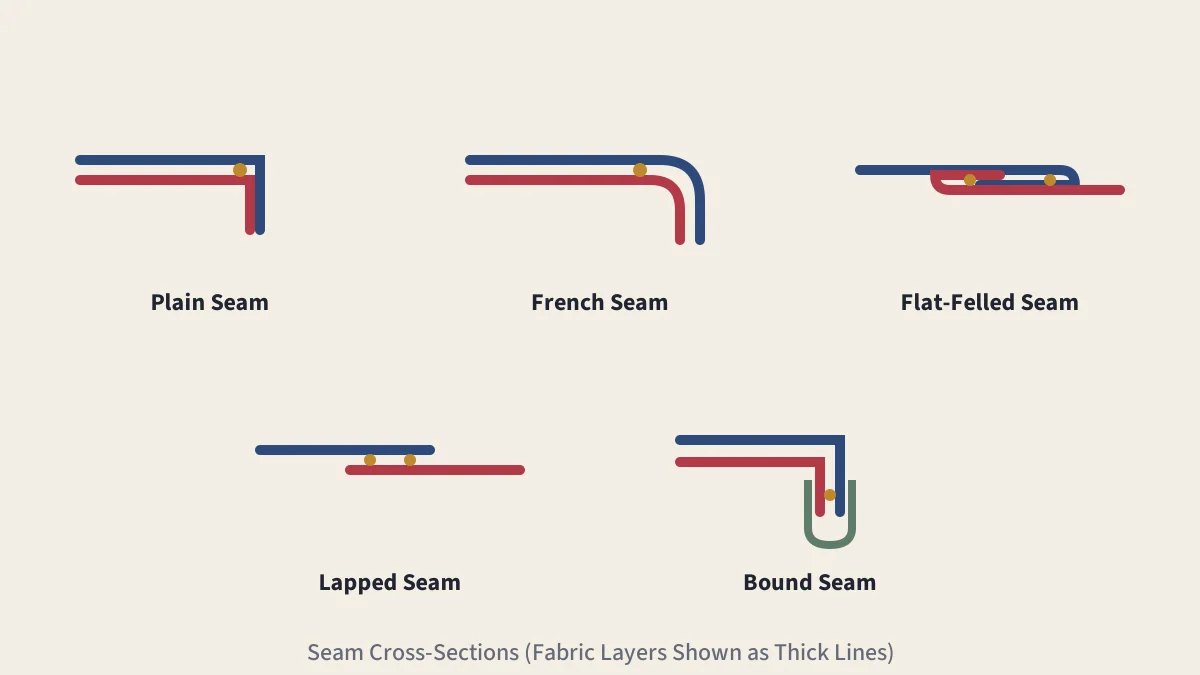
Not always. Seams inside a fully lined garment, a pillow or a lined bag are protected. Most knits do not fray, and felt, fleece and leather do not fray at all. Self-enclosed seams, such as French and flat-felled seams, build the finish into the seam itself; see types of seams. Everything else needs a finish.
Machine and Cutting Finishes
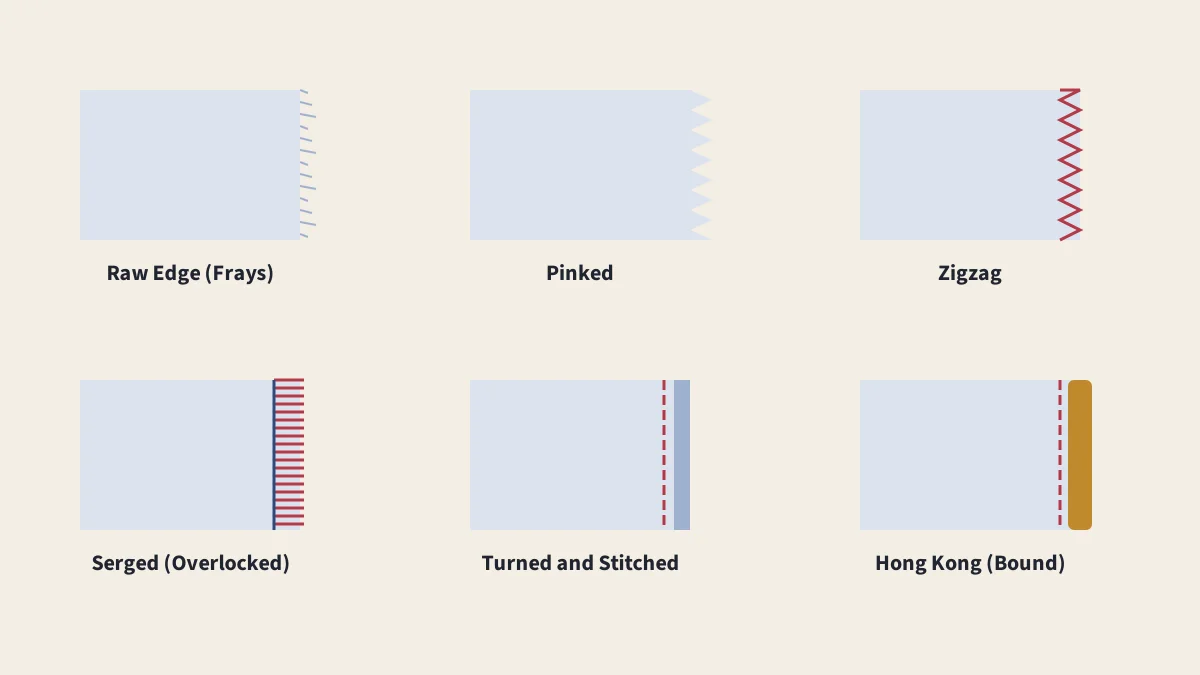
Pinked Edges
Trim the seam allowance with pinking shears, whose saw-toothed blades cut a zigzag edge that slows fraying. It is fast and flat, but not durable on fabrics that fray badly. Pinking shears have their own history; see our history of scissors.
Zigzag
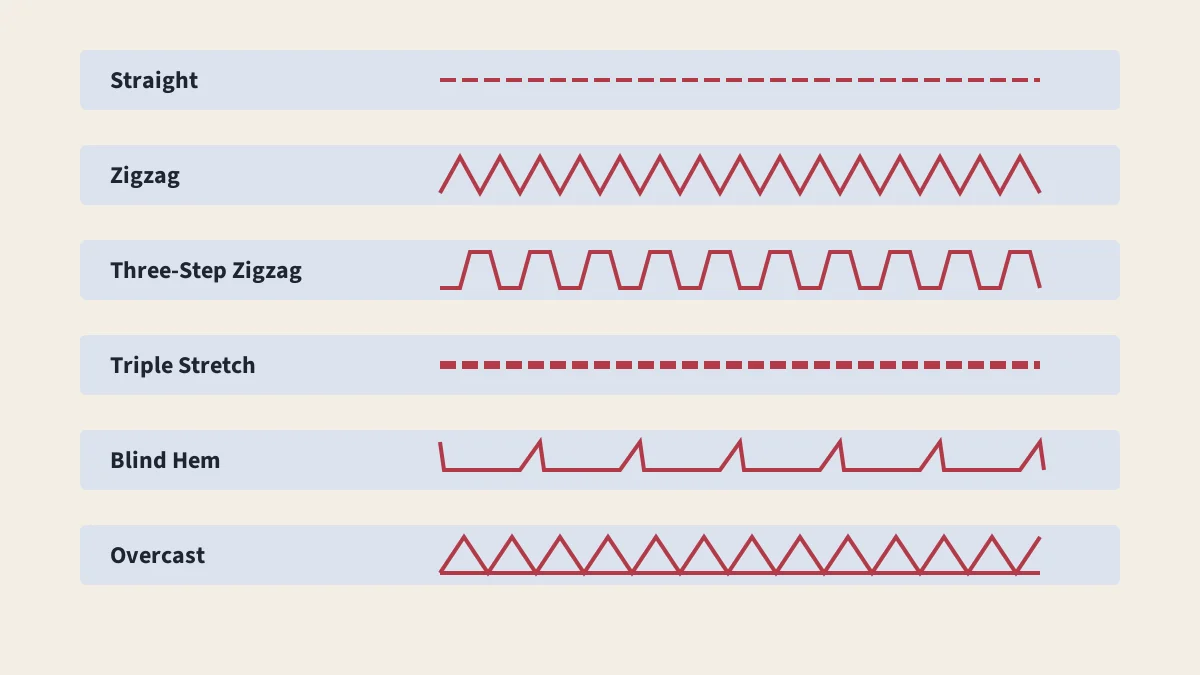
Sew a medium-width zigzag along the raw edge of each seam allowance, then trim close to the stitching if needed. It works on any machine and suits most medium-weight fabrics.
Three-Step Zigzag
Flatter and more secure than a regular zigzag, it is good for lightweight fabrics that tunnel or curl with a standard zigzag.
Overcast Stitch
Many machines have an overcast stitch and foot designed to wrap the raw edge, imitating a serger. See machine stitch types.
Serged (Overlocked)
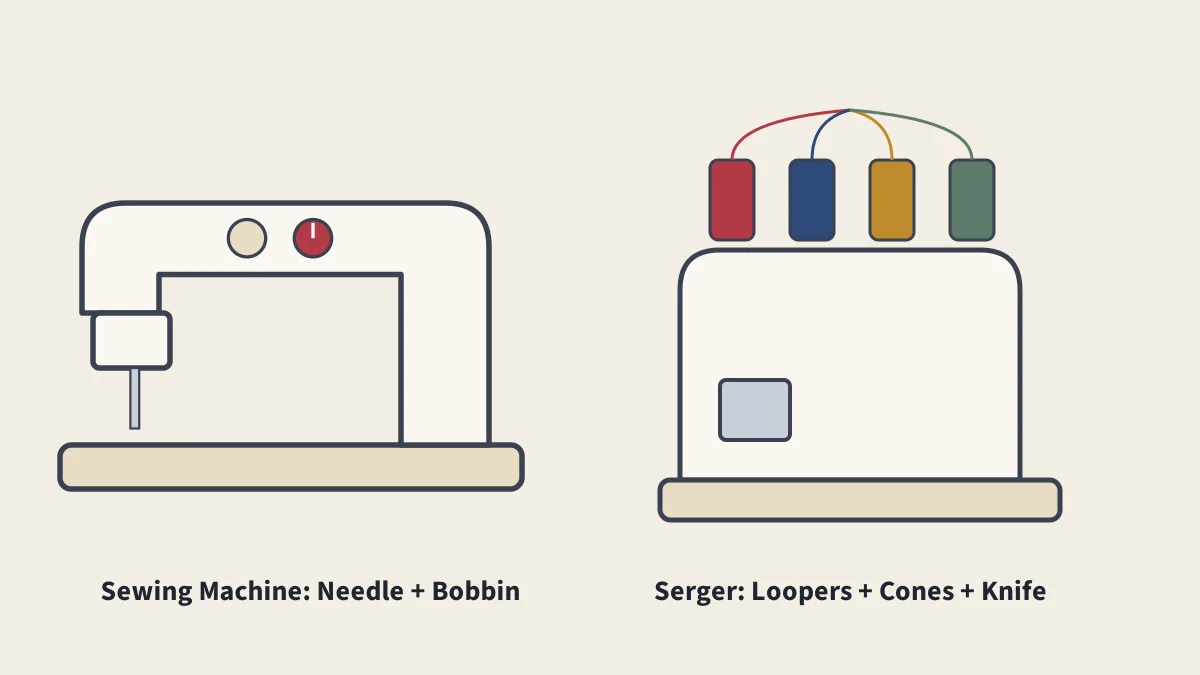
A serger trims and wraps each edge in one pass, the finish found inside most ready-to-wear clothing. It is fast, neat and stretchy, and it suits both knits and wovens. See how a serger works.
Turned and Bound Finishes
Turned and Stitched (Clean Finish)
Fold the raw edge of each seam allowance under by about 1/8 to 1/4 inch (3 to 6 mm) and stitch close to the fold. It is neat and durable for light and medium fabrics but adds bulk on heavy ones.
Bias-Bound Edge
Wrap each seam allowance, or both together, in a strip of bias binding and stitch it in place. It is durable and attractive, good for unlined jackets and fabrics that fray heavily.
Hong Kong Finish
A refined bound finish: a strip of lightweight bias fabric is stitched to the right side of each seam allowance, wrapped around the raw edge and stitched in the ditch, leaving the underside raw but hidden. It is flatter than a full binding and often seen in high-quality unlined jackets and coats, sometimes in a contrasting color as a design detail.
Enclosed Finishes
- French seam: encloses raw edges in a narrow tube; best for sheer and lightweight fabrics.
- Flat-felled seam: folds and double-stitches the allowances; best for jeans, shirts and workwear.
- Mock French seam: allowances folded in toward each other and stitched together; useful on curves.
Choosing a Seam Finish
| Finish | Speed | Durability | Bulk | Best For |
|---|---|---|---|---|
| Pinked | Very fast | Low | Very low | Stable cottons, wool that frays little |
| Zigzag | Fast | Medium | Low | Most medium-weight wovens |
| Three-step zigzag | Fast | Medium to high | Low | Lightweight wovens |
| Serged | Very fast | High | Low | Knits and wovens of most weights |
| Turned and stitched | Moderate | High | Medium | Light to medium wovens |
| Bias-bound | Slow | Very high | Medium | Unlined jackets, heavy fraying |
| Hong Kong | Slow | High | Low to medium | Unlined jackets and coats |
| French seam | Moderate | High | Low | Sheers and fine fabrics |
| Flat-felled seam | Moderate | Very high | Medium | Jeans, shirts, workwear |
Tips for Better Seam Finishes
- Test first on a scrap of the same fabric to choose stitch width and length.
- Press before finishing. Decide whether the seam will be pressed open (finish each allowance separately) or to one side (finish both together).
- Match the fabric. Lightweight fabrics need light finishes; bulky finishes show through as ridges.
- Use the right thread. All-purpose thread suits most finishes; finer thread helps on sheers.
To go back to the start of this section, see our guide to hand sewing stitches, which includes the overcast stitch for finishing edges by hand.
For the bias strips used in bound and Hong Kong finishes, see bias tape and binding.
Sources
- Seam (sewing), Wikipedia
- Overlock, Wikipedia
Frequently Asked Questions
Do I need to finish seams?
On woven fabrics that fray, yes, unless the seam will be enclosed by a lining or is a self-enclosed seam such as a French or flat-felled seam. Most knits do not fray and often need no finish, though serging gives a neater result.
What is the easiest seam finish?
Pinking with pinking shears is the quickest, and a zigzag stitch along the edge is the easiest machine finish. Both suit fabrics that fray only lightly.
What is a Hong Kong seam finish?
A Hong Kong finish wraps each seam allowance separately in a strip of bias binding, sewn so that the binding encloses the raw edge on the front and lies flat underneath. It is often used in unlined jackets because it looks beautiful inside.
How do I finish seams without a serger?
Use a zigzag, three-step zigzag or overcast stitch on your sewing machine; pink the edges; turn under and stitch the edge; bind it; or use an enclosed seam such as a French or flat-felled seam.
Keep Reading
Types of Seams
Plain, French, flat-felled, lapped, bound and other seams compared.
Serger vs. Sewing Machine
How a serger and a sewing machine differ, and whether you need both.
Machine Stitch Types
The utility stitches that do most of the work, and when to use each.
Hand Sewing Stitches
Every essential hand stitch, what it is for and how to sew it.