How a Serger Works: Loopers, Knives and Overlock Stitches (2026)
A serger can look intimidating, with its cones, loopers and color-coded threading paths. But every part has a clear job. Here is how an overlock stitch is formed and what each thread combination is used for.
In This Article
Serger Basics in Brief
- Needles (one or two) form the seam line
- Loopers (upper and lower) wrap thread around the edge
- Knives trim the edge just before it is stitched
- Differential feed stretches or eases the fabric
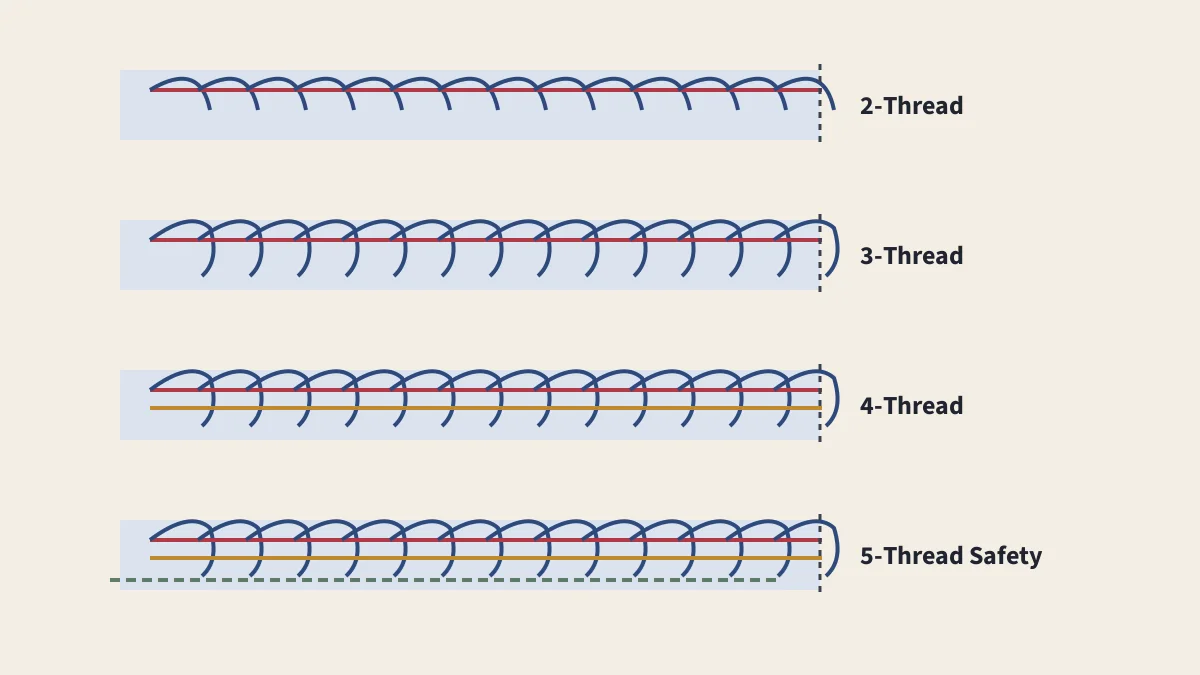
- Thread count sets the stitch: 2, 3, 4 or 5 threads
A serger, or overlocker, is built to do three jobs at once: trim the fabric, sew the seam and enclose the raw edge in thread. It does this without a bobbin. Instead, loopers below and above the fabric carry thread around the edge, interlocking with the needle threads. The stitch was invented by the Merrow Machine Company in 1881, and its basic principle has hardly changed since.
The Parts of a Serger
| Part | What It Does |
|---|---|
| Thread cones and stand | Hold the large cones or spools, one for each needle and looper |
| Tension dials | One for each thread, so each can be balanced independently |
| Needles (one or two) | Form the stitch line; on 4-thread stitches, the left needle sets the seam width |
| Upper looper | Carries thread over the top of the fabric to the edge |
| Lower looper | Carries thread under the fabric to the edge, where it interlocks with the upper looper thread |
| Upper and lower knives | Trim the fabric edge just ahead of the needles, like scissors |
| Stitch finger | A small prong the stitches form around, which sets the stitch width and keeps the edge flat |
| Differential feed | Two sets of feed dogs that can move at different rates |
How an Overlock Stitch Forms
- The knife trims the edge to a clean line just before the needles reach it.
- The needle passes through the fabric and forms a loop underneath, as on a sewing machine.
- The lower looper swings through the needle loop, carrying its thread under the fabric toward the edge.
- The upper looper rises and catches the lower looper thread at the edge, carrying its own thread over the top of the fabric back to the needle.
- The needle comes down again through the upper looper's loop, locking everything in place.
The result is a chain of interlocking threads that wraps the edge. Because the looper threads form loops rather than locking tightly, overlock stitches stretch, which makes them ideal for knits. This is closely related to the chain stitch family described in lockstitch vs. chain stitch.
Serger Stitches by Thread Count
| Stitch | Threads | Best For |
|---|---|---|
| 2-thread overedge | 1 needle + 1 looper | Lightweight edge finishing, flatlock, fine fabrics |
| 3-thread overlock | 1 needle + 2 loopers | Edge finishing, lightweight seams, stretchy seams |
| 3-thread rolled hem | 1 needle + 2 loopers, narrow setting | Narrow rolled edges on scarves, napkins, ruffles |
| 3-thread flatlock | 1 needle + 2 loopers, loosened needle tension | Decorative flat seams, activewear details |
| 4-thread overlock | 2 needles + 2 loopers | Strong seams in knits and wovens; the everyday serger stitch |
| 5-thread safety stitch | 3-thread overlock + 2-thread chain stitch | Strong seams in woven fabrics; common in manufacturing |
In the garment industry these stitches belong to standardized stitch classes, and the overlock family is numbered in the 500 class. Two- and three-thread formations are also known as "merrowing," after the Merrow Machine Company.
Differential Feed
Ordinary feed dogs move fabric at one rate. A serger with differential feed has two sets, one in front of the needles and one behind, and their relative speed can be adjusted:
- Higher setting (front moves faster): eases or gathers fabric, and stops knits from stretching out into a wavy "lettuce" edge.
- Lower setting (front moves slower): gently stretches fabric, preventing lightweight wovens from puckering. Pushed further, it creates a deliberately rippled "lettuce" hem on knits.
- Neutral (1.0): both sets move together, for stable fabrics.
Threading a Serger
Serger threading paths are color-coded on the machine, one color for each needle and looper. Most manuals recommend threading in a set order, usually the loopers first (upper, then lower) and the needles last, because the loopers sit behind and below the needles. Some modern sergers have air threading, which blows the thread through the looper paths. When rethreading, a common shortcut is to tie the new thread onto the old one and pull it through, with the tension dials released.
What a Serger Cannot Do
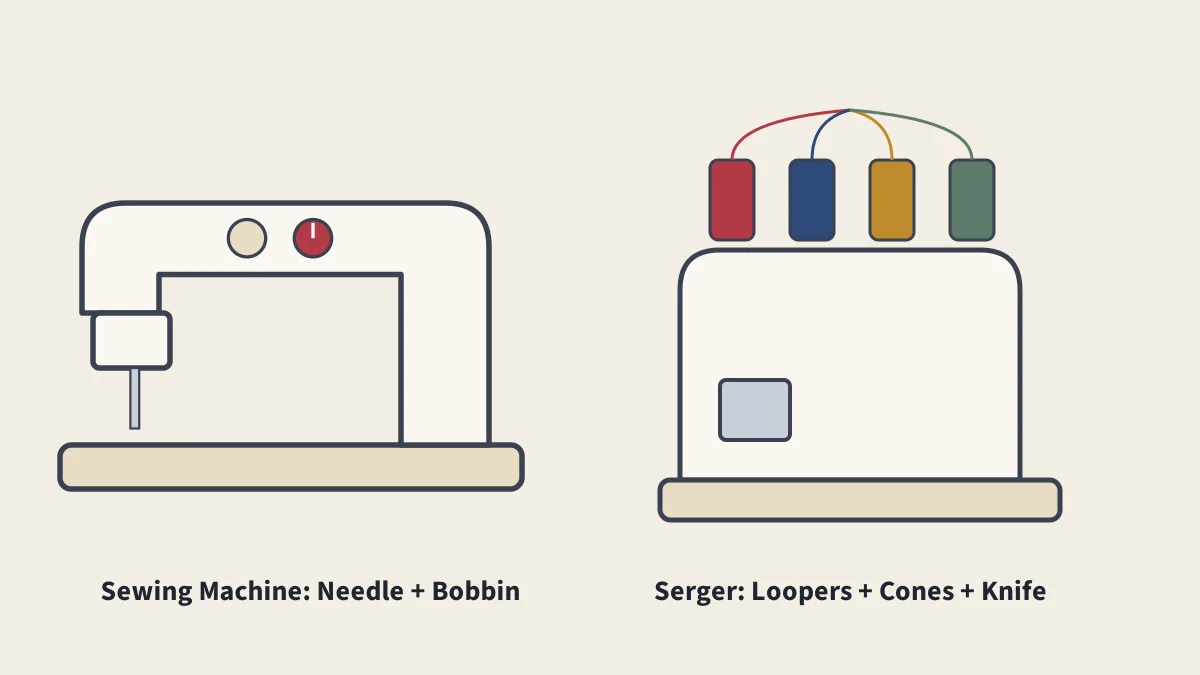
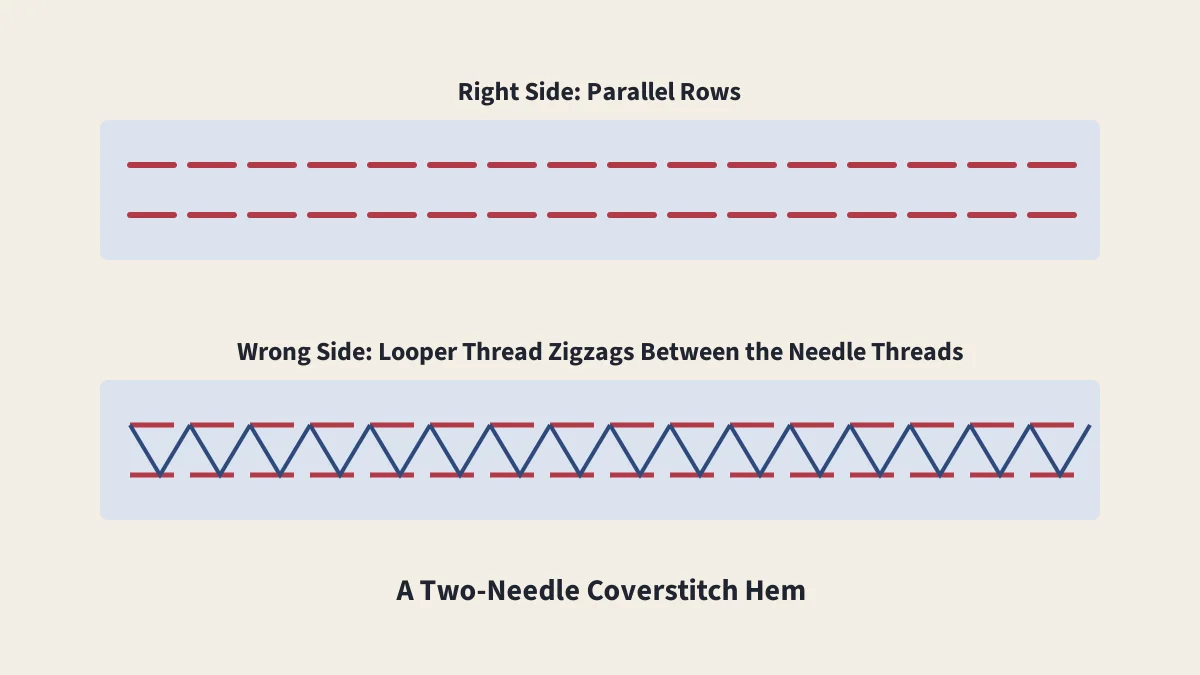
A serger only sews at the edge, so it cannot topstitch, insert zippers, make buttonholes or sew darts and pockets. Most sewists use it alongside a regular sewing machine. Our comparison of a serger vs. sewing machine explains when it is worth having both, and our guide to coverstitch machines covers the hems a serger usually cannot sew.
Sources
- Overlock, Wikipedia
- Merrow Sewing Machine Company, Wikipedia
Frequently Asked Questions
What is the difference between a 3-thread and a 4-thread serger stitch?
A 3-thread overlock uses one needle and two loopers and is lighter and stretchier, good for finishing edges and lightweight fabrics. A 4-thread overlock adds a second needle, which makes the seam stronger and more stable, so it is the usual choice for sewing knit seams.
What does differential feed do on a serger?
A serger with differential feed has two sets of feed dogs that can move at different speeds. Moving the front set faster gathers or eases fabric and prevents stretchy knits from rippling; moving it slower stretches fabric and prevents fine fabrics from puckering.
What is a 5-thread safety stitch?
A 5-thread safety stitch combines a 3-thread overlock on the edge with a separate 2-thread chain stitch seam, sewn at the same time. It is strong and widely used for woven fabrics in garment manufacturing.
Why are serger threads color-coded?
Serger threading paths are complicated, so manufacturers mark each path with a color to help you follow the right route for each needle and looper.
Keep Reading
Serger vs. Sewing Machine
How a serger and a sewing machine differ, and whether you need both.
Coverstitch Machines
How coverstitch hems work and how they compare with sergers.
Seam Finishes
Pinked, zigzag, serged, Hong Kong, bound and enclosed finishes.
Lockstitch vs. Chain Stitch
How the two machine stitches differ, and where each is still used.