Embroidery Stitches: The Essential Stitches, Illustrated (2026)
Hundreds of embroidery stitches exist, but most belong to a few families: flat, looped, knotted and couched. Learn a handful from each, and you can stitch almost any design.
In This Article
Stitch Families in Brief
- Flat: running, backstitch, satin
- Looped: chain, lazy daisy, blanket, feather
- Knotted: French knot, bullion knot
- Couched: laid threads held by another
- Crossed: cross stitch and herringbone
Embroidery stitches can be grouped by how the needle and thread move. Knowing the families makes new stitches easier to learn, since most are variations of a few basic movements. For practical sewing stitches, see the stitches and seams guide.
Flat Stitches
Flat stitches pass up and down through the fabric, mostly in one direction, and are good for fine detail.
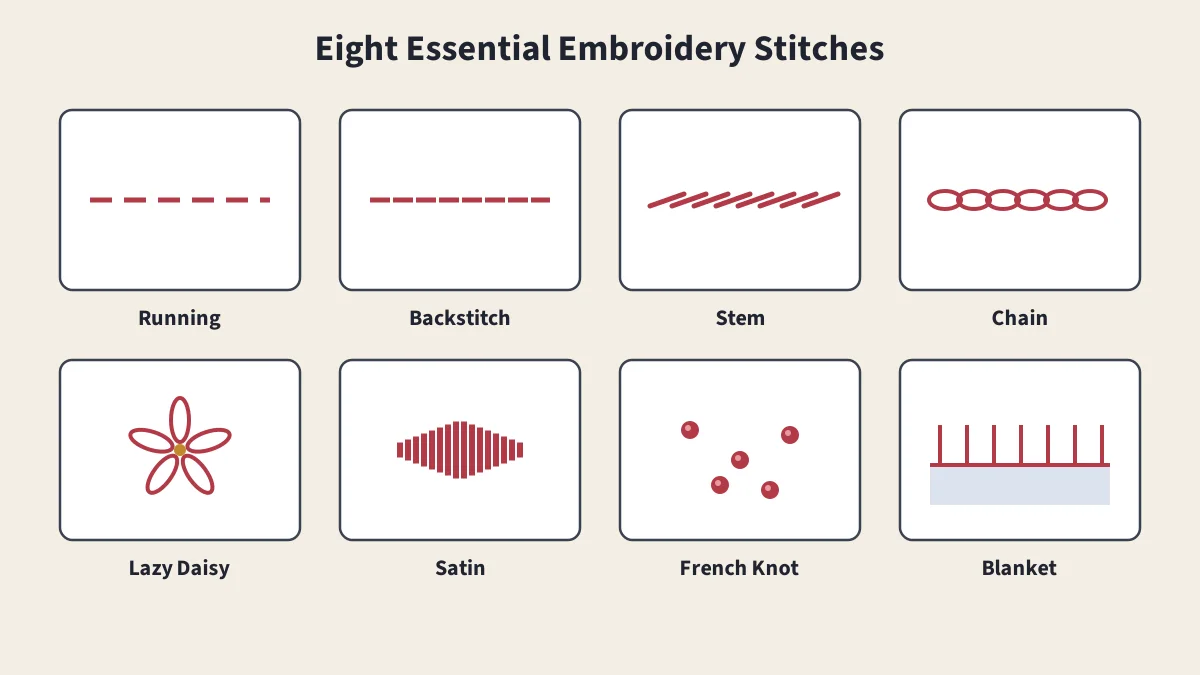
| Stitch | How It Works | Use |
|---|---|---|
| Running | The needle weaves up and down at even intervals | Lines, outlines, sashiko; the basis of many stitches |
| Backstitch | Each stitch goes back to meet the previous one | Solid outlines and lettering |
| Holbein (double running) | A running stitch with the gaps filled on a second pass | Blackwork; reversible lines |
| Stem | Overlapping slanted stitches | Stems and curved outlines |
| Split | Each stitch comes up through the previous one | Fine lines and shading |
| Satin | Straight stitches packed side by side | Smooth filled shapes |
| Long and short | Staggered satin stitches | Shading and blending colors |
| Seed | Tiny scattered straight stitches | Textured fills |
Looped Stitches
Looped stitches catch a loop of thread on the surface of the fabric.
- Chain stitch: the needle passes back through its own loop to form a linked chain.
- Lazy daisy (detached chain): a single loop anchored at its wide end by a small tacking stitch; ideal for petals.
- Blanket and buttonhole stitch: worked along an edge; buttonhole stitches are packed tightly, blanket stitches spaced out. Both help stop woven fabric fraying.
- Feather stitch: looped stitches worked alternately left and right, for foliage, borders and smocking.
- Fly stitch: a single open loop held by a tacking stitch, forming a V or Y.
Knotted Stitches
The thread is wrapped around the needle before it passes back through the fabric.
- French knot: a small twisted knot, for dots, flower centers and texture.
- Chinese knot: similar, but taking a tiny stitch in the background fabric.
- Bullion knot: a long coil, for roses and raised details.
- Coral stitch: a line of knots along a thread.
Couched and Laid Stitches
In couching, one thread is laid on the surface and held down by a second, finer thread. The laid threads are often heavier or metallic, as in goldwork. Variants include Bokhara, Romanian and battlement couching.
Crossed Stitches
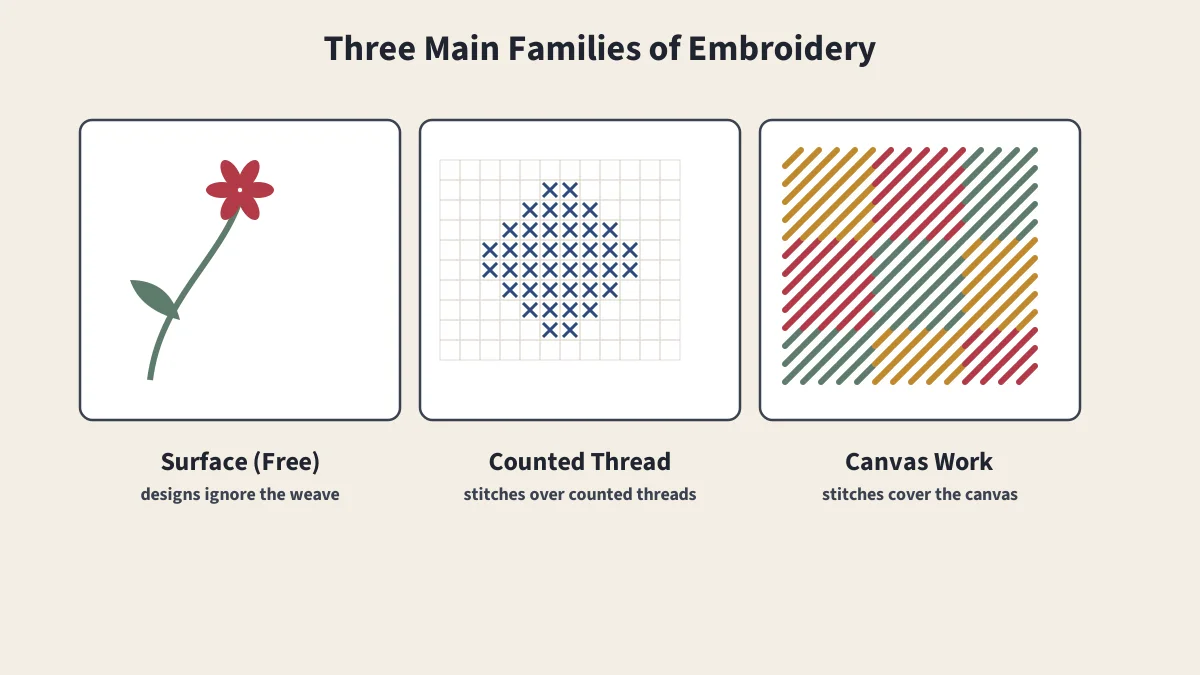
Cross stitch forms diagonal X pairs, usually worked over counted threads; herringbone stitch forms a row of crossing diagonals. See types of embroidery.
Sources
- Embroidery stitch, Wikipedia
Frequently Asked Questions
What are the basic embroidery stitches?
Running stitch, backstitch, stem stitch, chain stitch, lazy daisy, satin stitch, French knot and blanket stitch cover most beginner designs.
What is the best stitch for outlining?
Backstitch gives a clean line; stem stitch gives a slightly twisted, rope-like line that suits curves; chain stitch gives a bold outline.
What is satin stitch?
Straight stitches laid closely side by side to fill a shape with smooth, shiny color.
What is couching?
A technique in which a thread is laid on the surface and held down by small stitches of a second thread. It is used for heavy and metal threads that can't pass through fabric easily.
Keep Reading
Types of Embroidery
The main families and named styles of embroidery.
Decorative Stitches
Machine and hand decorative stitches, and how to use them well.
Hand Sewing Needle Types
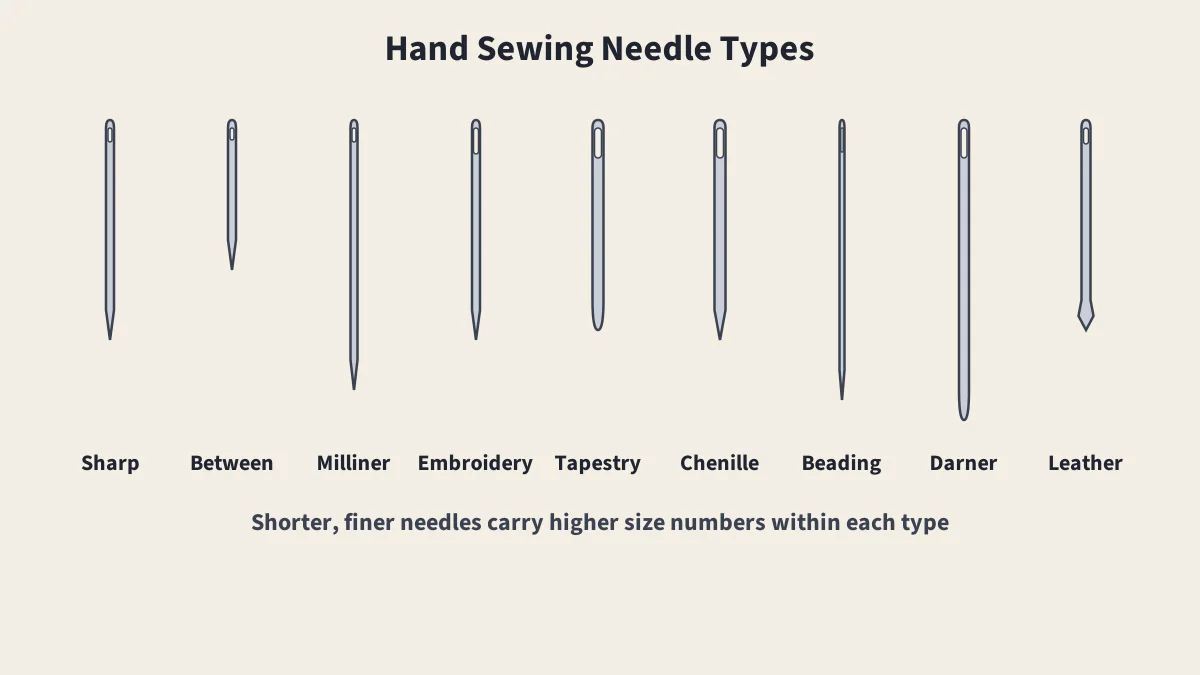
Every common hand needle type, what it is for and how sizes work.
Hand Sewing Stitches
Every essential hand stitch, what it is for and how to sew it.