Mechanical vs. Computerized Sewing Machines: Which Suits You? (2026)
Both kinds of machine sew the same lockstitch. The difference is how you control them, how much they do for you, and what happens when something goes wrong. Here is a clear comparison.
In This Article
The Short Version
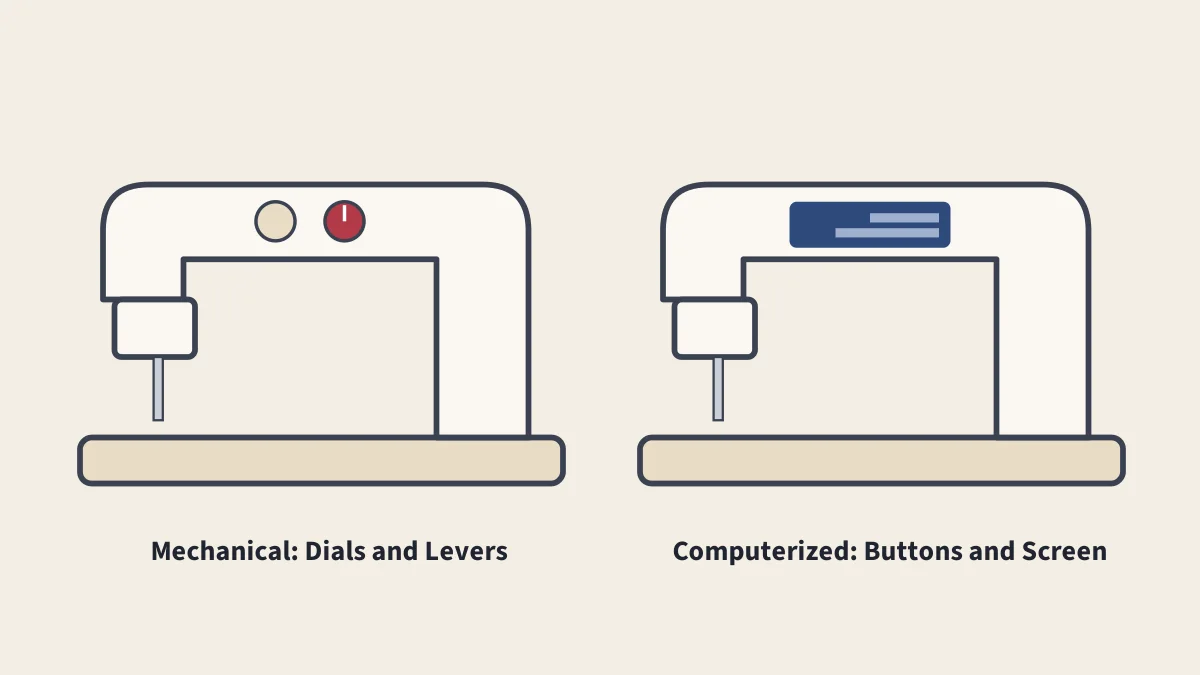
- Mechanical: dials and levers, fewer stitches, simple, durable, easy to repair
- Computerized: buttons or screen, many stitches, automation, precise and repeatable
- Same core: both make the same lockstitch with a needle and bobbin
- Choose by: what you sew, your budget and how much automation you want
Walk into a sewing machine store and you will see two broad families. Mechanical machines have chunky dials and a handful of stitches. Computerized machines have buttons, screens and stitch menus running into the hundreds. Underneath, both work the same way, forming a lockstitch with a needle and bobbin. What differs is how the machine is controlled and how much it does for you.
A Short History
For their first century, all sewing machines were mechanical: the stitch was set by gears, cams and levers. Zigzag and decorative stitches arrived in the mid-twentieth century using cams, shaped discs that move the needle bar side to side. Singer's company timeline dates its first zigzag machine to 1952 and describes its Athena 2000 of 1975 as the world's first electronic sewing machine. In 1978 the company introduced the Touchtronic 2001, which it describes as the first computer-controlled machine. Today, computerized machines dominate the mid- and upper-price range, while mechanical machines remain popular as simple, affordable workhorses.
Mechanical Sewing Machines
On a mechanical machine, you choose the stitch by turning a dial, set length and width with knobs, and control speed with the foot pedal. An electric motor drives the machine, but there is little or no electronics.
Advantages
- Simple to learn. Every setting is visible and physical.
- Durable. Fewer electronic parts means fewer things to fail.
- Easy to repair. Technicians can fix most mechanical faults, and parts are often available for decades.
- Affordable. Basic mechanical machines are usually the cheapest new machines.
Disadvantages
- Fewer stitches, typically a dozen to a few dozen.
- Buttonholes are often four-step rather than one-step.
- No memory, no automatic thread cutting, and usually no needle up/down setting.
- Settings are less precise and repeatable than on a computerized machine.
Computerized Sewing Machines
Computerized machines replace dials with buttons or a touchscreen. Electronic control lets the machine position the needle precisely for each stitch, so it can offer far more stitch patterns and automatic functions.
Advantages
- Many stitches, often hundreds, including alphabets and decorative patterns.
- Automatic one-step buttonholes sized from the button itself.
- Convenience features such as needle up/down, automatic thread cutting, speed control, start/stop buttons and built-in help.
- Precision and memory: settings can be saved and repeated exactly.
- Embroidery: combination machines can also stitch embroidery designs. See how embroidery machines work.
Disadvantages
- Higher cost.
- Repairs to electronics can be expensive, and circuit boards for older models may become unavailable.
- More menus and settings to learn.
- More sensitive to power surges, dust and heat.
Side-by-Side Comparison
| Feature | Mechanical | Computerized |
|---|---|---|
| Controls | Dials, knobs, levers | Buttons, display, touchscreen |
| Number of stitches | Usually a dozen to a few dozen | Dozens to hundreds |
| Buttonholes | Often four-step | Usually one-step automatic |
| Speed control | Foot pedal only | Foot pedal plus speed limiter; often start/stop button |
| Needle up/down, thread cutter | Rarely | Common |
| Learning curve | Gentle | Gentle to moderate |
| Repairs | Usually simple and cheaper | Can be costly for electronics |
| Price | Lower | Moderate to high |
Which Should You Choose?
| If You... | Consider |
|---|---|
| Are a beginner on a tight budget | A basic mechanical machine |
| Mostly sew straight seams, mending and simple projects | Mechanical |
| Make many garments with buttonholes | Computerized, for one-step buttonholes |
| Quilt often | Computerized features such as needle down, speed control and a larger throat help |
| Want decorative stitches, lettering or embroidery | Computerized or a combination machine |
| Want a machine you can maintain and repair easily for decades | Mechanical |
What Matters More Than Mechanical vs. Computerized
- Build quality: a solid frame and good feeding matter more than the number of stitches.
- Stitch quality: look for even straight stitches on thin and thick fabrics.
- Useful stitches: straight, zigzag, three-step zigzag, a stretch stitch, blind hem and a good buttonhole cover most needs. See machine stitch types.
- Service and parts: a dealer or technician nearby makes ownership much easier.
- Feet and accessories: check the shank type and available feet; see the presser feet guide.
Whichever type you choose, regular cleaning and maintenance will keep it sewing well for years.
Sources
- Sewing machine, Wikipedia
Frequently Asked Questions
What is the difference between a mechanical and a computerized sewing machine?
A mechanical machine is controlled by dials, knobs and levers that physically set the stitch, length and width. A computerized machine uses buttons or a touchscreen and electronic circuits and motors to control the stitch, which allows many more stitches and automatic features.
Are mechanical sewing machines better for beginners?
They are often simpler to understand and cheaper, which suits many beginners. But a basic computerized machine can be just as easy to use, and features such as an automatic buttonhole and needle up/down are helpful for learners.
Do computerized sewing machines last as long as mechanical ones?
A well-made machine of either type can last for many years. Mechanical machines have fewer electronic parts to fail and are often easier to repair, while computerized machines may eventually need circuit-board replacements, which can be expensive or unavailable for older models.
When was the first computerized sewing machine made?
According to Singer, its Athena 2000 of 1975 was the world's first electronic sewing machine, and its Touchtronic 2001 of 1978 was the first computer-controlled machine.
Keep Reading
Types of Sewing Machines
Every type of sewing machine explained, from mechanical to industrial.
Parts of a Sewing Machine
A labeled diagram and what every part of the machine does.
Sewing Machine Maintenance
Cleaning lint, oiling safely, and when to book a service.
Isaac Singer and the Singer Company
An actor, a lawyer and a payment plan built sewing's most famous brand.