Lockstitch vs. Chain Stitch: Why Your Machine Uses Two Threads (2026)
The first sewing machine to go into commercial use made a chain stitch. Nearly every home machine today makes a lockstitch. Here is how the two stitches differ, why the lockstitch won, and where chain stitching is still essential.
In This Article
The Short Version
- Lockstitch: two threads lock at every needle hole; secure, neat, same on both sides
- Chain stitch: loops pulled through loops; fast and stretchy but can unravel
- Home machines: almost all make a lockstitch
- Factories: use both, often pairing chain stitch with overlock
Sewing machine history turned on a choice between two stitches. Barthélemy Thimonnier's machines, the first put to commercial use in a Paris workshop in 1830, sewed a chain stitch. The lockstitch machines of Walter Hunt and Elias Howe, and the manufacturers who followed them, won the household market. Both stitches are still used today, but for different jobs.
What Is a Lockstitch?
A lockstitch uses two threads: one passes through the needle and the other comes from a bobbin or shuttle. Each thread stays on its own side of the fabric, and the two interlace at every needle hole. On a well-balanced seam, the interlock is hidden inside the fabric, and the stitching looks the same on both sides. Our guide to how a sewing machine works shows the hook catching the needle thread and wrapping it around the bobbin thread.
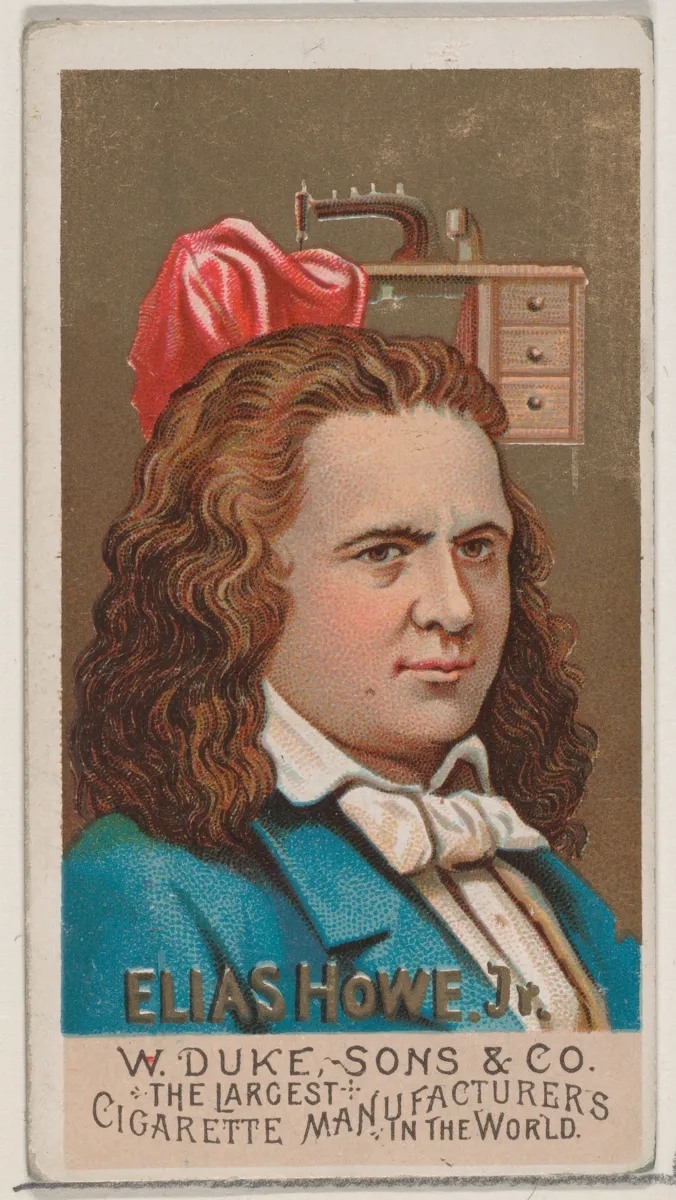
The lockstitch is the stitch on most household machines and on most single-needle industrial machines. Elias Howe's 1846 U.S. patent covered a lockstitch machine, as the portrait above, from an 1888 cigarette card series, commemorates.
What Is a Chain Stitch?
A chain stitch is made from loops. The needle pushes a loop of thread through the fabric, and a looper below holds it while the next loop is pushed through it, building a chain on the underside. A single-thread chain stitch uses just one thread. A multi-thread chain stitch (often called a double chain stitch) adds a looper thread underneath and is much more secure.
Side-by-Side Comparison
| Feature | Lockstitch | Chain Stitch |
|---|---|---|
| Threads | Two: needle and bobbin | One or more, using a looper instead of a bobbin |
| Appearance | Same on both sides when balanced | Straight line on top, loops underneath |
| Security | Does not unravel if one stitch breaks | Single-thread chain unravels easily from one end |
| Stretch | Limited when sewn straight | More elastic, especially multi-thread chain stitch |
| Thread supply | Limited by bobbin capacity | Fed from cones; no bobbin to change |
| Typical use | Home sewing, general seams, topstitching | Factory seams, jeans hems, basting, closing sacks |
The Weakness of the Single-Thread Chain
A single-thread chain stitch is not self-locking. If the thread breaks or is not tied at both ends, the whole length of stitching can come out with one pull. It is also easily ripped out, and the direction of sewing cannot change much from one stitch to the next. Those drawbacks are a big reason the lockstitch won the home market.
Where Chain Stitch Is Still Used
- Garment factories. Chain stitch is still used in clothing manufacture, usually combined with an overlock stitch along the same seam; the multi-thread chain stitch gives strength and some stretch, and machines fed from large cones of thread rarely stop.
- Jeans hems. Many jeans are hemmed with a chain stitch, which creates the twisted "roping" look many denim fans prize.
- Sergers and coverstitch machines. These machines use loopers to form looped stitches, closely related to chain stitch, for edges and hems.
- Basting. A temporary single-thread chain stitch is easy to pull out.
- Chain-stitch embroidery. Vintage-style chain-stitch embroidery machines make flowing decorative lines on jackets and patches.
How Stitches Are Classified
Industry standards group machine stitches into families. Plain stitches fall into four general categories: chainstitch, lockstitch, overlock and coverstitch. The ISO 4915:1991 standard recognizes more than three dozen distinct stitch formations, using from one to seven threads. The same three-digit numbering is used by the American standard ASTM D6193: single-thread chain stitches belong to class 100, lockstitches to class 300 and multi-thread chain stitches to class 400. That is why the straight lockstitch made by a standard home machine is called a "301" stitch in the garment industry.
Which Should You Use?
For home sewing, the question is mostly settled for you: your sewing machine makes a lockstitch, and it is the right choice for nearly every seam, zipper and topstitched detail. Chain stitch becomes relevant if you buy a serger or coverstitch machine, collect vintage single-thread machines, or want an authentic chain-stitched hem on jeans. To see where the rivalry between stitches began, read who invented the sewing machine.
Sources
- Sewing machine, Wikipedia
- Chain stitch, Wikipedia
- Elias Howe, Jr., from the series Great Americans, The Metropolitan Museum of Art
Frequently Asked Questions
What is the main difference between a lockstitch and a chain stitch?
A lockstitch interlocks two threads, a needle thread and a bobbin thread, at every needle hole. A chain stitch forms a series of loops, each pulled through the one before, from one thread or more, using a looper instead of a bobbin.
Why does chain stitch unravel?
A single-thread chain stitch is not self-locking. If the thread breaks or the end is not secured, pulling the loose end undoes every loop in turn.
Is chain stitch stronger than lockstitch?
A multi-thread chain stitch, as used in factories, is strong and more stretchy than a lockstitch. A single-thread chain stitch is weak because it unravels easily.
Why are jeans hemmed with a chain stitch?
Chain-stitched hems are fast to sew in a factory, and many denim fans prize the twisted, rippled 'roping' effect they create on the hem after washing.
Keep Reading
How a Sewing Machine Works
The lockstitch step by step: needle, hook, bobbin and feed dogs.
Who Invented the Sewing Machine?
Saint, Thimonnier, Hunt, Howe or Singer? The inventors and who deserves the credit.
The Sewing Machine War
How Howe and Singer's feud ended in America's first patent pool.
Feed Sack Dresses
How flour and feed bags became printed dress fabric for rural families.