Sewing Machine Needles: Sizes, Types and Color Codes Explained (2026)
The right needle is the cheapest fix in sewing. Match the size and point to your fabric and thread, and many skipped stitches, puckers and broken threads disappear. Here is how to read a needle packet.
In This Article
Needles in Brief
- Home machines use the 130/705 H needle system with a flat shank
- Size: a bigger number means a thicker needle; 90/14 is metric 90 and U.S. 14
- Type: point and eye shape match the fabric and thread
- Color bands: on SCHMETZ needles, the upper band shows type, the lower band size
- Change needles when stitches skip, thread shreds or the needle is bent
A sewing machine needle looks simple, but it is a precision part. Its shape guides thread through the fabric and creates the loop the hook needs to catch for every stitch. A needle that is too fine, too thick, dull or wrong for the fabric is behind many of the problems sewists blame on the machine. As SCHMETZ, the German needle maker, puts it, replacing the needle is the easiest way to improve stitch quality.
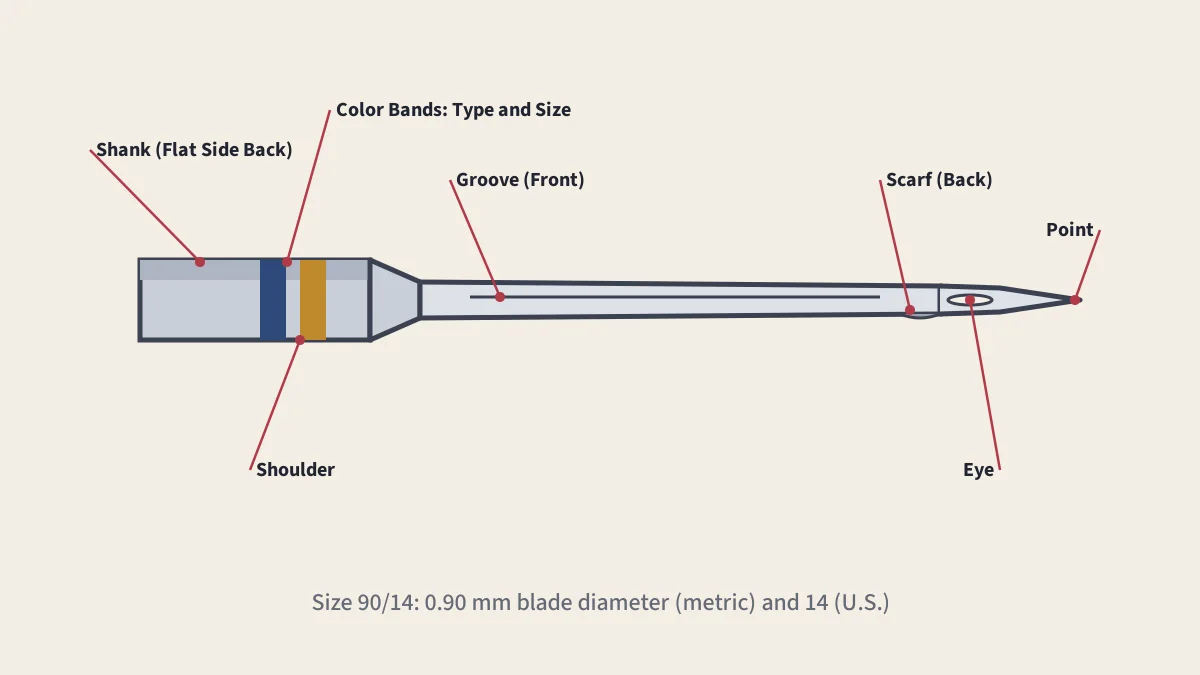
The Parts of a Machine Needle
| Part | What It Does |
|---|---|
| Shank | The thick top that fits into the machine. Household needles have a flat side; industrial needles have round or other shapes. |
| Shoulder | The taper between the shank and the blade. |
| Blade | The thin shaft; its diameter determines the needle size. |
| Groove | A channel down the front that guides the thread to the eye. |
| Scarf | An indentation above the eye, on the back, that lets the hook catch the thread loop. |
| Eye | The hole the thread passes through; its shape and size vary by needle type. |
| Point | The tip, shaped to pierce or slip between fibers depending on the fabric. |
How Needle Sizes Work
Needle packets show two numbers, such as 75/11 or 90/14. The first is the metric size, which is the blade diameter in hundredths of a millimeter: a size 75 needle is 0.75 mm thick. The second is the U.S. size for the same needle. In both systems, the higher the number, the thicker the needle.
| Size (Metric/U.S.) | Fabric Weight | Example Fabrics |
|---|---|---|
| 60/8, 65/9 | Very fine | Silk chiffon, organza, fine lace |
| 70/10 | Light | Lawn, voile, batiste, lightweight silks |
| 75/11 | Light to medium | Lightweight knits, shirting |
| 80/12 | Medium | Quilting cotton, poplin, linen blends |
| 90/14 | Medium to heavy | Twill, light denim, heavier linen, many home décor fabrics |
| 100/16 | Heavy | Denim, canvas, upholstery fabric |
| 110/18, 120/19 | Very heavy | Heavy canvas, multiple layers of denim, heavy upholstery |
Thread matters too: thicker thread needs a needle with a larger eye, which usually means a larger size or a topstitch needle.
Needle Types and Color Codes
SCHMETZ marks its needles with colored bands; the upper band indicates the needle type and the lower band the size. The color codes below are SCHMETZ's; other brands may use different markings.
| Type | SCHMETZ Color | Key Feature | Best For |
|---|---|---|---|
| Universal | Size band only | Slightly rounded point | Most woven fabrics and many knits |
| Jersey (ball point) | Orange | Medium ball point | Knits and some stretch fabrics |
| Stretch | Yellow | Ball point with special eye and scarf | Elastic materials and highly elastic knitwear |
| Microtex (sharp) | Purple | Very slim, acute point | Microfibers, silk, coated materials, precise topstitching |
| Quilting | Green | Tapered, slightly rounded point | Piecing and machine quilting |
| Jeans/Denim | Blue | Medium ball point, reinforced blade | Denim, thick woven fabrics, quilts |
| Leather | Brown | Cutting point | Leather and synthetic leather only (not for knits or wovens) |
| Embroidery | Red | Light ball point, wide eye and groove | Rayon, polyester and specialty embroidery threads |
| Metallic | Pink | Elongated eye | Metallic and other specialty threads |
| Topstitch | Light green | Elongated eye | Topstitching with heavy or textured threads |
| Hemstitch (wing) | Size band only | A wing on each side | Heirloom sewing and decorative holes in loosely woven fabric |
Twin and triple needles carry two or three needles on one shank, producing parallel rows of stitching, a common way to hem knits on a home machine.
Needle Systems: Will It Fit?
The needle system used by home sewing machines is 130/705 H; these needles have a flat shank and a scarf. The flat side of the shank usually faces the back of the machine, so the needle can only go in one way. Industrial machines, sergers and some specialty machines use different systems with round or otherwise shaped shanks, so check your manual before buying needles for them.
When to Change Your Needle
Needles wear out. Damaged or worn needles can cause broken or shredded thread, skipped or uneven stitches, puckered fabric and a popping sound as the needle enters the fabric. Change the needle:
- when any of those symptoms appear;
- after hitting a pin or the needle plate, even if it looks fine;
- when switching to a very different fabric, such as from cotton to knit or denim;
- at the start of a new project, a habit many sewists follow.
How to Change a Needle
- Turn off the machine and raise the needle to its highest position.
- Lower the presser foot, or place a scrap of fabric under it, so a dropped needle cannot fall into the machine.
- Loosen the needle clamp screw and remove the old needle.
- Insert the new needle with the flat side of the shank facing the direction your manual shows (usually the back), and push it all the way up.
- Tighten the clamp screw firmly and rethread the machine.
Sources
- Sewing machine needle, Wikipedia
Frequently Asked Questions
What do the two numbers on a sewing machine needle mean?
They are the same size in two systems. The first is the metric size, which gives the blade diameter in hundredths of a millimeter, so a size 90 needle is 0.90 mm thick. The second is the U.S. size. A 90/14 needle is therefore metric 90 and U.S. 14.
What needle size should I use for cotton?
A universal or sharp needle in size 80/12 suits most medium-weight cottons, including quilting cotton. Use 70/10 for lighter cottons and 90/14 for heavier ones.
What does 130/705 H mean?
It is the needle system used by home sewing machines. These needles have a flat shank and a scarf. The flat side faces the back of most machines, which makes the needle easy to insert correctly.
How often should I change my sewing machine needle?
Change it whenever you notice skipped stitches, snagged or shredded thread, puckering or a popping sound as the needle enters the fabric, or if it is bent. Many sewists also start each new project, or each heavy project, with a fresh needle.
Keep Reading
Parts of a Sewing Machine
A labeled diagram and what every part of the machine does.
Common Sewing Machine Problems
Thread nests, skipped stitches, broken needles and feeding faults fixed.
Stitch Length and Tension Explained
What the dials mean, common settings, and how to balance tension.
History of the Sewing Needle
From Denisovan bird bone to Redditch steel, the tool behind every stitch.