Sewing Machine Bobbin Types: Class 15, 66, L and M Compared (2026)
Bobbins look almost identical, but a fraction of a millimeter can ruin your stitches. Here is how to tell the common bobbin classes apart and find the one your machine needs.
In This Article
Bobbin Types in Brief
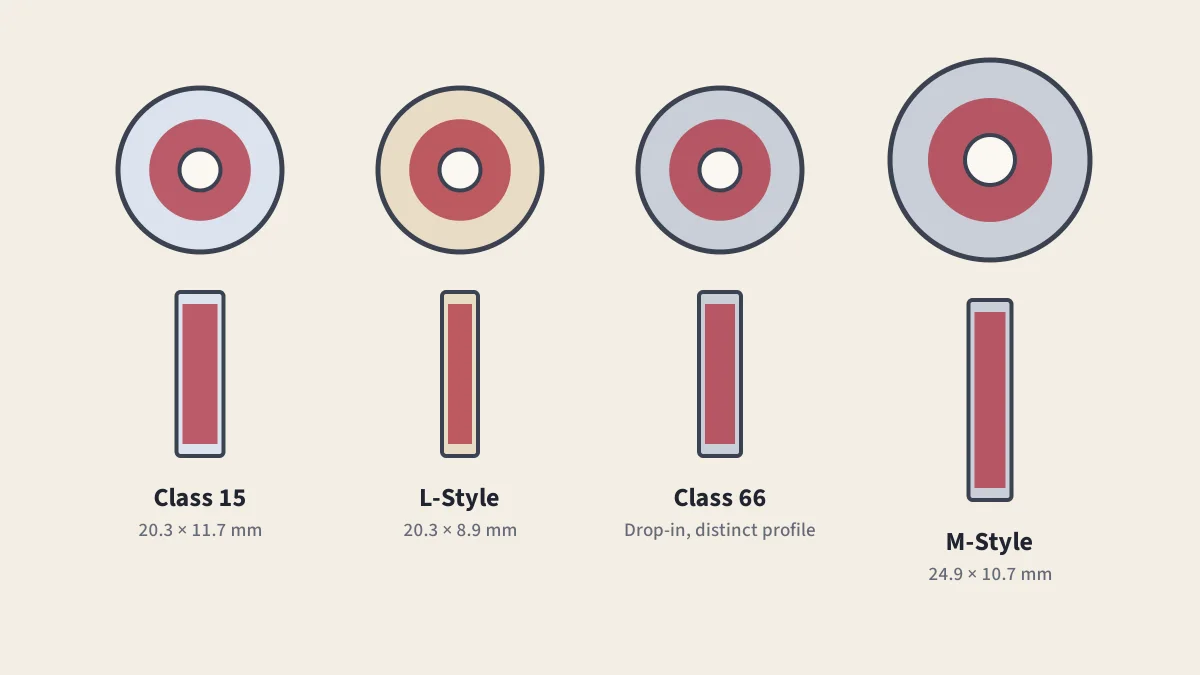
- Class 15 (A-style): the most common home bobbin, about 20.3 × 11.7 mm
- Class 15J: same size but slightly curved sides; not a substitute
- L-style: same diameter, narrower, about 8.9 mm wide
- Class 66: used in many Singer drop-in machines and vintage models
- M-style: larger, about 24.9 mm, for longarm and industrial machines
There are dozens of bobbin styles in the sewing world, but nearly all home sewing machines use one of a handful of classes. Because they look so similar, using the wrong one is one of the easiest mistakes to make, and one of the most confusing, since the machine may still sew, just badly. Even a small difference in height or profile changes how the bobbin spins and how much tension the thread gets.
The Main Bobbin Classes
| Class | Approx. Diameter | Approx. Width | Typical Machines |
|---|---|---|---|
| Class 15 (A-style) | 20.3–20.6 mm | 11.1–11.7 mm | Most modern home machines from many brands |
| Class 15J | Similar to Class 15 | Similar to Class 15 | Some machines that specify 15J; sides are slightly curved |
| L-style | 20.3 mm | 8.9 mm | Some computerized and multi-needle embroidery machines; some industrial machines |
| Class 66 | Similar to Class 15 | Differs in height and profile | Older Singer machines and many Singer drop-in models |
| M-style | 24.9 mm | 10.7 mm | Longarm quilting and commercial machines |
Measurements vary slightly between manufacturers and sources. Always check your manual.
Class 15 (A-Style)
The Class 15 bobbin is about the size of a U.S. nickel, about 20.3 mm across and 11.7 mm wide, with two flat sides. It is available in plastic and metal and is the most widely used bobbin in home and computerized machines. It is the standard bobbin for most current machines from brands such as Brother, Baby Lock, Juki, Janome, Elna, Bernette and Singer. Its name comes from the Singer 15, whose bobbin and case design was widely copied.
Class 15J
Class 15J looks almost exactly like Class 15, but its sides curve very slightly. The curve is barely visible, but it is enough to affect performance, so a 15J should not be used in a machine designed for Class 15, and standard Class 15 bobbins can jam in a machine designed for 15J.
L-Style
L-style bobbins share the Class 15 diameter but are noticeably slimmer, about 8.9 mm wide. They hold less thread as a result. Sources disagree on whether an L-style bobbin works in a Class 15 machine: some say it can, others say the height difference makes them incompatible. Everyone agrees on the reverse: a Class 15 bobbin is too wide to fit an L-style machine.
Class 66
Class 66 bobbins take their name from the Singer 66 of 1902 and are common in older Singer machines, while most current Singer models use Class 15. Class 66 bobbins are designed for drop-in (horizontal) bobbin systems, so you do not remove a bobbin case to change them. Class 15 and Class 66 are the pair most often confused, and they are not drop-in replacements for each other: a Class 66 may wobble in a Class 15 case, while a Class 15 can sit too high in a Class 66 case.
M-Style
M-style bobbins are the big ones, about the size of a U.S. quarter at roughly 24.9 mm across. They hold far more thread, which is why they are standard on longarm quilting machines such as those from A-1, Gammill and Handi Quilter, as well as many commercial machines. Never try to fit one into a machine designed for smaller bobbins.
How to Identify Your Bobbin
- Check the manual. It names the bobbin class or part number.
- Look up the model. Manufacturers and dealers list the bobbin for each model online.
- Measure an original bobbin. Use calipers to measure diameter and height in millimeters, and compare them with the table above.
- Check the shape. Look for flat or curved sides and the size of the center hole.
- Test the fit. A correct bobbin sits flush in the case or hook area and turns freely without wobbling.
Metal or Plastic?
Bobbins come in plastic, metal (often steel or aluminum) and specialty versions such as prewound bobbins with magnetic cores. The right material is the one your manufacturer specifies. Some machines are designed for plastic bobbins and may sew poorly or confuse bobbin sensors with metal ones; others, including many vintage machines, need metal. Do not mix materials within one machine just because the size matches.
How Much Thread Each Holds
| Bobbin | Thread Wound on a Home Machine (Superior Threads test) |
|---|---|
| Class 15 | About 83 yards |
| L-style | About 66 yards |
| M-style | About 125 yards |
Results depend on the thread weight and how tightly the bobbin is wound. Factory-wound prewound bobbins hold considerably more. Our guide to winding a bobbin explains how to wind them evenly.
Signs You Are Using the Wrong Bobbin
- The bobbin wobbles, rattles or sits higher than the case rim.
- Stitches are loose, loopy or inconsistent underneath even after rethreading.
- The thread jams or nests in the bobbin area.
- The bobbin cover will not sit flat.
If you see these signs, compare your bobbin with an original or the manual before adjusting tension. For other causes, see common sewing machine problems.
Sources
- Bobbin, Wikipedia
- Sewing machine, Wikipedia
Frequently Asked Questions
What is the most common bobbin size?
Class 15, also called A-style, is the most widely used bobbin in home sewing machines. It is about 20.3 mm across and about 11.7 mm wide, roughly the size of a U.S. nickel, with two flat sides.
Are Class 15 and Class 66 bobbins interchangeable?
No. They look similar, but their height and profile differ. A Class 66 bobbin can wobble in a machine built for Class 15, and a Class 15 bobbin can sit too high in a Class 66 machine. Both cause poor stitches.
Can I use an L-style bobbin in a Class 15 machine?
L-style bobbins have the same diameter as Class 15 but are narrower, and some sources say they will work in a Class 15 machine. The reverse never works: a Class 15 bobbin is too wide for an L-style machine. Your manual is the safest guide.
Should I use metal or plastic bobbins?
Use the material your machine's manufacturer specifies. Some machines are designed for plastic bobbins and their sensors or tension can be affected by metal, while others, including many vintage machines, need metal.
Keep Reading
How to Wind a Bobbin
Steps for modern and vintage machines, plus fixes for lumpy bobbins.
How to Thread a Sewing Machine
The thread path step by step, plus the habits that prevent tangles.
Parts of a Sewing Machine
A labeled diagram and what every part of the machine does.
Common Sewing Machine Problems
Thread nests, skipped stitches, broken needles and feeding faults fixed.