Rotary Cutters and Cutting Mats: How the Quilter's Toolkit Works (2026)
A rotary cutter looks like a pizza wheel and cuts like a scalpel. With a mat and a ruler, it slices clean, straight strips through several layers at once, and it changed quilting when it arrived in 1979.
In This Article
Rotary Cutting in Brief
- Invented: by OLFA, 1979
- Blade: a sharp circular blade that rolls through fabric
- Mat: protects the table and blade, with a printed grid
- Ruler: thick clear acrylic guides the blade
- Best for: straight strips, squares and several layers at once
For centuries, fabric was cut with shears. In 1979 a new tool appeared that worked more like a pizza wheel. The rotary cutter rolls a circular blade along the edge of a ruler, slicing through fabric laid flat on a protective mat. It is now an everyday tool for quilters and many garment sewists.
A Japanese Invention
The rotary cutter was invented by the Japanese company OLFA, founded in Osaka in 1956 by Yoshio Okada. Okada had already invented the snap-off blade, the segmented utility knife blade that breaks off to reveal a fresh edge. The company's name comes from the Japanese words for "bend and break" and "blade." OLFA introduced the first rotary cutter in 1979, originally for garment making. Quilters adopted it quickly.
How the System Works
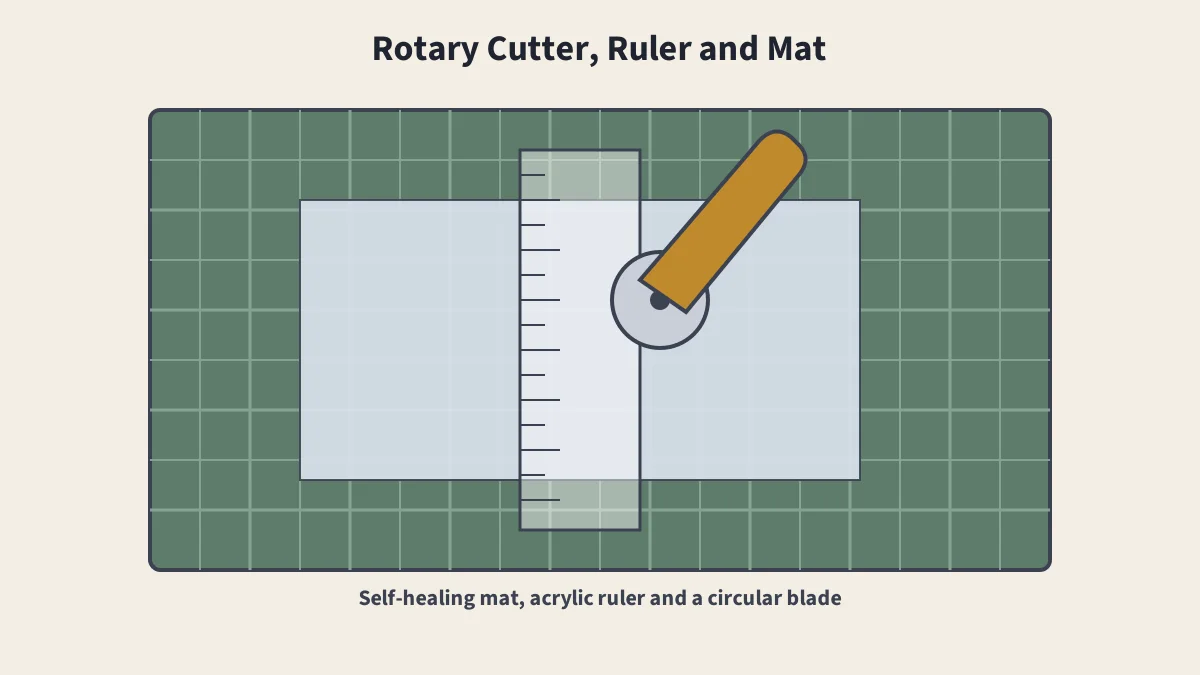
- The mat lies on the table. The blade cuts against it without damaging the table or dulling instantly.
- The fabric lies flat on the mat, often folded or layered.
- The ruler, made of thick clear plastic, sits on top of the fabric at the measurement you want.
- The cutter runs along the ruler's edge, cutting a perfectly straight line.
Because fabric stays flat and the ruler guides the blade, rotary cutting is faster and often more accurate than shears for straight lines. For curves and pattern pieces, many sewists still prefer shears; see types of scissors.
Blade Sizes
Rotary blades come in several diameters. Smaller blades suit small curves and detailed cutting; larger blades suit straight lines, broad curves and cutting through more layers. A medium blade is the usual first choice.
Cutting Mats
Cutting mats are usually made of plastics such as vinyl, and many are marketed as "self-healing," meaning cuts close up after the blade passes, though Wikipedia notes that this claim is not well documented. Most mats are printed with grid lines, often every 5 or 10 mm or in inches, which help with placing and measuring fabric.
| Do | Avoid |
|---|---|
| Store the mat flat | Rolling or bending it, which can warp it |
| Keep it out of direct sun | Hot cars, irons and radiators |
| Cut in different areas | Always cutting on the same grid line |
Rulers
Quilting rulers are thick, clear plastic, so you can see the fabric through them and run the blade along the edge without riding up onto the ruler. They are printed with grids and angle lines for cutting strips, squares and triangles; see measuring tools.
Safe Rotary Cutting
- Close the blade guard every time you put the cutter down. Most cutters have a retractable blade that locks.
- Cut away from your body, and keep your fingers well back from the ruler's edge.
- Stand up to cut long strips, so you can press evenly.
- Change dull blades. A dull blade skips threads and tempts you to press harder.
- Store cutters out of children's reach.
Rotary cutting is at the heart of modern quilting, alongside longarm quilting machines.
Sources
- Rotary cutter, Wikipedia
- OLFA, Wikipedia
- Cutting mat, Wikipedia
Frequently Asked Questions
Who invented the rotary cutter?
The Japanese company OLFA introduced the first rotary cutter in 1979. Its founder, Yoshio Okada, had earlier invented the snap-off blade utility knife in 1956.
Do I need a cutting mat with a rotary cutter?
Yes. The blade must cut against a surface that protects both the table and the blade. Cutting mats are made for this and are usually printed with a measuring grid.
What size rotary cutter should I buy?
Smaller blades suit small curves and detailed cutting, while larger blades suit straight lines and broad curves. A medium blade is the usual all-purpose choice.
How do I store a cutting mat?
Flat, and away from heat and direct sunlight. Cutting mats are generally not heat resistant, and a mat stored bent can warp so it no longer lies flat.
Keep Reading
Scissors and Shears
Shears, pinking shears, embroidery scissors and snips compared.
Measuring Tools
Tape measures, gauges, quilting rulers and curves explained.
Longarm Quilting Machines
Frames, throat space, stitch regulation and computerized quilting.
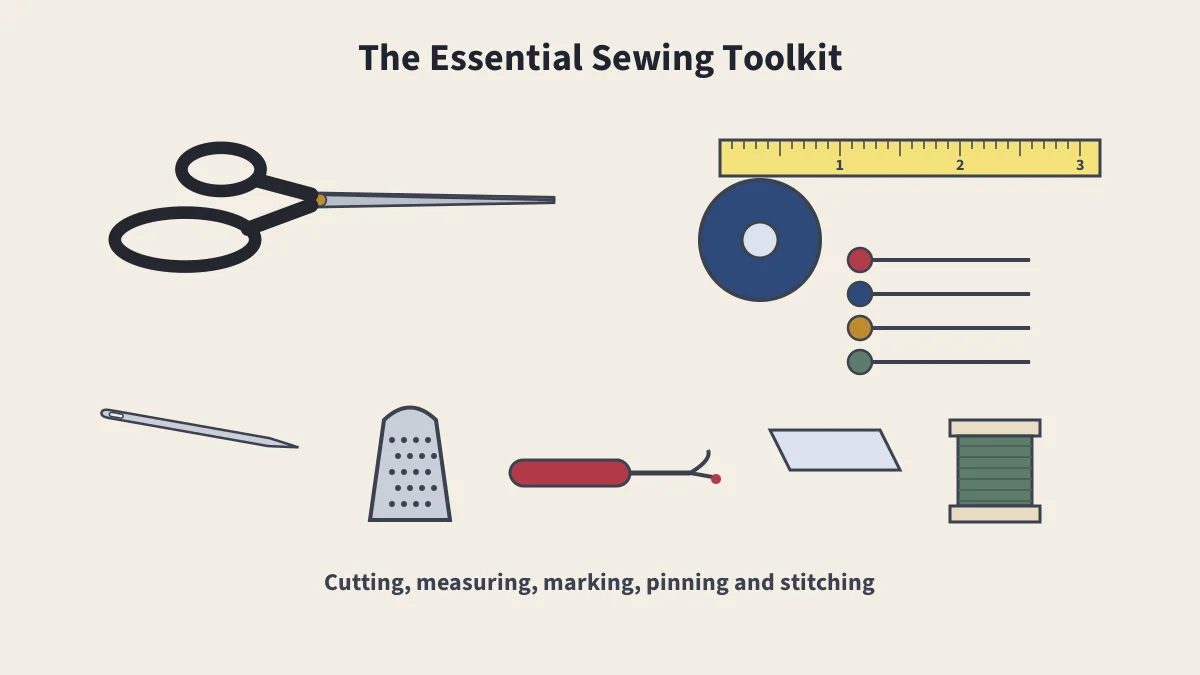
Sewing Tools and Notions
The core sewing toolkit, from needles and pins to cutters and rulers.