Buttons: Types, Sizes and a 4,000-Year History (2026)
Buttons began as ornaments thousands of years before anyone sewed a buttonhole. Today they come in a handful of basic types, measured in an old unit called the ligne. Here is how to tell them apart and choose the right one.
In This Article
Buttons in Brief
- Earliest buttons: shell ornaments in the Indus Valley by 2000 BC
- First buttonholes: 13th-century Germany
- Main types: sew-through, shank, toggle, covered, stud
- Sizing: lignes; 40 lignes = 1 inch
- Common materials today: plastic, shell, metal and wood
Buttons are so ordinary that their history is easy to overlook. They began as decorations, became fasteners in the Middle Ages, and are now made by the billion in every shape and material. Choosing the right button affects how a garment looks, how it closes and how long it lasts.
From Ornament to Fastener
Seashell buttons were used for ornament in the Indus Valley Civilization by 2000 BC; an early example comes from Mohenjo-daro. For a long time, buttons were more ornament than fastening. Before buttonholes, clothing edges were simply brought together and held with toggles, belts or lacings. Buttonholes for fastening clothing first appeared in 13th-century Germany, and buttons and buttonholes then spread across Europe.
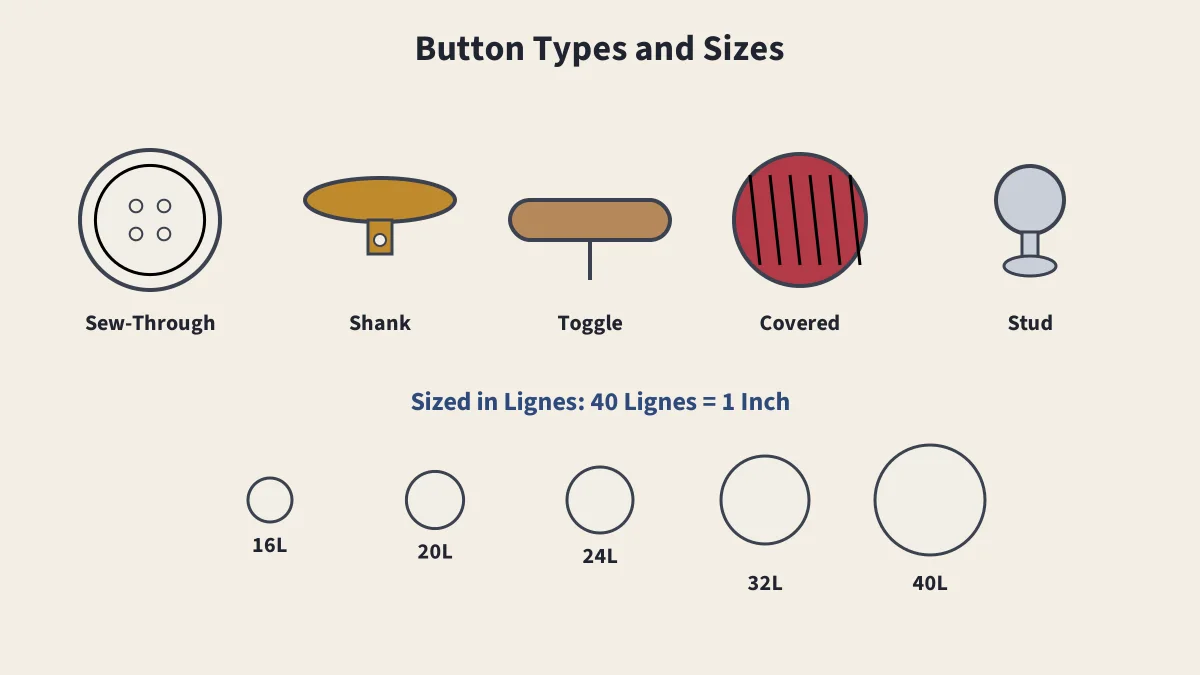
Types of Buttons
| Type | Description | Best For |
|---|---|---|
| Sew-through (flat) | Two or four holes through the button | Shirts, blouses and most everyday garments |
| Shank | A loop or hollow protrusion on the back | Coats, jackets and thick fabrics; raised or decorative buttons |
| Toggle | Stick-shaped, passed endways through a loop | Duffle coats and casual outerwear |
| Covered | Fabric stretched over a form and held by a back | Matching buttons on dresses and bridal wear |
| Stud | A button and counterpart joined by a bar, pushed through holes | Dress shirts and formal wear |
| Snap (press stud) | Metal discs pressed together | See closures |
Button Sizes: Lignes
Buttons are measured in lignes, a unit used by the button trade, with 40 lignes to the inch. A standard men's shirt button is about 16 lignes (roughly 10 mm), while suit jackets typically use buttons of about 32 lignes (roughly 20 mm). Patterns usually state the button size needed, and buttonholes are sized to match.
| Lignes | Approx. Diameter | Typical Use |
|---|---|---|
| 16L | 10 mm | Shirt buttons |
| 24L | 15 mm | Shirt cuffs, cardigans, sleeve buttons |
| 32L | 20 mm | Suit jackets |
| 40L | 25 mm | Coats |
Diameters follow from 40 lignes = 1 inch (25.4 mm); typical uses vary with style.
Materials
Buttons have been made from shell, bone, horn, metal, wood, glass and many other substances. Today, hard plastic, seashell, metal and wood are the most common. Natural materials such as shell and horn are prized for their luster and variety, while plastic is cheap and consistent.
Which Side?
Men's garments usually button with the right side over the left, and women's with the left over the right. Nobody knows for sure why. One theory links men's buttons to drawing a weapon without it catching, another links women's buttons to right-handed servants who dressed their employers, and some Jewish communities reverse the convention for religious reasons. None of these explanations is confirmed.
Sewing Buttons On
Strong thread, a thread shank and a backing button on heavy fabrics make buttons last. For step-by-step instructions, see how to sew on buttons and snaps, and for buttonholes, see types of buttonholes.
For where buttons sit on a shirt, see types of plackets and types of cuffs.
Sources
- Button, Wikipedia
Frequently Asked Questions
What are the main types of buttons?
Sew-through (flat) buttons with two or four holes; shank buttons with a loop or protrusion on the back; toggles, which pass endways through a loop; covered buttons with fabric over a form; and studs, which are pushed through holes on both sides.
How are button sizes measured?
In lignes (often written L). Forty lignes equal one inch. A standard men's shirt button is about 16 lignes (around 10 mm), and suit jacket buttons are typically about 32 lignes (around 20 mm).
Why are buttons on different sides for men and women?
No one knows for certain. Popular theories say men's right-side buttons suited drawing a weapon, and women's left-side buttons suited right-handed servants who dressed their employers. None of these explanations is confirmed.
When were buttonholes invented?
Buttons were used as ornaments for thousands of years, but buttonholes for fastening clothing first appeared in 13th-century Germany, according to Wikipedia.
Keep Reading
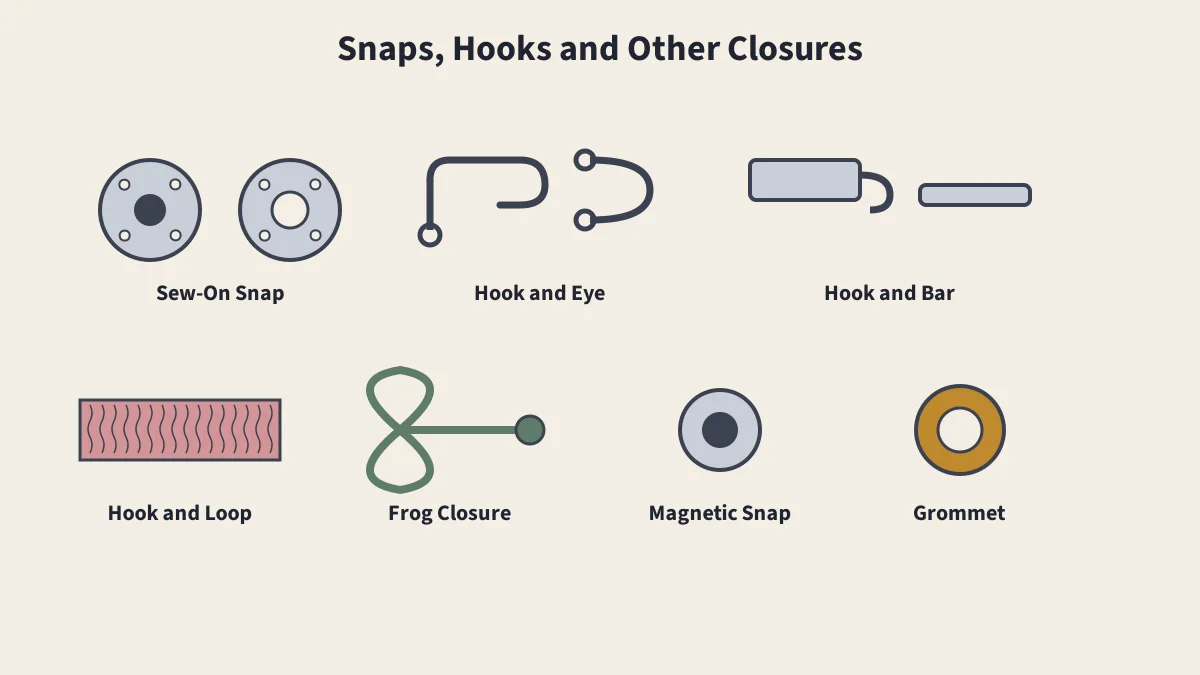
Snaps, Hooks and Closures
Snaps, hooks and eyes, hook and bar, frogs, magnets and grommets.
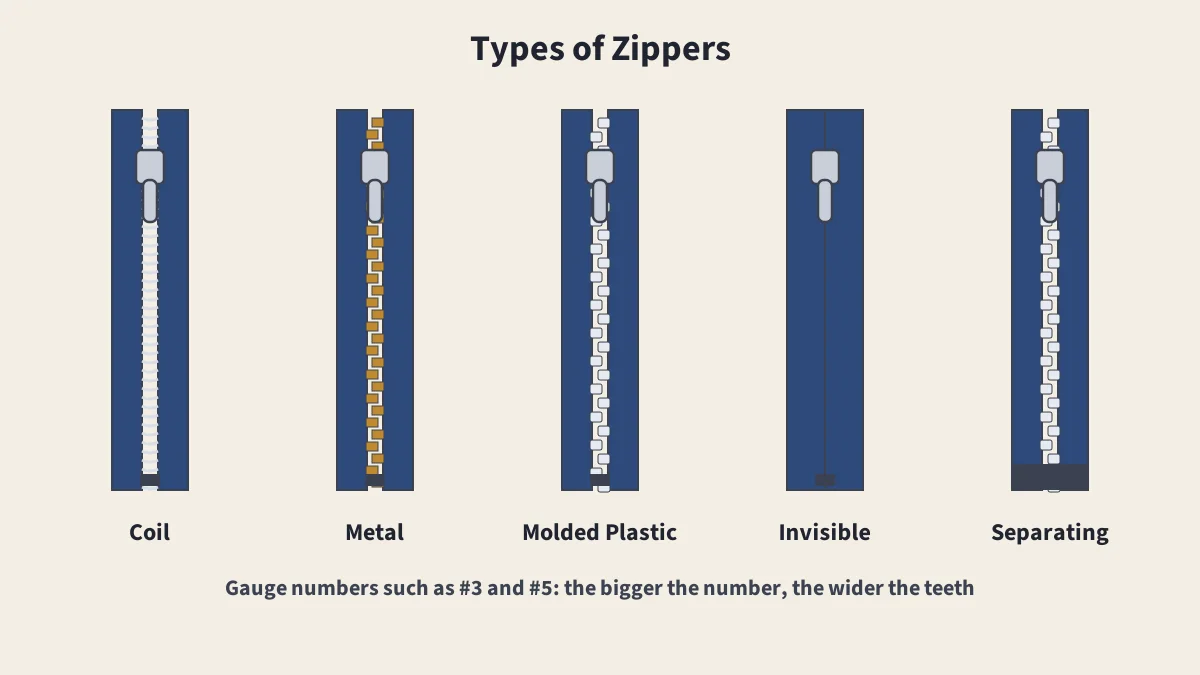
Types of Zippers
Coil, metal, plastic, invisible and separating zippers compared.
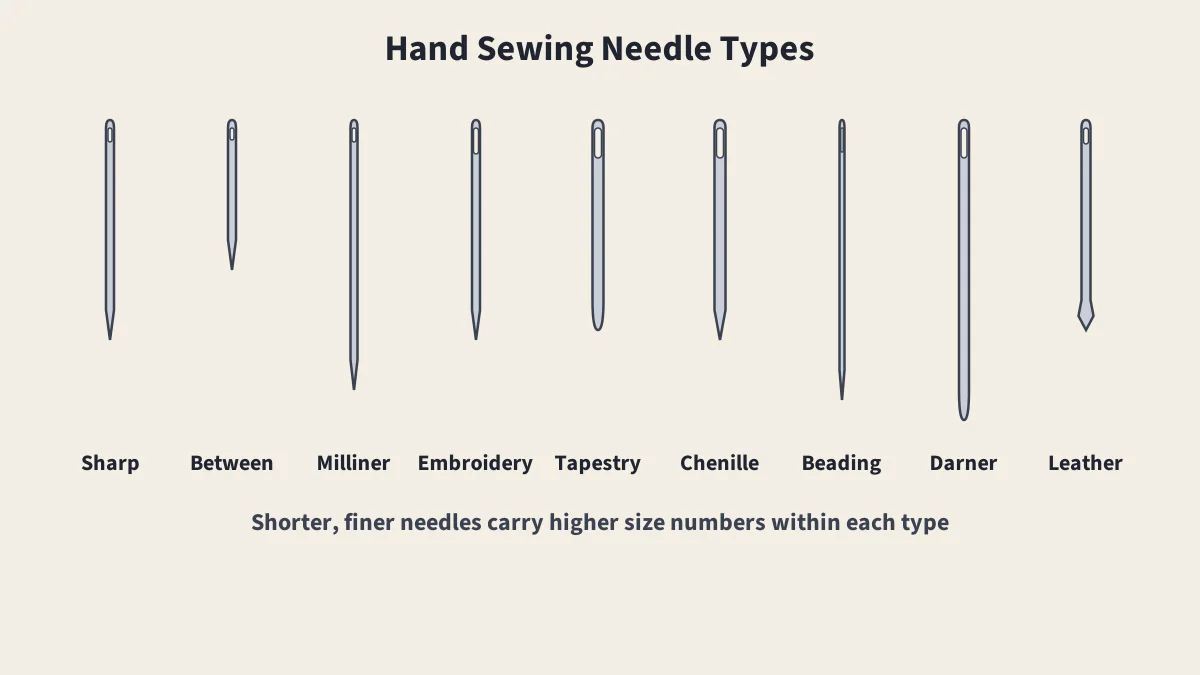
Hand Sewing Needle Types
Every common hand needle type, what it is for and how sizes work.
History of Snaps, Hooks and Velcro
Medieval hooks and eyes, 1880s snaps, and Velcro's burr-covered origins.