Embroidery Stabilizers: Which Backing for Which Fabric (2026)
Thousands of stitches packed into a small area will pull, pucker and distort fabric unless something holds it steady. That something is a stabilizer, and choosing the right one is half the secret of clean machine embroidery.
In This Article
Stabilizers in Brief
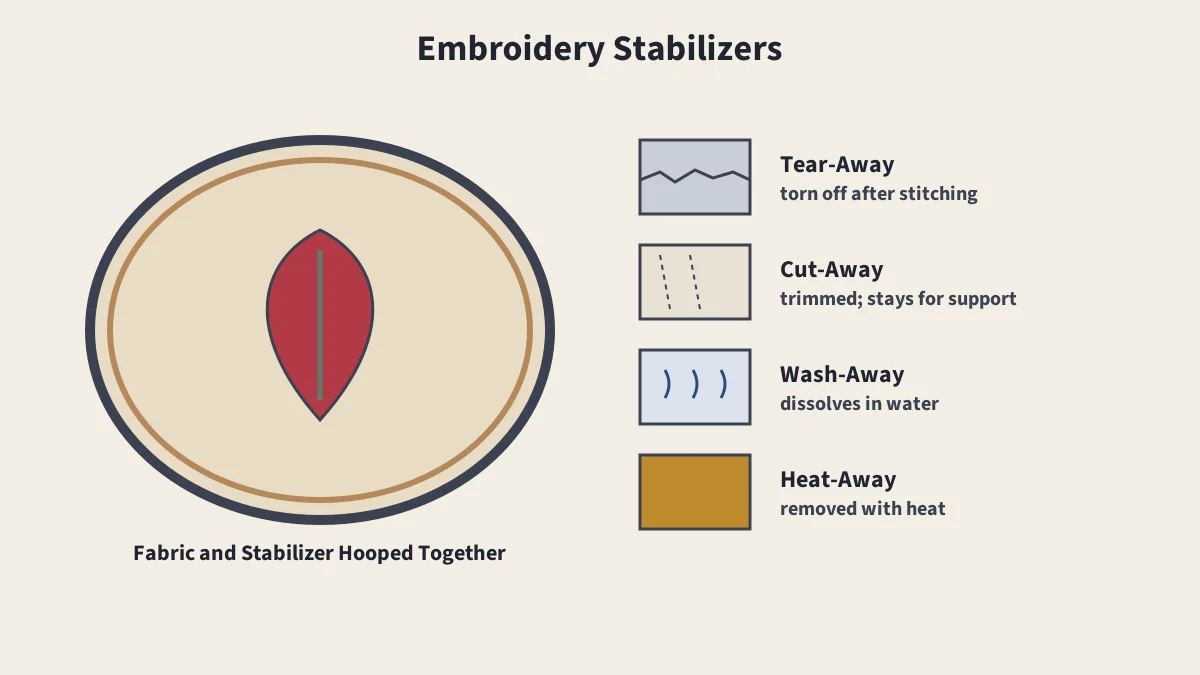
- Tear-away: for stable wovens; torn off after stitching
- Cut-away: for knits and dense designs; trimmed and left in
- Wash-away: dissolves in water; for lace and sheers
- Heat-away: removed with heat; for fabrics that cannot get wet
- Topping: keeps stitches on top of pile fabrics
Machine embroidery packs a great many stitches into a small area. Each one pulls on the fabric a little, and together they can pucker it, stretch it or let the design shift out of line. A stabilizer is a backing that supports the fabric while it is stitched. Wikipedia lists stabilizer choice among the main factors that affect the final result, alongside the fabric, the design size and the thread. For how the machines themselves work, see how embroidery machines work.
The Four Main Types
| Type | Removal | Best For |
|---|---|---|
| Tear-away | Torn away from the stitches | Stable wovens such as cotton, denim and canvas; lighter designs |
| Cut-away | Trimmed around the design; the rest stays | Knits, sweatshirts and other stretchy or unstable fabrics; dense designs |
| Wash-away (water-soluble) | Dissolved in water | Freestanding lace, sheers and projects where no backing should remain |
| Heat-away | Removed with heat from an iron | Fabrics that cannot be washed but need a temporary backing |
Tear-Away
Tear-away stabilizer supports the fabric during stitching, then tears off cleanly, leaving little behind. It suits fabrics that are already stable, because once the backing is gone, the stitches depend on the fabric alone.
Cut-Away
Cut-away stabilizer is trimmed close to the design, and the rest stays in the finished piece permanently. That ongoing support matters on knits, which stretch with every wearing and washing; without it, the design can distort over time.
Wash-Away and Heat-Away
Wash-away stabilizers are films or fabrics that dissolve in water, leaving no trace. Heat-away types are removed by heat instead, for fabrics that should not get wet. Both are used when any remaining backing would show, as on sheers or lace.
Toppings
On towels, fleece, velvet and other textured fabrics, stitches can sink into the pile and disappear. A thin topping, usually a water-soluble film, is laid on top of the fabric before stitching to hold the stitches up. The excess is torn or washed away afterward.
Hooping With a Stabilizer
- Choose the stabilizer for the fabric and the design density.
- Hoop the fabric and stabilizer together so they are taut but not stretched; some fabrics are instead "floated" on top of hooped stabilizer.
- Stitch the design.
- Unhoop, then tear, trim, wash or heat away the excess stabilizer and trim loose threads.
Stabilizer or Interfacing?
The two can look similar, but they do different jobs. Interfacing is built into a garment to give it shape and structure; see interfacing types. Stabilizer is mainly a support for stitching, and much of it is removed afterward. For embroidery thread, see types of thread.
For the main families of embroidery, see types of embroidery.
Sources
- Machine embroidery, Wikipedia
Frequently Asked Questions
What does an embroidery stabilizer do?
It supports the fabric while it is stitched, so dense embroidery does not pull, pucker or distort it. The stabilizer is hooped with the fabric or placed beneath it, then removed or trimmed after stitching.
When should I use cut-away stabilizer?
Use cut-away on knits and other stretchy or unstable fabrics, and for dense designs. It stays in the finished piece and keeps supporting the stitches through wear and washing.
When should I use tear-away stabilizer?
Use tear-away on stable woven fabrics such as cotton, denim and canvas, especially for lighter designs. After stitching, the excess is torn away from the design.
What is a topping in embroidery?
A topping is a thin, usually water-soluble film placed on top of textured fabrics such as towels, fleece and velvet. It keeps stitches from sinking into the pile, and the excess is torn or washed away afterward.
Keep Reading
How Embroidery Machines Work
Hoops, digitizing, stabilizers and embroidery file formats explained.
Interfacing Types
Fusible vs. sew-in, woven vs. nonwoven vs. knit, and how to apply it.
Types of Thread
Thread fibers, uses, and weight, tex and denier explained.
Decorative Stitches
Machine and hand decorative stitches, and how to use them well.