Sewing Trims: Piping, Rickrack, Ribbon and Lace Explained (2026)
Trims are the finishing touch: a line of piping on a cushion, a zigzag of rickrack on an apron, a lace edge on a slip. Each has its own construction, uses and history.
In This Article
Trims in Brief
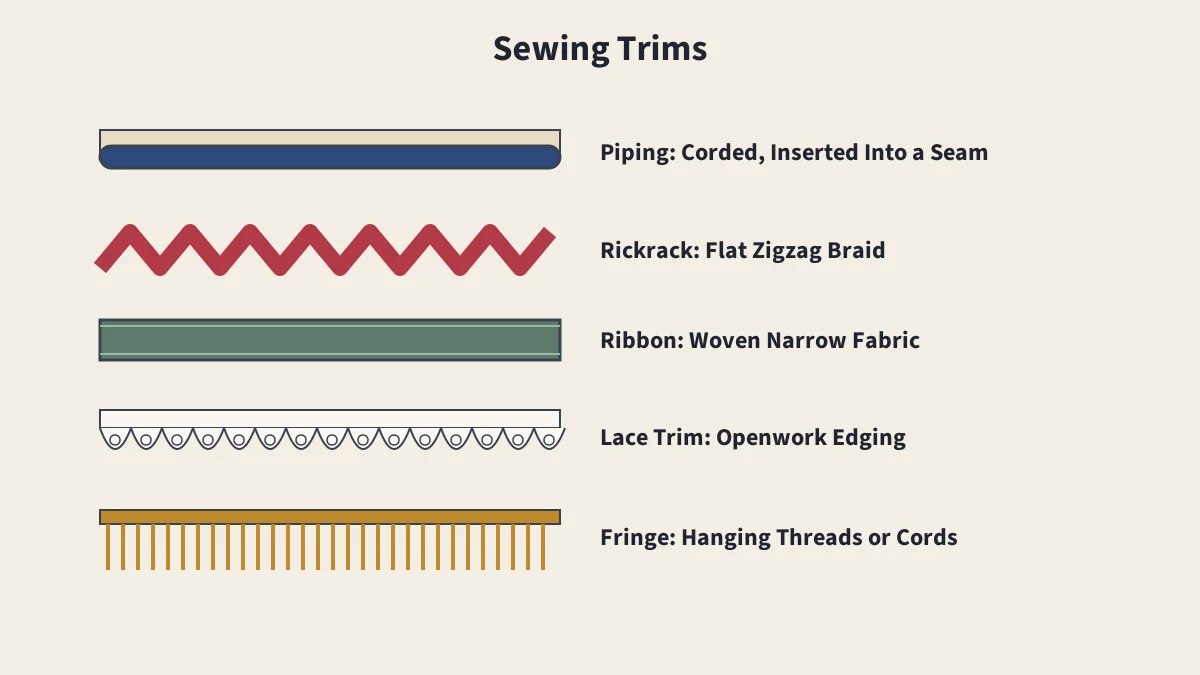
- Piping: corded fabric strip set into a seam
- Rickrack: flat zigzag braid
- Ribbon: narrow woven fabric with finished edges
- Lace trim: openwork edging or insertion
- Fringe: hanging threads, cords or beads
A trim is a decorative strip added to a garment or home furnishing. Trims emphasize edges and seams, add color and texture, and can hide or finish raw edges. Most are sold by the meter or yard and are stitched on by machine or by hand.
Piping
Piping is made from a strip of folded fabric that forms a narrow "pipe" inserted into a seam, outlining the edges or style lines of a garment or textile item. It is usually cut on the bias so it bends around curves, and it is often wrapped around a cord to make it round and firm; see bias tape. It can be made from matching or contrasting fabric, or from leather.
Piping is common on upholstery, bags and decorative pillows. In clothing, piped pocket openings, edges and seams are characteristic of Western wear.
Rickrack
Rickrack is a flat braided trim shaped like a zigzag. It was invented in the mid-19th century; in the 1860s it was called waved crochet braid or waved lacet braid, and it took its modern form and name around 1880. Its popularity came in waves:
| Period | Rickrack's Story |
|---|---|
| 1890s | American home sewists use rickrack imported from Europe |
| 1910s | A revival as American manufacturers begin supplying it |
| 1930s–1950s | Decorates feed sack dresses in rural America |
| 1970s | Peak popularity |
Rickrack once also served a practical purpose, finishing fabric edges before sewing machines and overlockers were common. See our story of feed sack dresses.
Ribbon
Ribbon is a narrow strip of woven fabric with finished edges, so it does not fray. Grosgrain has a ribbed texture and is sturdy; satin is smooth and shiny; velvet has a soft pile; and wire-edged ribbon holds a shape for bows. Ribbon is used for ties, trims, hanging loops and ribbon embroidery.
Lace Trim
Lace is an openwork fabric of looped, twisted or knotted threads. As a trim it comes as edging, with one scalloped edge, for hems and necklines; as insertion, with two straight edges, set between two pieces of fabric; and as appliqués, individual motifs stitched on top. Lace trims decorate lingerie, bridal wear and household linens.
Fringe, Pom-Poms and Braid
- Fringe: hanging threads, cords or beads along a heading tape, used on lampshades, cushions, Western wear and costumes.
- Pom-pom trim: small yarn balls along a tape.
- Braid and gimp: flat or corded decorative braids used on upholstery and uniforms.
How to Attach Trims
- Pre-wash trims if the garment will be washed, to avoid shrinking or color bleeding.
- Insert piping between two fabric layers, raw edges aligned, and stitch close to the cord with a zipper or piping foot.
- Stitch rickrack down its center, or tuck half of it into a seam so only the curves show.
- Ease trims around corners rather than stretching them.
For how lace itself is made, see types of lace.
Sources
- Piping (sewing), Wikipedia
- Rickrack, Wikipedia
- Lace, Wikipedia
Frequently Asked Questions
What is piping in sewing?
Piping is a trim made from a strip of folded fabric, usually cut on the bias and often wrapped around a cord, inserted into a seam so it forms a narrow 'pipe' along the edge. It outlines cushions, upholstery, bags and garment seams.
What is rickrack?
Rickrack is a flat, braided trim shaped like a zigzag. It was invented in the mid-19th century, reached its modern form and name around 1880, and is used decoratively on clothing, aprons and curtains.
When was rickrack popular?
Rickrack had several waves of popularity: in the 1890s, again from the 1910s, on feed sack dresses in rural America from the 1930s to 1950s, and at a peak in the 1970s.
Why do cassocks have colored piping?
In Western Christian clergy dress, colored piping on a black cassock can indicate rank. In the Roman Catholic Church, for example, scarlet piping is used for cardinals and amaranth red for bishops.
Keep Reading
Bias Tape and Binding
Single-fold vs. double-fold bias tape, and how to use binding.
Feed Sack Dresses
How flour and feed bags became printed dress fabric for rural families.
Decorative Stitches
Machine and hand decorative stitches, and how to use them well.
Buttons
Button types, ligne sizes, materials and history.