Singer Serial Numbers: How to Date a Vintage Singer (2026)
A Singer serial number can tell you roughly when your machine was made, which model it is and sometimes which factory built it. But the date it gives is not quite what most people think. Here is how to read one.
In This Article
Serial Numbers in Brief
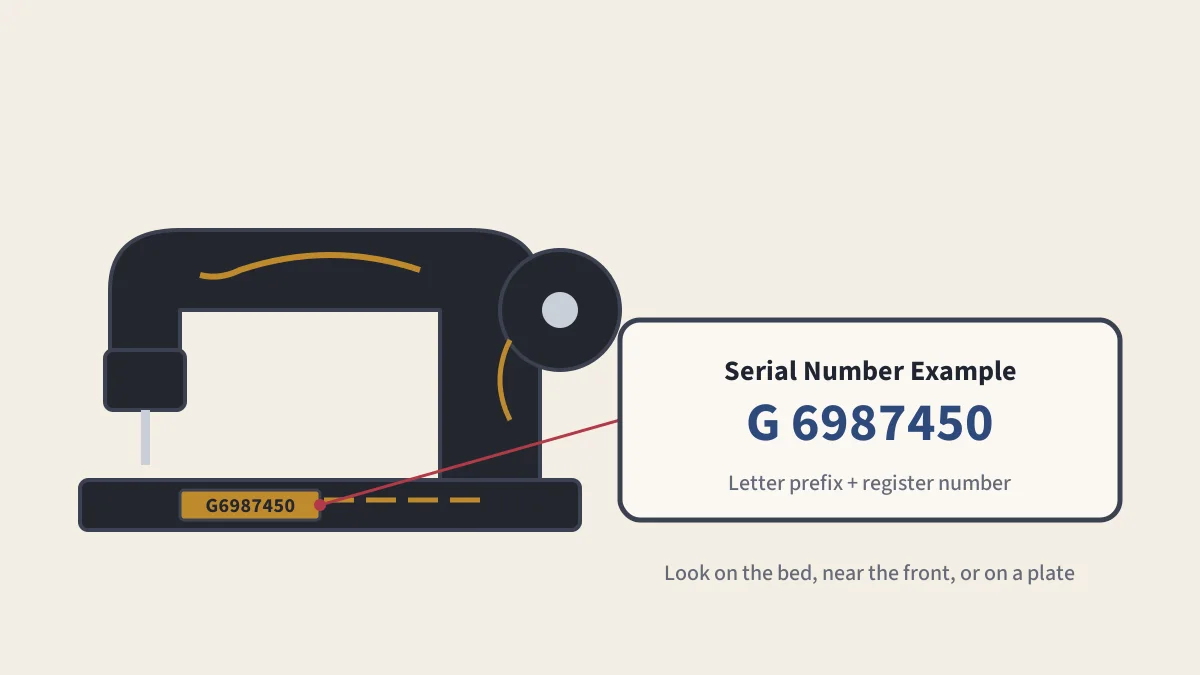
- Location: usually stamped on the bed, front right
- Before 1900: numbers only, no letter prefix
- From 1900: a letter prefix, later two letters
- Model suffix: a letter after the model number shows the factory (K = Kilbowie)
- The date: an allotment date, not the exact day the machine was made
Singer made more sewing machines than any other company, in factories on several continents, and it kept records of the serial numbers it issued. That makes Singers easier to date than most vintage machines. Collectors have compiled Singer's records into tables, most notably those published by the International Sewing Machine Collectors' Society (ISMACS), which match ranges of serial numbers to models, quantities and dates.
Where to Find the Serial Number
On most Singer machines, the serial number is stamped into the bed of the machine, usually near the front on the right-hand side, close to the pillar. On some later machines it appears on a small plate. Look carefully: it may be worn, painted over or hidden by dirt, and a soft cloth with a little sewing machine oil can help reveal it.
How Singer Serial Numbers Work
Before 1900: Numbers Only
Singer machines made before 1900 have no letter prefix. Many early machines have two numbers: a large "register" number and a smaller "factory" number. On the Singer New Family (class 12), for example, the register numbers ran in sequence across both Elizabethport and Kilbowie, while the lower factory number was a running total of that class made at each factory. From 1870 to 1900, all Singer machines were made at either Elizabethport in New Jersey or Kilbowie in Scotland, and the two plants seem to have been issued blocks of numbers.
From 1900: Letter Prefixes
From 1900, all Singer serial numbers carried a letter prefix, such as G or Y, followed by a number. As the single letters were used up, Singer moved to two-letter prefixes, such as EJ on Featherweights from Kilbowie or JA on Canadian machines. In the records, each prefix-and-number range is listed with the factory, the model, the quantity of numbers and the date the block was allotted.
Canadian machines show how this worked. Until 1924, serial numbers for machines made in Canada were issued by the Elizabethport factory. From then on, Singer's St. John's, Quebec, factory used its own J series: JA from 1924 to 1936, JB from 1936 to 1948, JC from 1948 to 1954 and JD from 1954 to 1961.
Reading the Model Number Suffix
Singer model numbers are often written with a letter after the class number, such as 15K or 66K. That letter is a location code: K means Kilbowie in Scotland, M means Monza in Italy and B means Bonnières in France. Elizabethport in New Jersey was the exception, using a dash instead of a letter, as in 15-91 or 201-2.
| Suffix | Factory |
|---|---|
| – (dash) | Elizabethport, New Jersey, USA |
| K | Kilbowie (Clydebank), Scotland |
| M | Monza, Italy |
| B | Bonnières, France |
| A | Anderson, South Carolina, USA (on slant-needle models such as 301A and 401A) |
An Example
A Singer with serial number G6987450 falls in a block of 50,000 numbers, G6939401 to G6989400, allotted on April 29, 1919, for model 66 machines. All G-series numbers were allotted to the Elizabethport factory. So this is a model 66 from Elizabethport, made in or soon after 1919.
Allotment Dates vs. Manufacturing Dates
This is the point most often misunderstood. Singer's records show when a block of serial numbers was allotted, not when each machine was built. The numbers were not actually used on machines until months, or even years, after those allotment dates, and sometimes they may not have been used at all. A machine is therefore usually a little younger than its allotment date suggests, and there are no records of individual machines actually made.
How to Date Your Singer Step by Step
- Find the serial number on the bed and write down every letter and digit.
- Look up the range in published Singer serial number tables, such as those compiled by ISMACS, by searching for the prefix and finding the block that contains your number.
- Note the model, factory and allotment date listed for that block.
- Check the machine against the model. Compare the bobbin system, shape and decals with the listed model; a mismatch may mean a typo in the number or a replaced part.
- Treat the date as approximate. Expect the machine to have been finished around or after that date.
When the Number Does Not Fit
- Worn or misread digits: 3, 5, 6, 8 and 9 are easy to confuse on worn stamping.
- Machines assembled in one country from parts made in another: some machines badged as made in St. John's are known to carry Kilbowie serial numbers.
- Later factories: Singer opened factories in other countries during the 20th century, each with its own letter codes.
- Slant-needle models from Anderson, South Carolina: production records for these are incomplete, so their dating relies partly on collectors' research.
What the Serial Number Will Not Tell You
A serial number dates a machine and identifies its model, but it says nothing about condition, completeness or value. For those, see our guides to what an old Singer is worth and Singer decals. For the bigger story, see the history of the Singer Company.
Sources
- Singer Corporation, Wikipedia
Frequently Asked Questions
Where is the serial number on a Singer sewing machine?
On most Singer machines, it is stamped into the bed, usually near the front on the right-hand side, sometimes on a small plate. On a few models it is on the underside. Electric motors have their own separate numbers.
Does a Singer serial number tell you the exact year it was made?
Not exactly. Singer's records give the date a block of serial numbers was allotted to a factory for a particular model. Machines were stamped and finished months, sometimes years, after that date, so the allotment date is an approximate guide, not a precise manufacturing date.
What does the letter at the start of a Singer serial number mean?
From 1900, Singer serial numbers carried letter prefixes, which, combined with the numbers, identify a block in Singer's records. Certain prefixes are associated with particular factories.
What does the K in a Singer model number like 15K mean?
A letter after the model number indicates the factory. K means Kilbowie (Clydebank) in Scotland, M means Monza in Italy and B means Bonnières in France, for example. Machines from Elizabethport, New Jersey, used a dash instead, as in 15-91.
Keep Reading
Vintage Sewing Machine Identification
Serial numbers, bobbins, decals, badges and factory codes explained.
Singer Decals Identification Guide
Sphinx, Red Eye, Tiffany, Lotus and other decal sets, with models and dates.
What Is an Old Singer Worth?
Model, condition, completeness and demand: what decides value.
Isaac Singer and the Singer Company
An actor, a lawyer and a payment plan built sewing's most famous brand.