Bernina History: From a Swiss Workshop to Sewing Computers (2026)
Bernina began with one inventor's hemstitch machine in a small Swiss town and has stayed in the same family for well over a century. Its models, from the 105 to the 530 Record, are a short history of home sewing technology.
In This Article
Bernina in Brief
- Founded: 1893, Steckborn, Switzerland
- Founder: Karl Friedrich Gegauf (1860–1926)
- First household machine: Model 105, 1932
- First zigzag: Model 117, 1938
- Ownership: the same family for generations
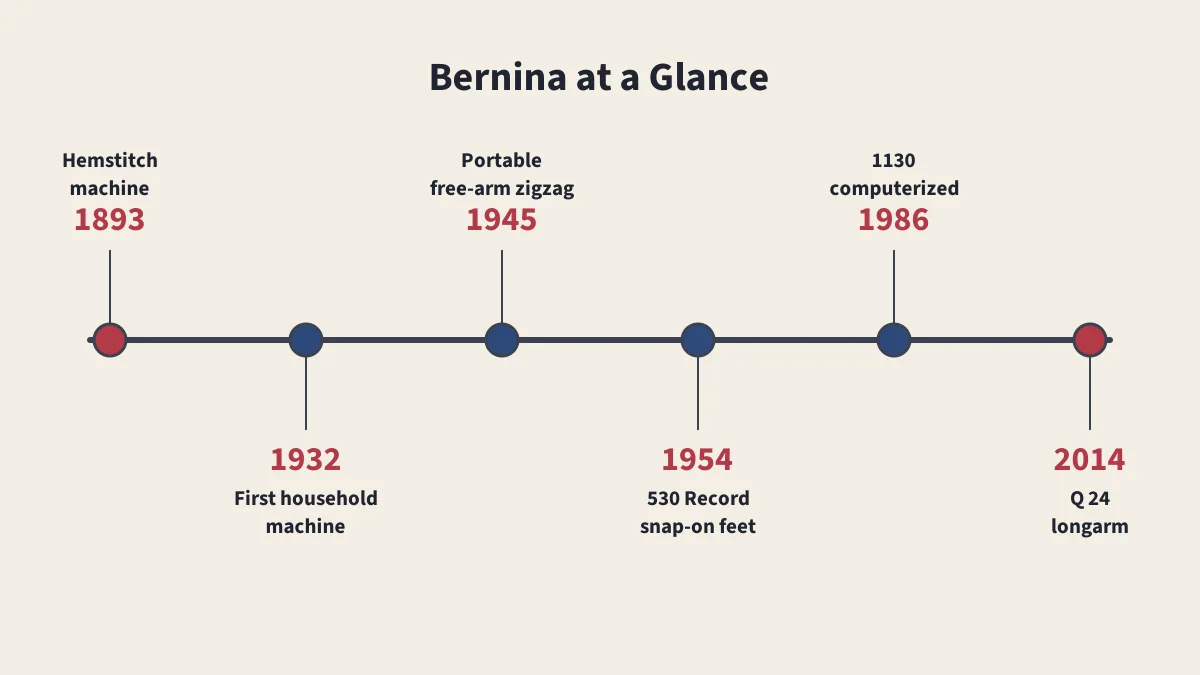
Bernina is one of the best-known names in home sewing, but its story begins with an industrial machine. In 1890 Karl Friedrich Gegauf set up a workshop in Steckborn, on the Swiss shore of Lake Constance, and in 1893 he built what Wikipedia describes as the world's first hemstitch sewing machine, able to sew 100 stitches per minute. Bernina treats 1893 as its founding year.
The Gegauf Workshop
Hemstitching was a decorative technique that had always been done by hand. Gegauf's machine mechanized it, and it found a market among textile manufacturers. The early years were not easy: a fire destroyed the workshop in 1895. The business recovered and continued to make industrial machines, and in 1919 Karl Friedrich and his son Fritz applied for a patent on the Wotan hemstitch machine, which also sold internationally.
The First Household Machines
After Karl Friedrich Gegauf's death in 1926, his sons Fritz and Gustav Gegauf led the company. In 1932 it launched its first household sewing machine, the Model 105, under the name Bernina. By October 26, 1937, the company had built 20,000 machines.
| Year | Model | Why It Mattered |
|---|---|---|
| 1932 | 105 | First Bernina household machine |
| 1938 | 117 | First Bernina zigzag machine |
| 1945 | 125 | Portable free-arm zigzag machine |
| 1954–1963 | 530 Record | Snap-on presser feet and a semi-automatic buttonhole |
| 1963 | 730 | Introduced the knee lifter |
| 1971 | 830 | Electronic foot control |
| 1986 | 1130 | Computerized, with one-step buttonholes |
The free arm let sewists slip sleeves and trouser legs around the bed, and zigzag stitching made it possible to finish seams, sew buttonholes and stitch stretch fabric on a home machine; see machine stitch types.
The Knee Lifter
The Model 730 of 1963 was the first Bernina with a patented knee-operated presser foot lifter. Pressing a lever with the knee raises the foot, so the sewist can keep both hands on the fabric while turning corners.
Into the Computer Age
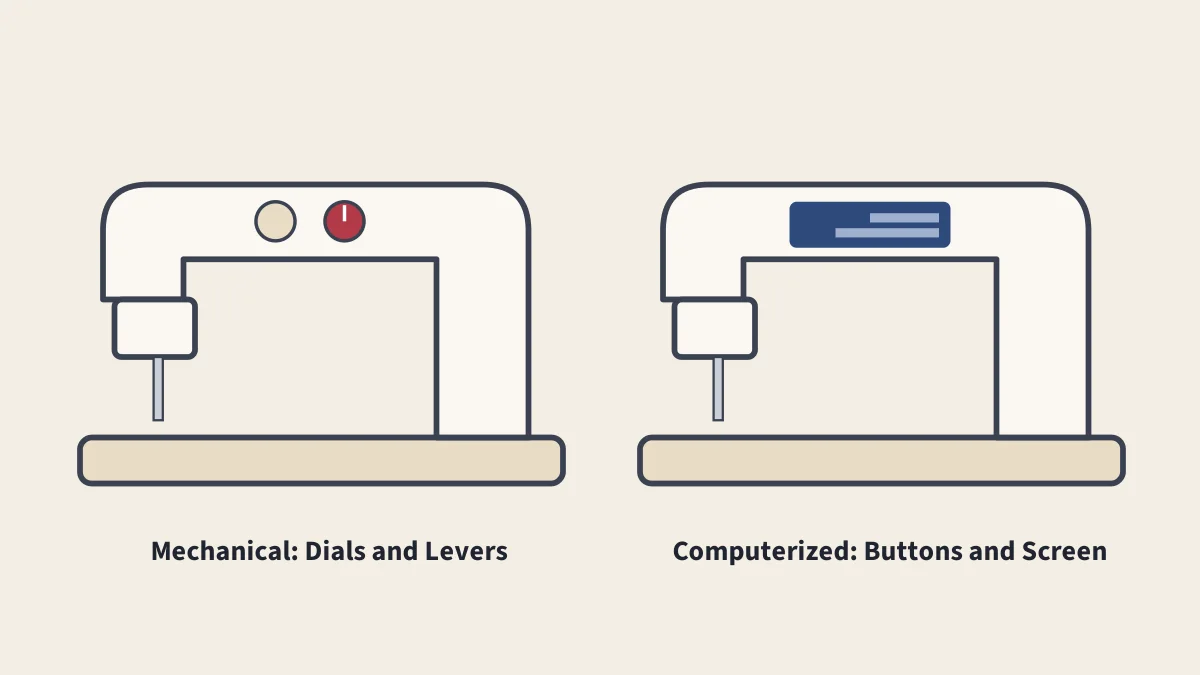
Bernina moved through electronics into computerized machines in the 1980s. The 1130 of 1986 was computerized and could sew one-step buttonholes. The artista 180 followed in 1998, and the artista 200 of 2002 combined sewing and embroidery in one computerized machine. In 2004, the 440 QE added a stitch regulator for free-motion quilting, and in 2014 Bernina introduced the Q 24 longarm quilting machine. See mechanical vs. computerized machines and longarm quilting machines.
A Family Company
- Karl Friedrich Gegauf: founder and inventor of the hemstitch machine.
- Fritz and Gustav Gegauf: his sons, who led the move into household machines.
- Odette Gegauf-Ueltschi: Fritz's daughter, who took over management in 1965.
- Hanspeter Ueltschi: her son, who took over in 1988.
The bernette line of more affordable machines takes its name from a combination of Bernina and Odette's first name.
Collecting Vintage Berninas
Older mechanical Berninas, including the 530 Record and the 700 and 800 series, are popular with sewists who want a durable, all-metal machine. When buying, check which presser feet the machine takes, since Bernina's foot attachment differs from the common low-shank system; see the presser feet guide.
Sources
- Bernina International, Wikipedia
Frequently Asked Questions
When was Bernina founded?
Bernina dates its founding to 1893, when Karl Friedrich Gegauf built a hemstitch machine in his workshop in Steckborn, Switzerland. The company's first household sewing machine followed in 1932.
What does the bernette name mean?
The bernette line's name combines Bernina with the first name of Odette Gegauf-Ueltschi, the daughter of Fritz Gegauf, who led the company from 1965.
What was the first Bernina zigzag machine?
Bernina's Model 117 of 1938 was its first zigzag machine. The Model 125 of 1945 combined zigzag with a portable free-arm design.
Is Bernina still family-owned?
Yes. The company has been run by members of the Gegauf family and their descendants, the Ueltschi family, for generations.
Keep Reading
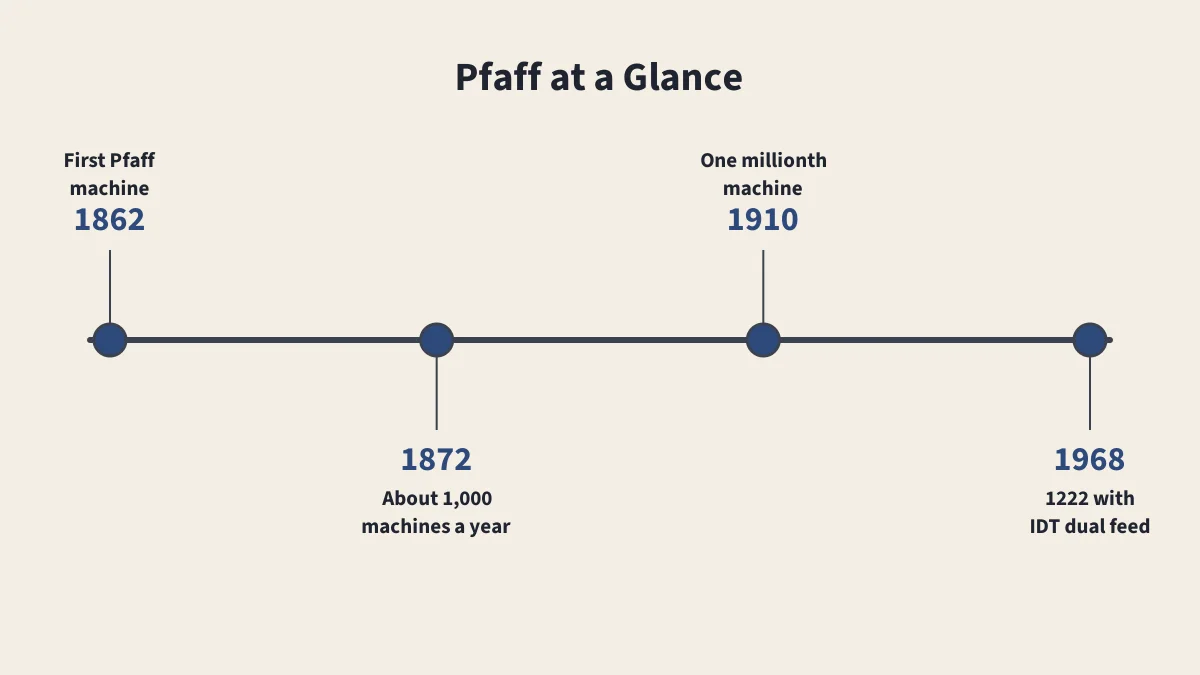
Pfaff History
Georg Michael Pfaff, Lina Pfaff's leadership and the IDT dual feed.
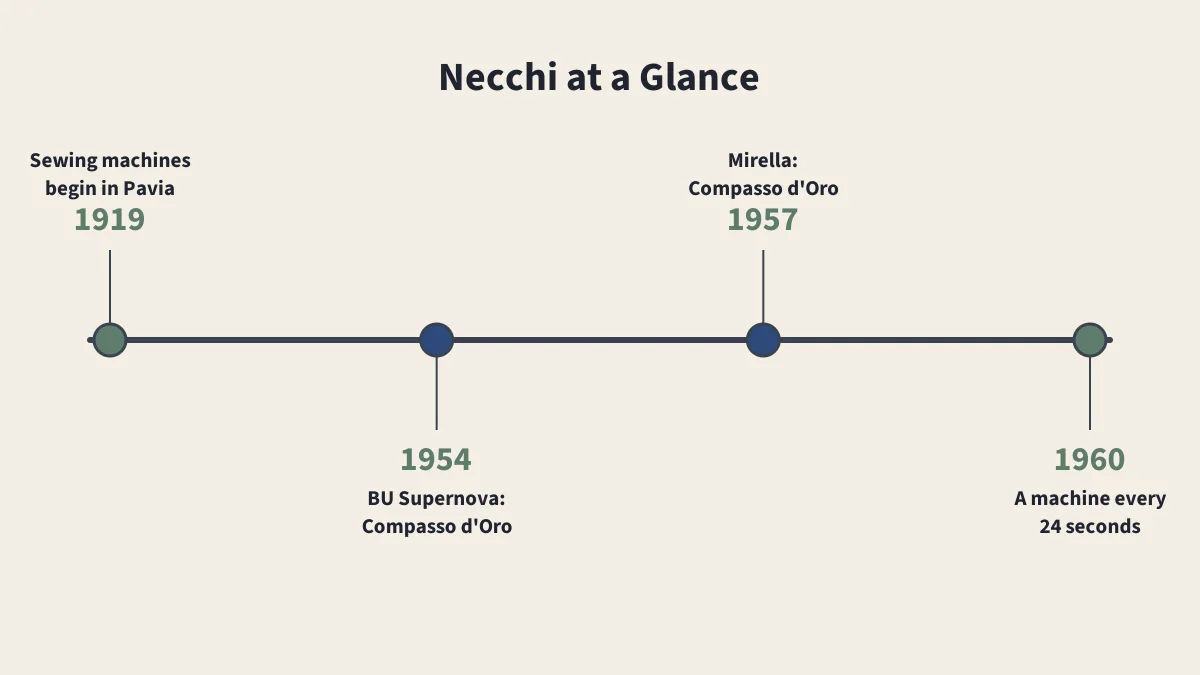
Necchi History
The Pavia foundry, Nizzoli's Supernova and the prize-winning Mirella.
Vintage Sewing Machine Brands
American, European and Japanese makers, plus badge-engineered machines.
Mechanical vs. Computerized Machines
Dials vs. touchscreens: features, durability and repairs compared.