Elna History: The Green Machine That Freed the Arm (2026)
In 1940 a small green machine from Geneva changed home sewing. The Elna 1 brought the free arm, once found only on industrial machines, to the kitchen table, in a case that doubled as a sewing table.
In This Article
Elna in Brief
- Inventor: Ramon Casas Robert
- Maker: Tavaro, Geneva, Switzerland
- First machine: Elna 1, 1940
- Big idea: the free arm for home sewing
- Today: an Elna brand owned by Janome
Most home sewing machines of the 1930s were heavy, flat-bedded machines in cabinets. The Elna 1 was different: compact, light, green and built around a free arm. It became one of the most influential home sewing machine designs of the 20th century.
Ramon Casas and Tavaro
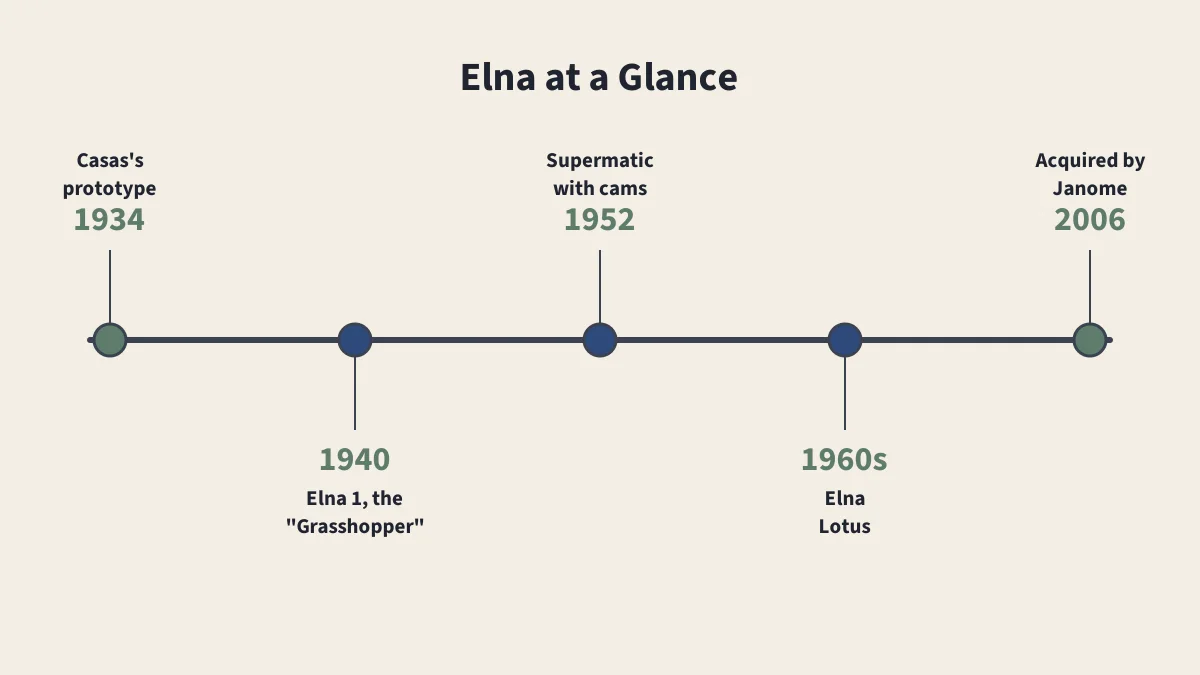
Ramon Casas Robert was a Spanish engineer. A working prototype of his sewing machine was reportedly complete as early as 1934, but development was interrupted by the Spanish Civil War, and he emigrated to Switzerland. While living in a hotel room in Geneva, he sold his patents through a holding company to Tavaro, a Geneva firm that had begun as the export division of a watch company and had made clockwork artillery fuzes before turning to peaceful industry. The first Elnas left the factory in 1940.
The Elna 1, the "Grasshopper"
The Elna 1 combined several features that made it stand out:
- Free arm: a narrow sewing arm, previously found only on industrial machines, that let sleeves, cuffs and trouser legs wrap around the mechanism.
- Light weight: under 7 kg, largely thanks to a molded aluminum body.
- Rotary hook: running with little movement or noise compared with oscillating shuttle machines.
- Clever case: its carrying case doubled as an extension table.
- Color: a matte green finish that gave it the nickname "Grasshopper."
Estimates of total Elna 1 production range widely, from 65,000 to half a million. The machine was phased out beginning in 1952.
The Supermatic
In 1952 Elna introduced the Supermatic, which Wikipedia describes as the world's first home sewing machine with automated reverse feed. It used a cam reader called the Elnagraph, with two-sided cams that could be swapped to change the decorative stitch. Cam machines stored stitch patterns in shaped discs before electronics took over; compare the Singer Slant-o-Matic and see decorative stitches.
Later Models
| Model | Notes |
|---|---|
| Elna 1 | The original free-arm "Grasshopper," 1940 |
| Supermatic | Automated reverse feed and interchangeable cams, 1952 |
| SP and TSP | Special Edition and Top Special Edition |
| Lotus | A compact portable; New York's Museum of Modern Art references an "Elna Lotus sewing machine, 1965" |
| Air Electronic | Controlled by an air cushion powered by an internal compressor instead of a pedal |
| Carina | Introduced a button-operated bobbin threader and an accessories case that slid under the free arm |
Decline and Janome
Like other European makers, Elna found it increasingly hard to compete as East Asian imports undercut European manufacturers on price. The Swiss company was deregistered in 1995 and later absorbed by Janome; collector histories date Janome's purchase of Elna's worldwide operations to August 2006. Elna-brand machines are still sold today.
Vintage Elnas Today
Elna 1 and Supermatic machines are popular with collectors for their design and engineering. They use parts and presser feet specific to Elna, so check that the bobbin case, cams and feet are present before buying. For care, see sewing machine maintenance. For another Swiss maker, see Bernina history.
Sources
- Elna (Swiss company), Wikipedia
Frequently Asked Questions
Who invented the Elna sewing machine?
The Spanish engineer Ramon Casas Robert. A working prototype was reportedly complete as early as 1934. After he emigrated to Switzerland during the Spanish Civil War, he sold his patents to the Geneva company Tavaro, and the first Elnas left the factory in 1940.
Why is the Elna 1 called the Grasshopper?
Because of its matte green finish. The nickname 'Grasshopper' stuck to the compact, lightweight machine.
What was special about the Elna Supermatic?
Introduced in 1952, the Supermatic was the world's first home sewing machine with automated reverse feed, according to Wikipedia. It read interchangeable cams to produce decorative stitches.
Who owns Elna now?
Janome. Elna's Swiss company was deregistered in 1995, and Janome later acquired Elna's worldwide operations; collector histories date the acquisition to August 2006. Elna-brand machines are still sold.
Keep Reading
Bernina History
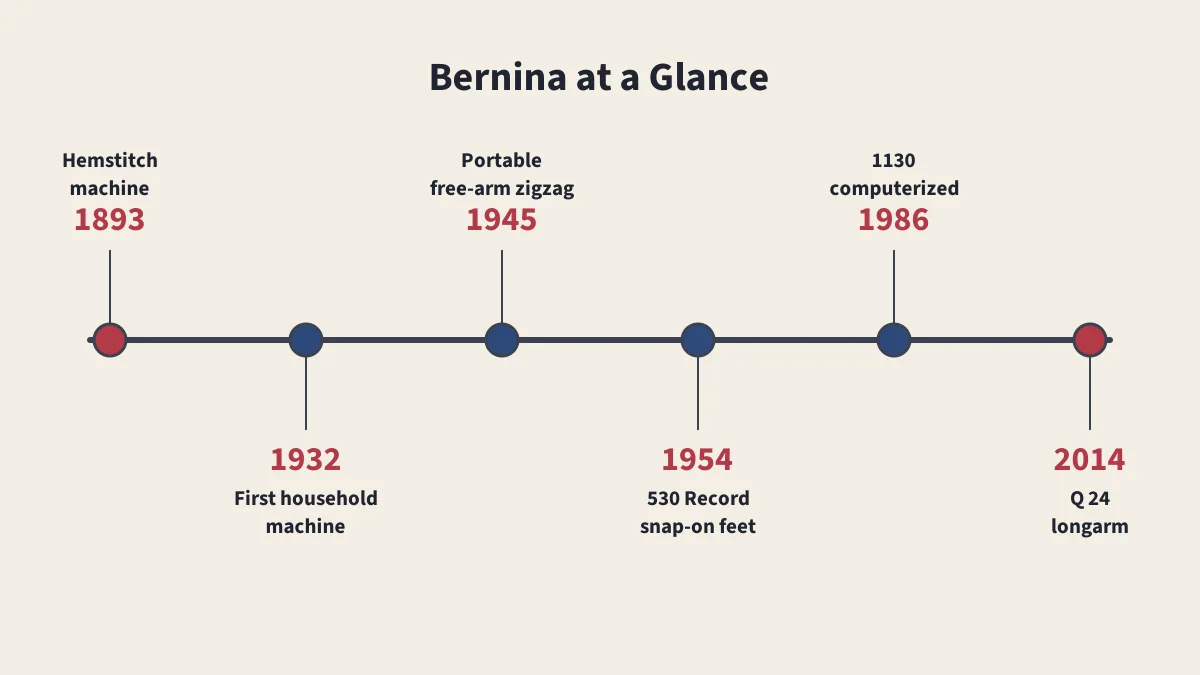
The Gegauf family, the first Bernina zigzag and the 530 Record.
Janome History
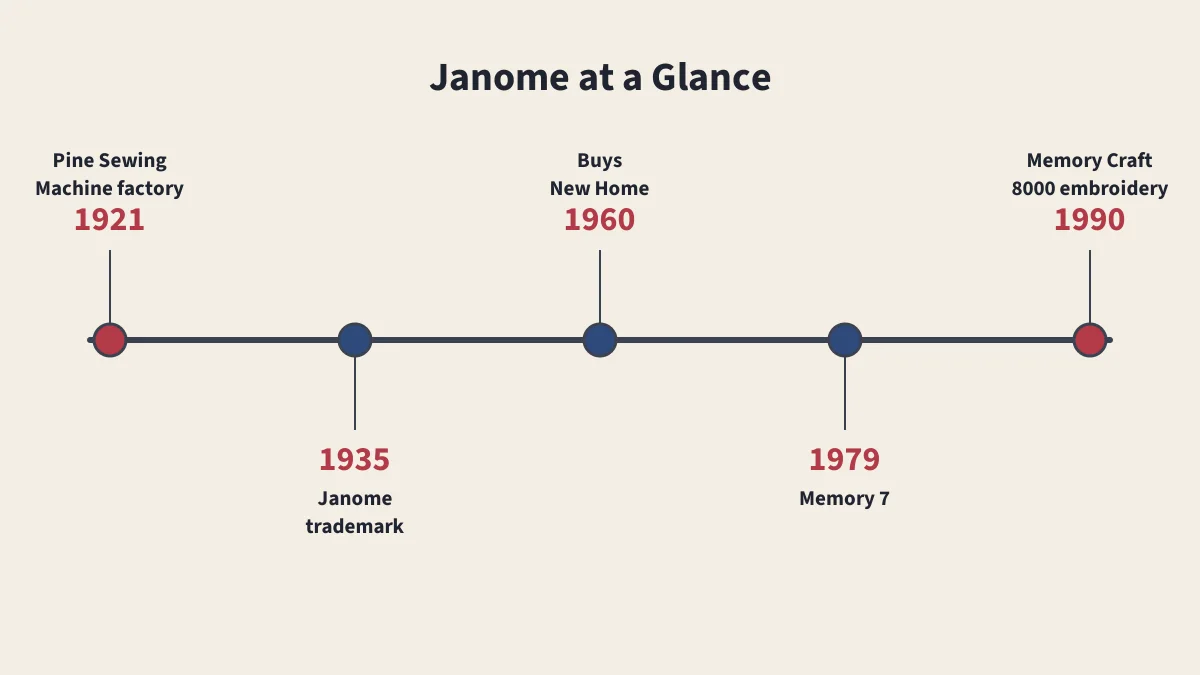
The Pine factory, the snake's eye bobbin and the Memory 7.
Husqvarna Viking History
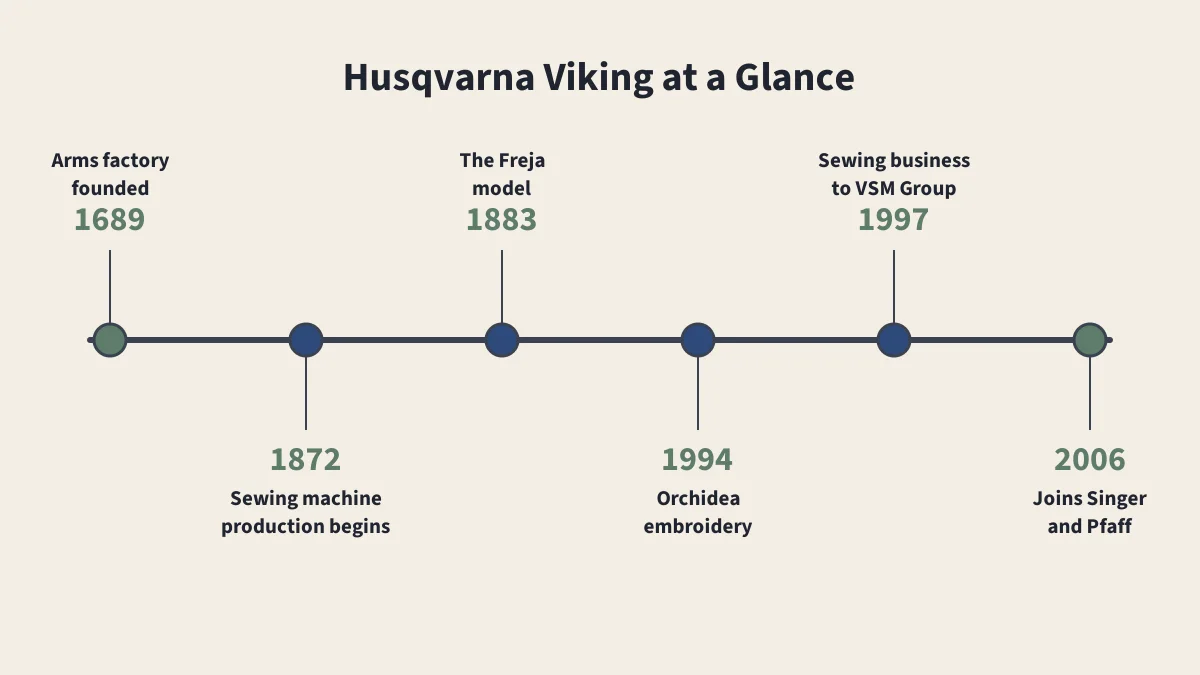
The 1689 arms factory, the first machines of 1872 and the Viking brand.
Vintage Sewing Machine Brands
American, European and Japanese makers, plus badge-engineered machines.