Darts and Tucks: How Flat Fabric Becomes Shaped Clothing (2026)
A dart is a stitched, tapering fold that turns flat fabric into a three-dimensional shape. Tucks are stitched folds too, but they are usually there for decoration or to shorten a garment.
In This Article
Darts and Tucks in Brief
- Dart: a tapered fold that creates shape
- Bust darts: side, French, shoulder, armhole and more
- Double-pointed: shapes the waist
- Tuck: an even fold, mainly decorative
- Alternatives: pleats, gathers or princess seams
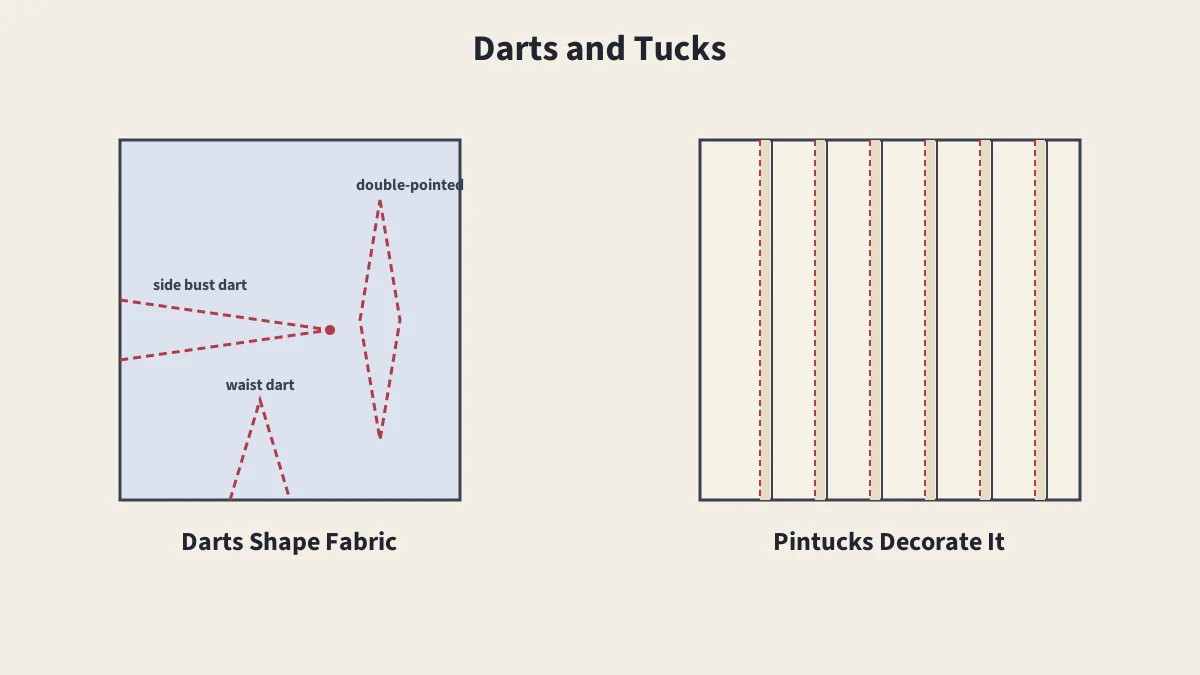
A dart is a fold of fabric, tapering to a point, sewn in to take in ease and shape a garment, especially around the bust. Removing a wedge from flat fabric and stitching its edges together forms a shallow cone, and the fabric softens that cone into a curve. The point of a dart aims at the fullest part of the body it is shaping.
Types of Dart
| Dart | Where | Shapes |
|---|---|---|
| Side bust dart | From the side seam toward the bust | Bust |
| French dart | A long, angled dart from low on the side seam | Bust and waist |
| Waist dart | From the waist up toward the bust, or down toward the hip | Waist |
| Double-pointed (fisheye) | Tapers at both ends across the waist | Waist of dresses and fitted tops |
| Shoulder, neckline and armhole darts | From the top edges toward the bust or shoulder blade | Bust and back |
| Skirt and trouser darts | From the waist down | Hips and seat |
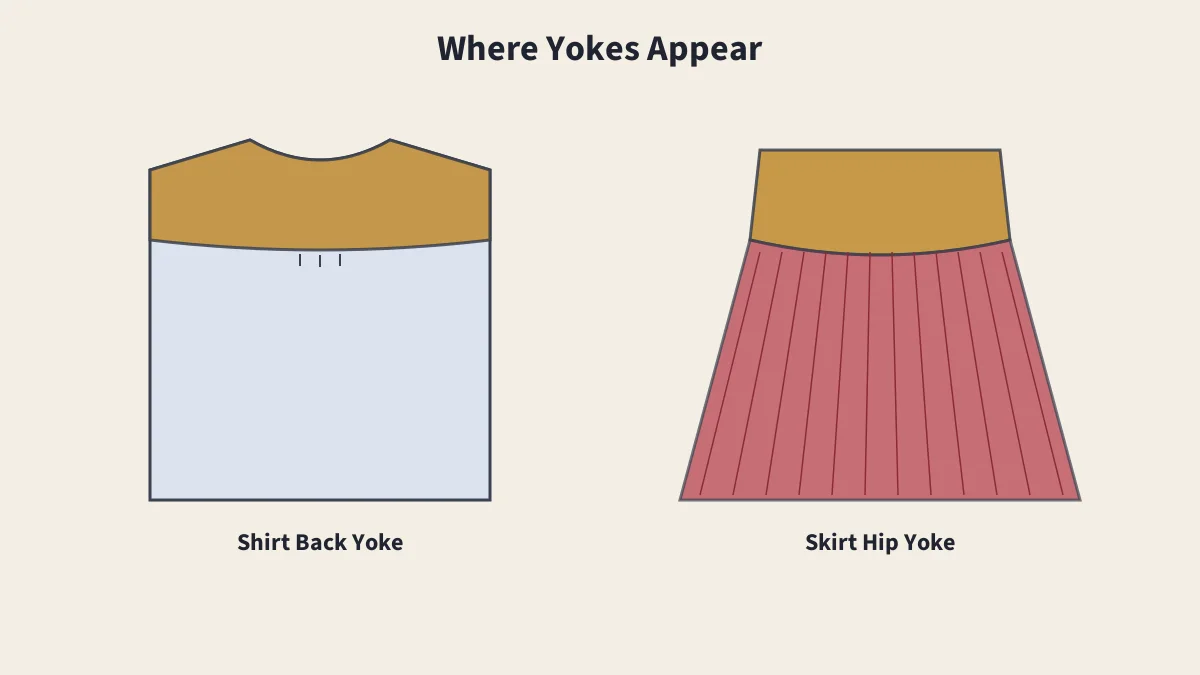
Pleats or gathers can do the same job as a stitched dart, and a princess seam turns a dart into a shaped seam running the length of the garment. On skirts, a yoke can replace darts entirely.
How to Sew a Dart
- Mark the dart legs and point carefully; see marking tools.
- Fold the dart right sides together, matching the legs, and pin.
- Stitch from the wide end toward the point, tapering gradually so the last few stitches run right along the fold.
- Don't backstitch at the point. Tie the threads in a knot, or sew off the edge and secure with a few tiny stitches, so the point doesn't pucker.
- Press over a tailor's ham; see pressing as you sew.
Tucks
A tuck is a stitched fold of even width, sewn on the right or wrong side. Tucks became very popular as decoration in the second half of the 19th century, when the sewing machine made them easier to sew. They were used on fine linen and cotton for blouses, lingerie, summer dresses and children's clothes, and on heavier cloth for suits.
- Pintucks: very narrow tucks, often sewn in groups, sometimes with a twin needle and a pintuck foot.
- Spaced tucks: wider tucks with gaps between them.
- Growth or hem tucks: deep tucks near the hem that shorten a garment and can be let out later. A 1625 boy's gown was shortened this way.
- Released tucks: stitched part way, then left open to release fullness, like a soft dart.
Sources
- Dart (sewing), Wikipedia
- Tuck (sewing), Wikipedia
Frequently Asked Questions
What is a dart in sewing?
A fold of fabric, tapering to a point, that is stitched to take in fullness and shape a garment, especially around the bust, waist and hips.
What is the difference between a dart and a tuck?
A dart tapers to a point to create shape. A tuck is a stitched fold of even width, usually used for decoration or to shorten a garment.
What is a double-pointed dart?
A dart that tapers at both ends and is widest in the middle, used to shape the waist of a one-piece dress or fitted top. It is sometimes called a fisheye or contour dart.
Which way should darts be pressed?
Vertical darts are usually pressed toward the center and horizontal darts downward, over a tailor's ham so the shape is kept. Wide darts in heavy fabric are cut open and pressed flat.
Keep Reading
Types of Pleats
Knife, box, accordion, kick and historical pleats.
Pressing as You Sew
Pressing vs. ironing, seams, curves and darts.
Godets, Gores and Gussets
Shaped insets for flare, fit and movement.
Yokes
Shirt, bodice, skirt and jeans yokes explained.