Types of Cuffs: Barrel, French and Trouser Turn-Ups (2026)
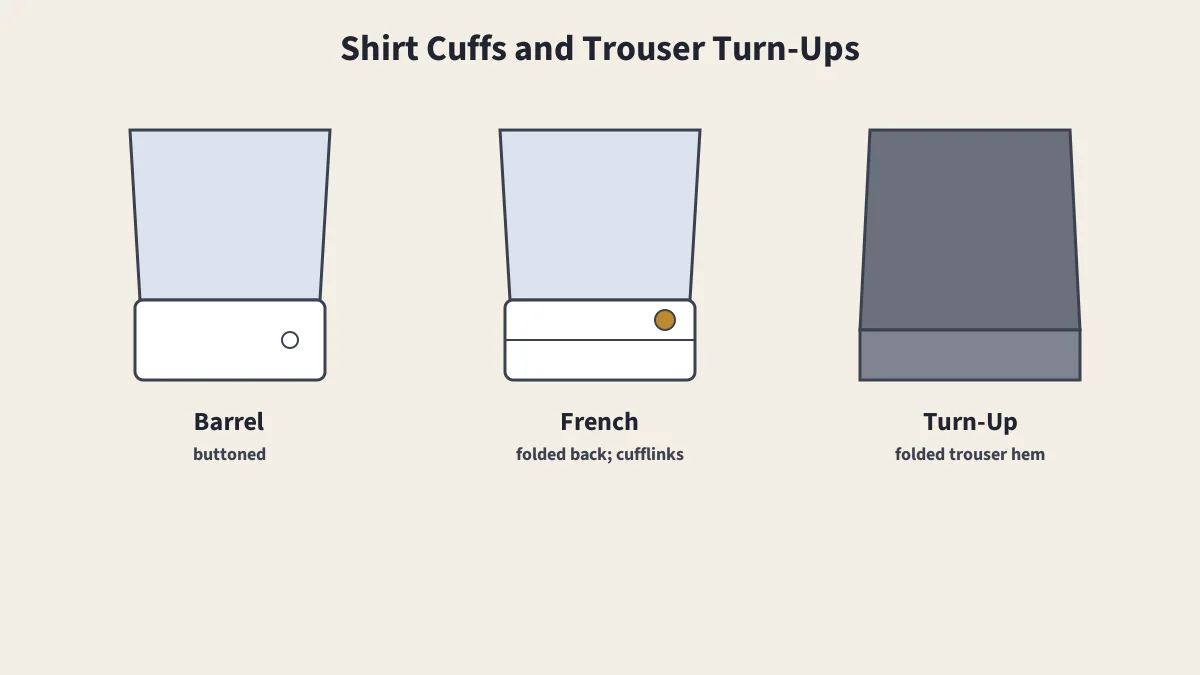
A cuff finishes the end of a sleeve or a trouser leg. Shirt cuffs range from everyday buttoned barrel cuffs to formal French cuffs with cufflinks.
In This Article
Cuffs in Brief
- Barrel: button and buttonhole
- French (double): folded back, cufflinks
- Single link: cufflinks, not folded
- Convertible: button or cufflinks
- Trouser cuffs: called turn-ups in the UK
A cuff is a layer of fabric at the lower edge of a sleeve, or at the bottom of a trouser leg. On shirts, cuffs protect the sleeve edge from fraying and could historically be repaired or replaced without replacing the whole garment.
Shirt Cuffs
| Cuff | Fastening | Notes |
|---|---|---|
| Barrel (button) | Buttonhole on one side, button on the other | The everyday cuff; some have two buttons to adjust the fit |
| French (double) | Cufflinks through both sides | Twice as long, folded back; formal and business wear |
| Single link | Cufflinks or silk knots | The original linked cuff; required for white tie |
| Convertible | Button or cufflinks | Common on ready-to-wear dress shirts |
| Turnback | Folded back on the sleeve | The sleeve's inside becomes the outside of the cuff |
Linked cuffs are usually worn "kissing", with the two edges pressed together face to face rather than overlapping.
Jacket Cuffs
Suit jacket sleeve buttons are generally decorative. "Surgeon's cuffs", with buttonholes that actually open at the wrist, are traditionally associated with bespoke tailoring, which is why jacket sleeves with working buttonholes are hard to shorten; see alterations.
Trouser Cuffs (Turn-Ups)
In the US, "cuffs" also means the folded-up bottom of trouser legs; in the UK, these are traditionally called turn-ups. The style reportedly began when men rolled up their trousers to keep them out of the mud on unpaved roads. The extra weight helps the trousers drape, and parents have long cuffed oversized children's trousers to unroll as they grow.
Sewing Cuffs
- Interface the cuff so it holds its shape; see interfacing.
- A sleeve placket lets the cuff open wide enough for the hand.
- The sleeve end is gathered or pleated to fit the cuff; see gathering.
- Edgestitch or topstitch after turning for a crisp finish; see topstitching.
Sources
- Cuff, Wikipedia
Frequently Asked Questions
What is the difference between a barrel cuff and a French cuff?
A barrel cuff has a buttonhole on one side and a button on the other. A French (double) cuff is twice as long, folds back on itself, and is fastened with cufflinks through buttonholes on both sides.
What is a convertible cuff?
A cuff that can be fastened with either a button or cufflinks.
What are trouser cuffs called in the UK?
Turn-ups. In the US, 'cuffs' refers to the folded-up bottom of trouser legs.
Why do trousers have cuffs?
The style reportedly began when men rolled up their trousers to avoid mud on unpaved roads. The extra weight at the hem also helps trousers hang well.
Keep Reading
Types of Sleeves
Set-in, raglan, kimono, puff, bishop, bell and more.
Types of Plackets
Pieced, French, fly-front and sleeve plackets.
Buttons
Button types, ligne sizes, materials and history.
Types of Hems
Double-fold, blind, rolled, faced, bound and knit hems compared.