Types of Garment Closures: How Clothes Open and Fasten (2026)
Every garment that is narrower than the body needs a way in. From laces and pins to zippers and hook-and-loop tape, each closure has its own look, strength and history.
In This Article
Closures in Brief
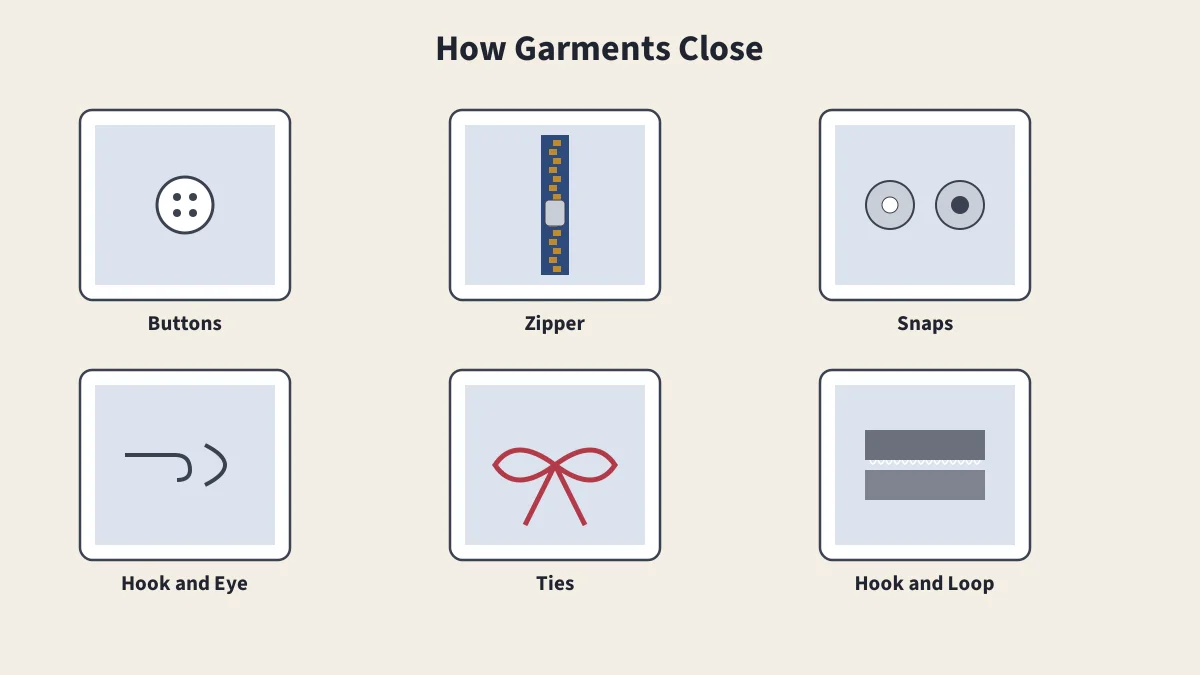
- Buttons: the most versatile
- Zippers: fast and smooth
- Snaps: quick, often hidden
- Hooks and eyes: flat, small strain points
- Hook-and-loop: George de Mestral, 1955 patent
A closure lets a garment open wide enough to put on and then fit closely once fastened. The choice of closure shapes the opening itself: buttons need a placket or overlap, zippers need a seam, and ties need a wrap or casing.
Comparing Closures
| Closure | Best For | Notes |
|---|---|---|
| Buttons | Shirts, coats, waistbands, cuffs | Decorative and adjustable; need buttonholes. See buttons. |
| Zippers | Skirts, trousers, dresses, jackets, bags | Quick; invisible, exposed and separating types. See types of zippers. |
| Snaps | Babywear, overlaps, hidden fastenings | Sew-on or pressed-in; can pop open under strain. |
| Hooks and eyes | Top of zippers, necklines, bras | Flat and discreet; trouser hooks take strain at waistbands. |
| Ties and laces | Wrap dresses, corsets, drawstrings | Adjustable, the oldest closures. |
| Toggles | Duffle coats | Easy to use with gloves. |
| Frogs | Chinese garments, military jackets | Decorative braided cord loops. |
| Buckles | Belts, straps, waist tabs | Adjustable. |
| Hook-and-loop tape | Children's and adaptive clothing, outdoor gear | Easy to open; can snag delicate fabrics. |
For sewing on snaps and hooks, see sewing on buttons and snaps; for zippers, see how to insert a zipper.
A Short History
- Pins, brooches and ties held early clothes together; see the history of the safety pin.
- Buttons were decorative for thousands of years before buttonholes appeared in 13th-century Germany; see types of buttonholes.
- The modern zipper developed in the late 19th and early 20th centuries; see the history of the zipper.
- Hook-and-loop tape followed in the 1950s; see the history of snaps, hooks and Velcro.
Choosing a Closure
- Strain: use buttons, trouser hooks or a strong zipper where the garment pulls.
- Fabric: lightweight fabrics suit invisible zippers and small snaps; heavy fabrics need sturdy hardware.
- Wearer: large buttons, magnets or hook-and-loop help children and people with limited dexterity.
- Look: exposed zippers and decorative buttons can be features; invisible zippers and hidden plackets disappear.
For more on the hardware, see snaps, hooks and other closures.
Sources
Frequently Asked Questions
What are the main types of garment closures?
Buttons, zippers, snaps, hooks and eyes, ties and laces, toggles, frog closures, buckles and hook-and-loop tape. Many garments combine two, such as a zipper with a hook and eye at the top.
Which closure is strongest?
Under strain, trouser hooks and bars, heavy-duty metal zippers and well-anchored buttons are among the strongest. Snaps and hook-and-loop tape are convenient but can pop open under load.
Who invented hook-and-loop tape?
Swiss engineer George de Mestral, who got the idea in 1941 from burrs clinging to his dog's fur. He filed a patent in 1951, granted in 1955. The name Velcro combines the French velours (velvet) and crochet (hook).
What is a frog closure?
A decorative fastening of braided cord, with a looped knot on one side and a loop on the other, common on Chinese garments and military uniforms.
Keep Reading
Buttons
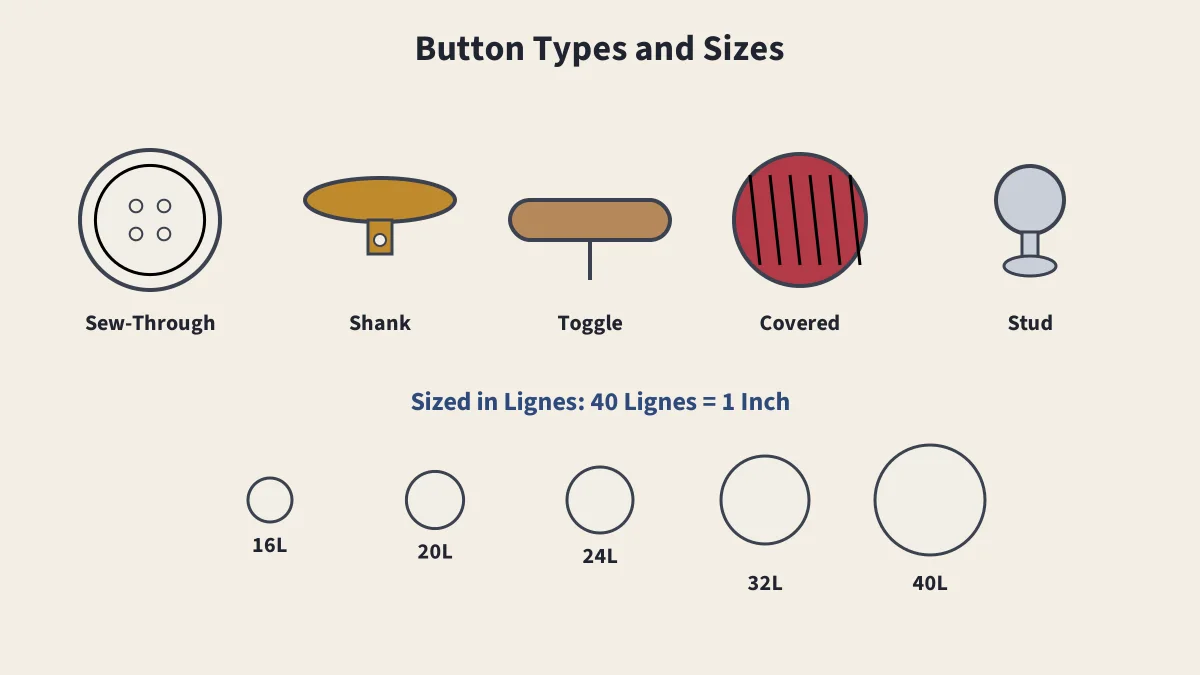
Button types, ligne sizes, materials and history.
Types of Zippers
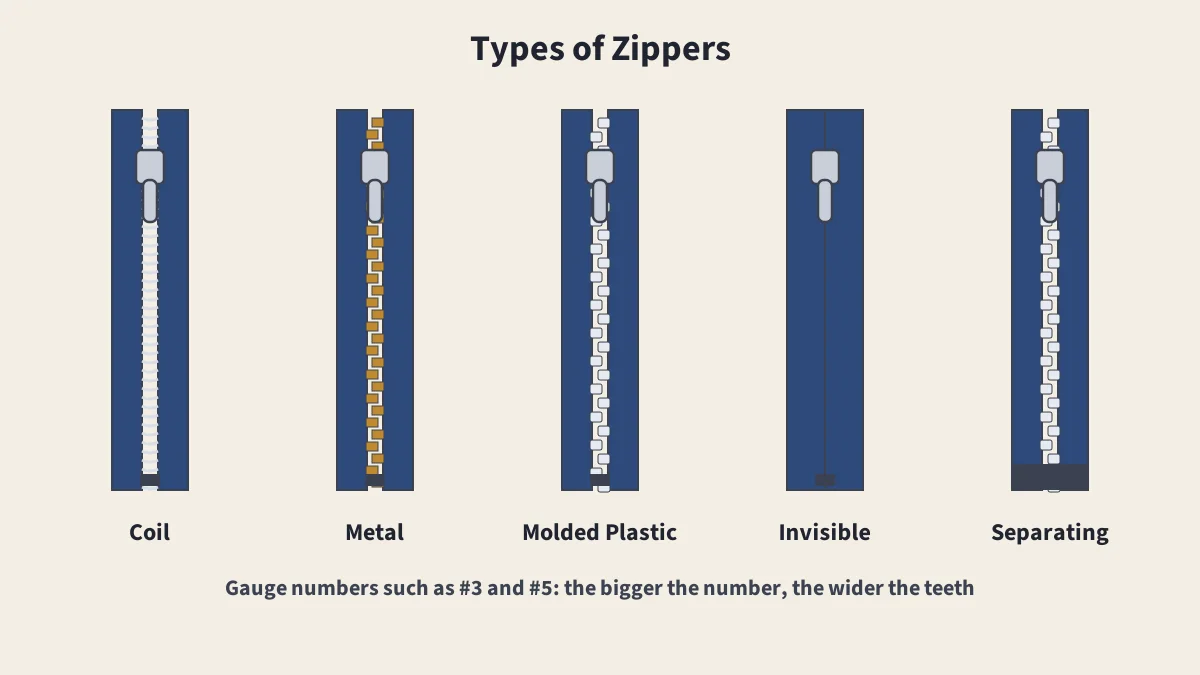
Coil, metal, plastic, invisible and separating zippers compared.
Snaps, Hooks and Closures
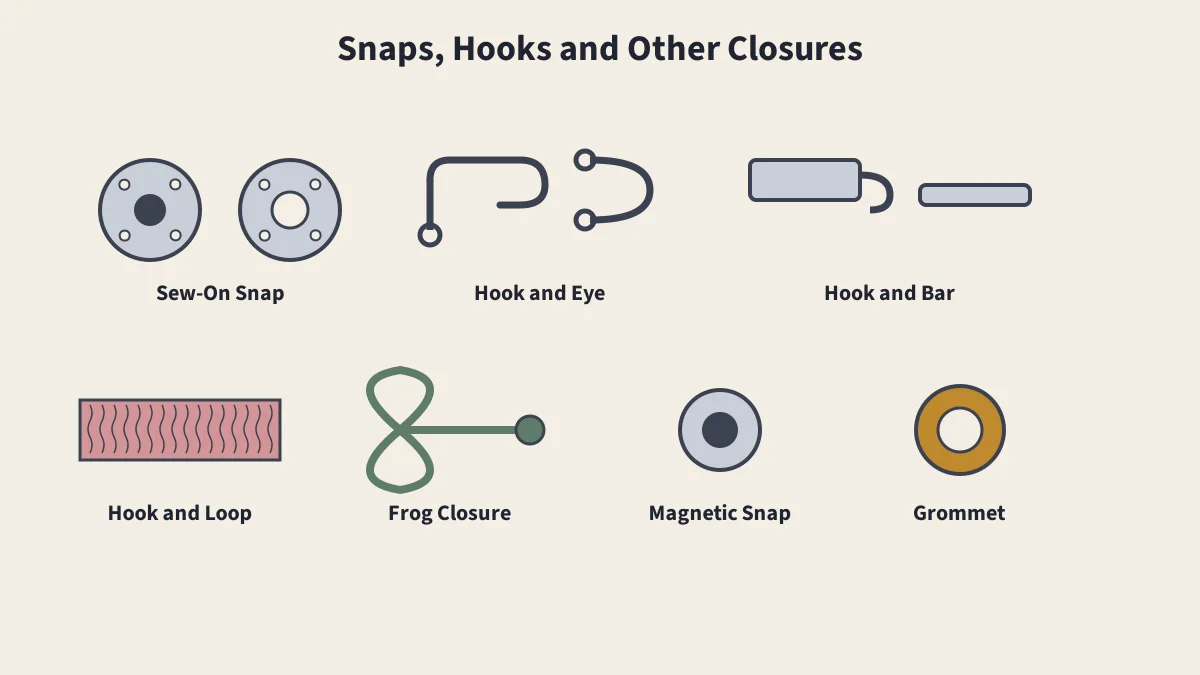
Snaps, hooks and eyes, hook and bar, frogs, magnets and grommets.
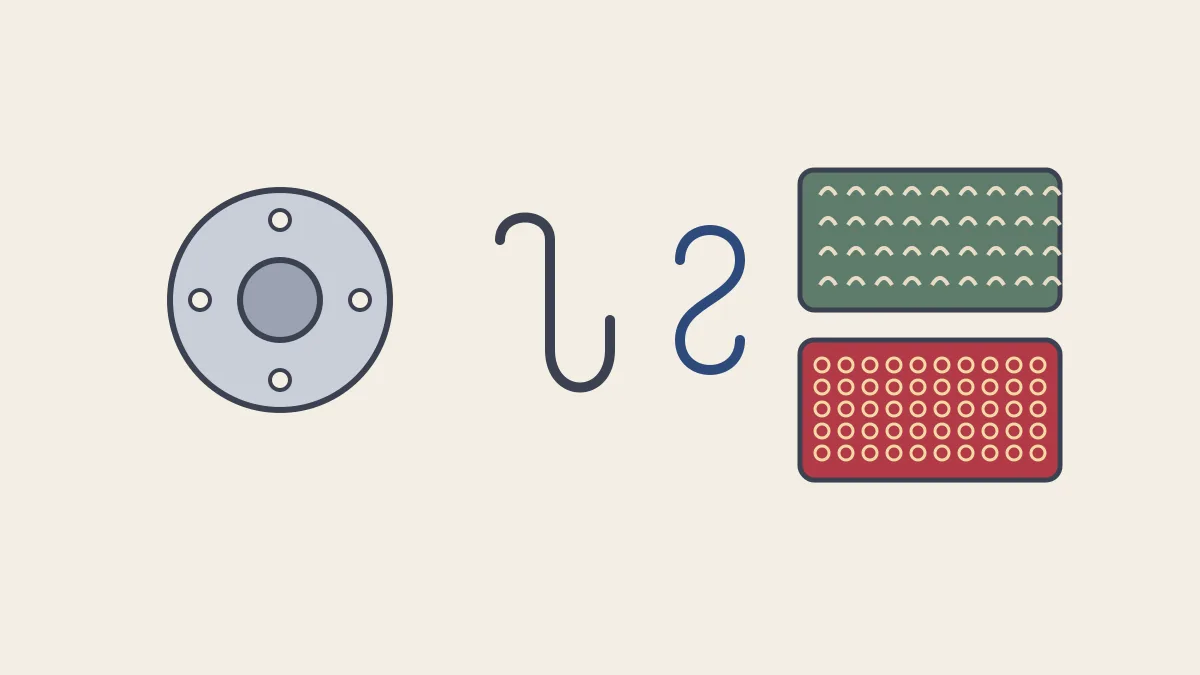
History of Snaps, Hooks and Velcro
Medieval hooks and eyes, 1880s snaps, and Velcro's burr-covered origins.