How to Darn: Repairing Holes in Socks, Sweaters and Fabric (2026)
Darning repairs a hole by weaving new threads across it with nothing but a needle and yarn. It was once an everyday household skill, and it is now popular again as part of visible mending.
In This Article
Darning in Brief
- What: weaving new thread across a hole
- Tools: darning needle, matching yarn, darning egg or mushroom
- Method: rows one way, then woven the other
- By machine: straight-stitch grid or darning stitch
- Fine darning: nearly invisible reweaving
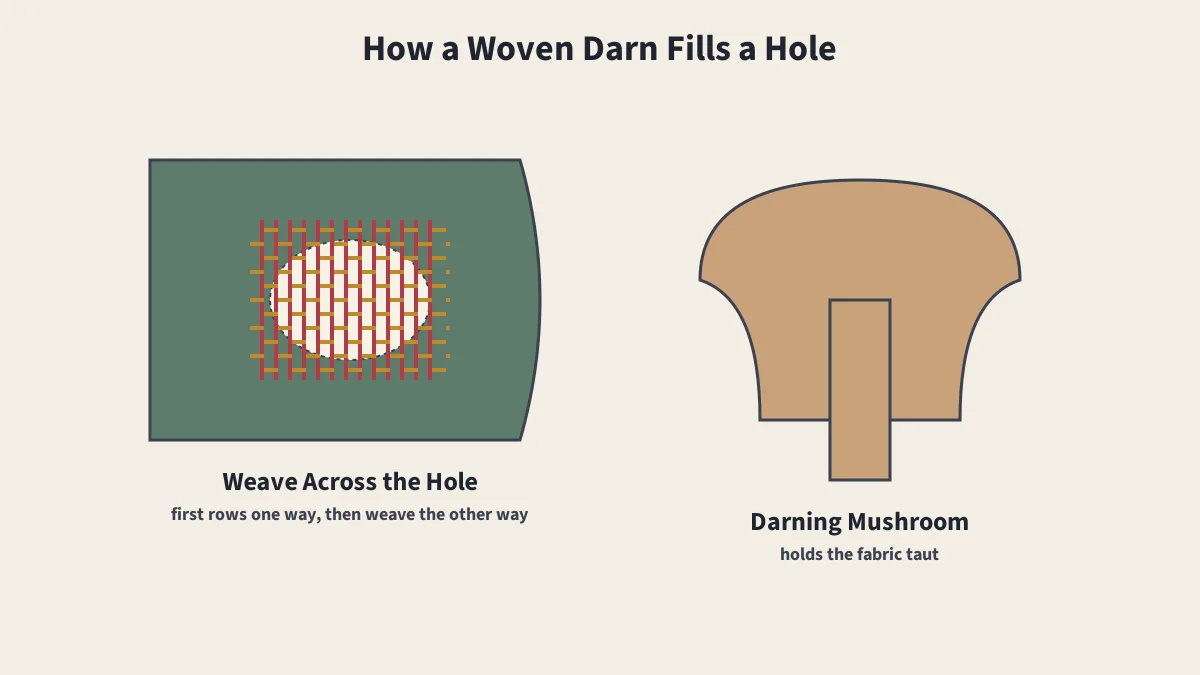
Darning repairs holes or worn areas in fabric or knitting with only a needle and thread. Rows of running stitches are laid in one direction along the grain, reversing at the end of each row, and then a second set is woven through them at right angles, rebuilding the fabric over the gap. It is usually done by hand but can also be done by machine.
What You Need
- Darning needle: long and blunt with a large eye; see hand sewing needles.
- Yarn or thread: similar in weight and fiber to the item; contrasting colors are popular for visible mending.
- A darning egg, mushroom or gourd to hold the area taut and keep its shape. Darning eggs have been made of stone, porcelain and wood; tiger cowry shells were sometimes used.
How to Darn a Hole by Hand
- Stretch the area over a darning egg or mushroom, without distorting it.
- Outline a square or circle of small running stitches around the hole, into sound fabric, to stabilize the edge.
- Lay the warp: stitch rows back and forth across the hole, anchoring each in sound fabric beyond the edge. Leave a small loop at each turn so the darn doesn't pucker when it shrinks or stretches.
- Weave the weft: turn the work and weave across the first rows, over one and under one, alternating the pattern on each row.
- Pack the rows gently with the needle so the darn is dense and even.
- Finish by weaving the yarn end into the darn on the wrong side; avoid knots in socks.
Machine Darning
Machine darning sews lines of straight stitch back and forth across the hole, then rotates the fabric and sews more lines at right angles. A stabilizer or patch behind the hole helps on worn fabric. Many modern machines have a built-in darning stitch.
Other Kinds of Darning
| Type | What It Is |
|---|---|
| Fine (Belgian) darning | Nearly invisible reweaving, sometimes with threads taken from a hem or seam |
| Swiss darning | Duplicate stitching over the knitted stitches of a sweater |
| Pattern darning | An ancient embroidery technique using straight stitches of varying length to form geometric designs |
| Net darning (filet lace) | A 19th-century technique stitching patterns onto a mesh to imitate lace |
A Little History
From the early 18th century, girls in Western Europe stitched darning samplers to show their domestic skill. In India, the craft is called rafoogari, and Kashmiri darners are especially renowned. During Second World War clothes rationing in the UK and Canada, small hand-held darning looms were sold to weave patches into cloth; see Make Do and Mend.
For the wider history of samplers, see the history of embroidery samplers.
Sources
- Darning, Wikipedia
- Visible mending, Wikipedia
Frequently Asked Questions
What is darning?
A sewing technique for repairing holes or worn areas in fabric or knitting using only a needle and thread or yarn. Rows of running stitches are laid across the hole and then woven through in the other direction.
What do I need to darn a sock?
A blunt darning needle with a large eye, yarn similar in weight and fiber to the sock, and something to hold the area taut, such as a darning egg, darning mushroom or even a light bulb-shaped object.
Can you darn with a sewing machine?
Yes. Machine darning runs lines of straight stitch back and forth across the hole, then turns the fabric and sews more lines at right angles. Some machines have a dedicated darning stitch.
What is invisible darning?
A fine darning technique, also called Belgian or invisible mending, that reweaves threads taken from a hem or seam of the same fabric to make an almost invisible repair. It is used on expensive fabrics.
Keep Reading
Patching and Visible Mending
Patching methods, sashiko, boro and visible mending.
Make Do and Mend
Coupons, blackout-curtain dresses and Mrs Sew and Sew in wartime Britain.
Hand Sewing Needle Types
Every common hand needle type, what it is for and how sizes work.
Wool
What wool is, why it is warm and felts, and how to sew it.