How to Match Plaids and Stripes Perfectly at Every Seam (2026)
Nothing shows careful sewing like plaid that continues unbroken across a seam. It takes extra fabric and some planning at the cutting table, but the method is the same for every plaid and stripe.
In This Article
Matching in Brief
- Sett: the repeating unit of a tartan
- Even plaids: mirror in both directions
- Uneven plaids: need a one-way layout
- Cut: single layer, one piece at a time
- Match: at the seamline, not the cut edge
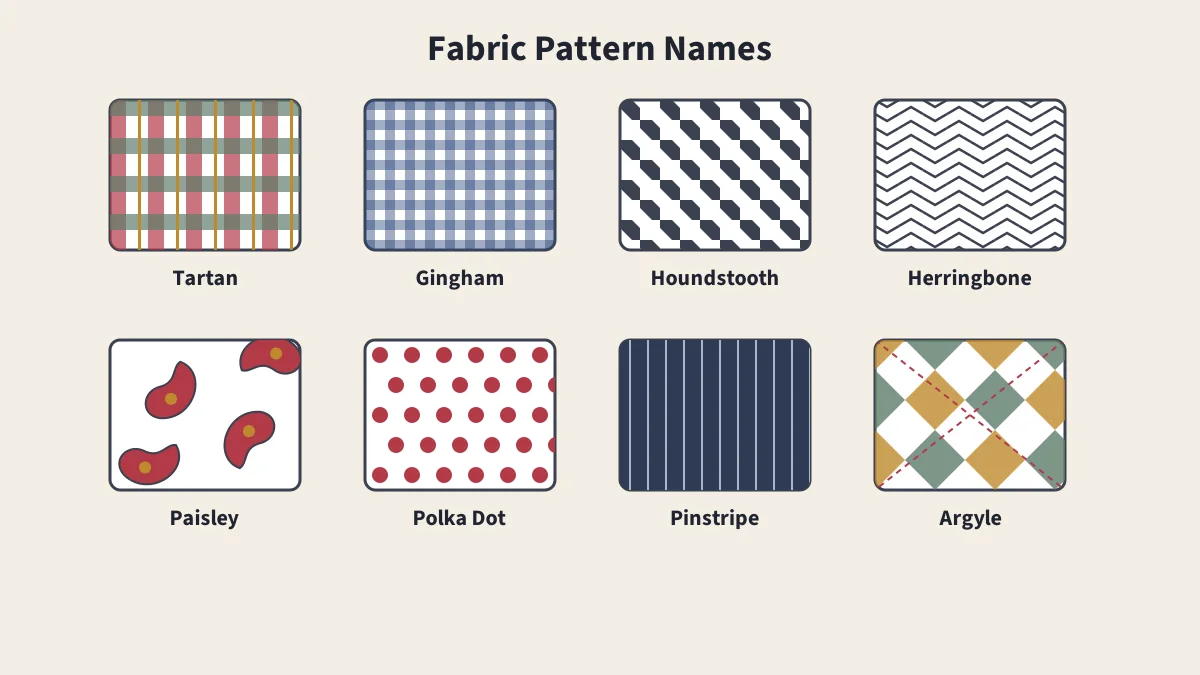
In North America, "plaid" is the everyday word for tartan-like checks; in Scotland and the UK, "tartan" is used, and "plaid" originally meant a rectangular garment or blanket. For named checks such as gingham, houndstooth and madras, see fabric pattern names.
Know Your Plaid
A tartan's repeating unit is called the sett. Most setts are symmetrical: the color sequence reverses at each pivot point. Asymmetrical setts, which repeat without mirroring, are rarer. To check a plaid, fold it at a dominant stripe. If the stripes match on both sides, horizontally and vertically, the plaid is even.
| Type | What You See | Layout |
|---|---|---|
| Even (balanced) | Stripes mirror from a center line both ways | Pieces can be turned; simpler to match |
| Uneven (unbalanced) | Sequence repeats without mirroring in one or both directions | All pieces one way, like a with-nap layout |
| Stripes | Lines in one direction | Match the one direction only |
Plan Before You Cut
- Buy extra fabric, at least one repeat per main piece, more for large or uneven plaids.
- Choose a dominant line to place at center front, center back and the hem.
- Mark matching points on the pattern, such as notches on side seams, and note which stripe falls on each.
- Avoid a bold horizontal stripe across the fullest part of the bust or hips if you prefer.
Cutting to Match
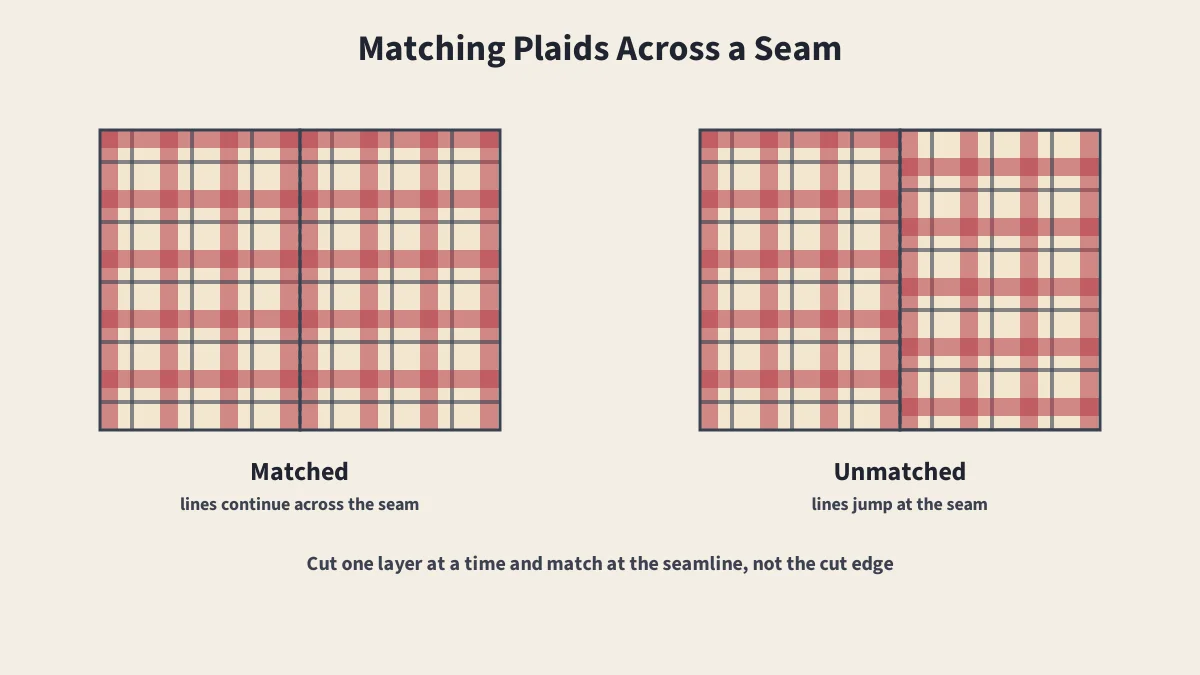
- Cut a single layer, right side up, one piece at a time.
- Cut the first piece, then flip it over and lay it on the fabric so its stripes sit exactly on matching stripes, to cut its mirror image.
- Trace the stripes onto the pattern tissue at the notches so the next piece can be aligned with them.
- Match at the seamline, not at the cut edge, since seam allowances can differ.
Sewing to Match
- Pin through the stripes exactly at the seamline, every few inches.
- Use a walking foot so the layers don't creep; see the presser feet guide.
- Slip-baste from the right side for perfect matching on wool and suiting.
- Cut pockets, yokes and cuffs on the bias as a deliberate design choice when matching would be impossible; see grain and bias.
Sources
- Tartan, Wikipedia
Frequently Asked Questions
What is the difference between an even and uneven plaid?
An even (balanced) plaid mirrors itself from a central line in both directions, so it can be matched easily. An uneven plaid's sequence repeats without mirroring, so pieces must all be laid out in one direction.
How much extra fabric do I need to match plaids?
Plan on extra fabric of at least one pattern repeat for each major piece; large or uneven plaids need more. Patterns sometimes note when a style isn't suitable for plaids.
Which seams should be matched?
Prioritize the most visible: center front and back, side seams below the waist, and horizontal lines across the front and sleeves at the chest. It isn't always possible to match every seam, such as darted areas or shoulder seams.
What is a sett?
The repeating unit of a tartan, a square of stripes arranged around a central pivot. Most setts are symmetrical, mirroring at each pivot.
Keep Reading
Fabric Pattern Names
Tartan, gingham, houndstooth, paisley, polka dots and more.
Cutting Fabric and Layout
Grainlines, folds, napped fabrics and clean cutting.
Grain, Bias and Selvage
Lengthwise grain, crosswise grain, true bias and selvage.
Types of Wool Fabric
Worsted vs. woolen, plus gabardine, tweed, flannel and more.