Resist Dyeing: Batik, Ikat, Shibori and Tie-Dye (2026)
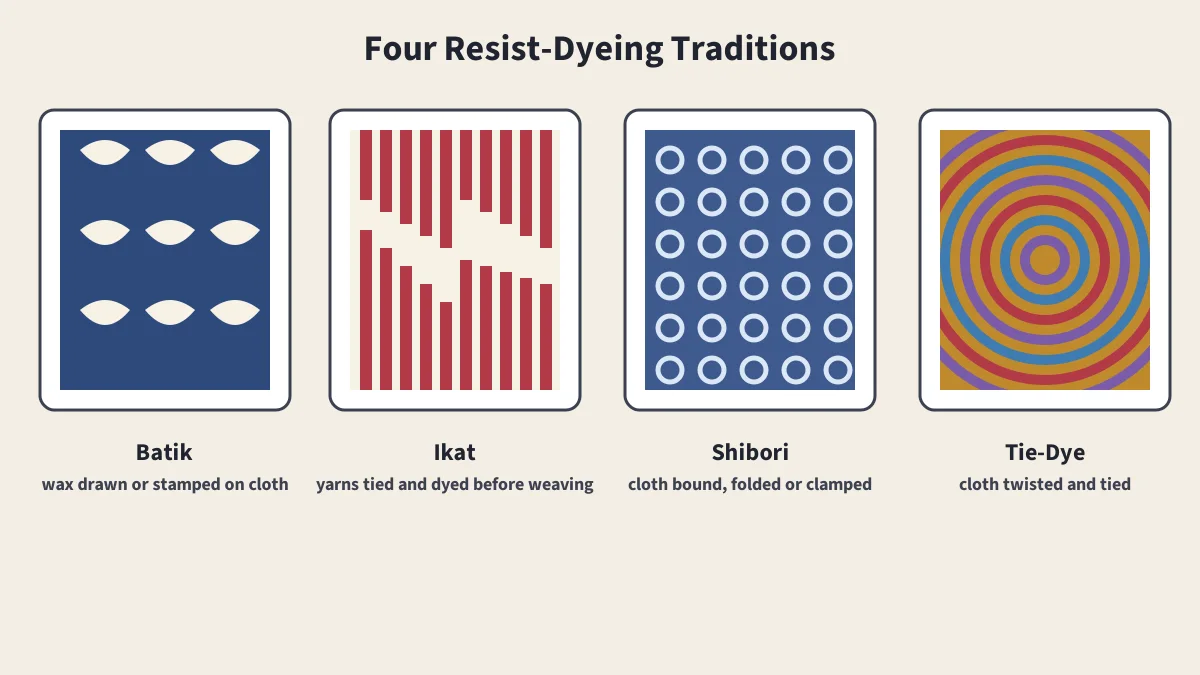
Some of the world's most admired textiles are made by stopping dye from reaching the cloth. Wax, thread, clamps and folds each block the dye in their own way, creating batik, ikat, shibori and tie-dye.
In This Article
Resist Dyeing in Brief
- Batik: wax on cloth
- Ikat: yarns bound and dyed before weaving
- Shibori: Japanese binding, folding and clamping
- Bandhani: Indian tie-dye
- Tie-dye: the general term for binding and folding
Resist dyeing protects part of a fabric or yarn from dye, so it stays the original color and forms a pattern. The resist can be wax, paste, tightly bound thread, folds or wooden clamps. The techniques developed in many cultures, and some of the most famous textiles in the world are made this way. For printed patterns, see textile printing methods.
Batik
Batik is a dyeing technique using wax resist. Wax is drawn or stamped onto cloth to block the dye, and when the wax is removed, a pattern remains. Repeated cycles of waxing and dyeing build up intricate, multicolored designs. Fine lines and dots are drawn with a canting, a small copper reservoir with a spout on a wooden handle, which produces "written batik" (batik tulis); a carved stamp called a cap is faster but less detailed.
Wax resist dyeing appears in many ancient cultures, including Egypt, China, India and West Africa, and Java developed it into one of its most sophisticated forms. On October 2, 2009, UNESCO recognized Indonesian batik as a Masterpiece of the Oral and Intangible Heritage of Humanity, and Indonesia now marks National Batik Day on that date.
Ikat
In ikat, the resist is applied to the yarns before they are woven. Bundles of yarn are tightly bound in places, then dyed; when woven, the dyed sections form the pattern, often with a characteristically blurred edge. Because the pattern is in the yarn, both faces of the cloth are patterned. The word ikat is Malay, meaning cord, thread or knot, and as a verb, "to tie" or "to bind."
| Type | Yarns Dyed |
|---|---|
| Warp ikat | Warp only |
| Weft ikat | Weft only |
| Double ikat | Both warp and weft; the hardest and most expensive |
Shibori
Shibori is a Japanese family of resist techniques that takes its name from the verb shiboru, "to wring, squeeze or press." The earliest surviving shibori-dyed cloth was donated to the Tōdai-ji temple in Nara in 756.
- Kanoko: sections bound with thread to make circles, what many people think of as tie-dye.
- Arashi: cloth wrapped diagonally around a pole and bound, giving storm-like diagonal lines.
- Itajime: folded cloth clamped between boards for repeating shapes.
- Kumo: fine pleating and binding for a spiderweb design.
Tie-Dye and Bandhani
Tie-dye describes resist techniques in which fabric is folded, twisted or bound before dyeing. The earliest surviving examples come from pre-Columbian Peru, dating from 500 to 810 AD. Bandhani is an Indian form of tie-dye that originated in western India. Modern psychedelic tie-dye became a fad in the United States in the late 1960s.
Telling Them Apart
- Crackle lines where dye seeped through cracked wax suggest batik.
- Blurred edges along the weave suggest ikat.
- Precise repeated shapes from folding and clamping suggest itajime shibori.
- Tiny dots in patterns suggest bandhani.
Sources
Frequently Asked Questions
What is resist dyeing?
Any dyeing method in which part of the fabric or yarn is protected from the dye, by wax, paste, binding thread, folding or clamping, so that it stays undyed and forms a pattern.
What is the difference between batik and ikat?
Batik applies wax to finished cloth before dyeing. Ikat applies the resist to the yarns before they are woven, so the pattern forms as the cloth is woven.
What is double ikat?
Ikat in which both the warp and weft yarns are resist-dyed before weaving, so the patterns must line up as the cloth is woven. It is the most difficult and expensive form.
When did tie-dye become popular in the US?
Modern psychedelic tie-dye did not become a fad until the late 1960s, when musicians such as Janis Joplin helped popularize it.
Keep Reading
Textile Printing Methods
Block, roller, screen and digital printing explained.
Indian Handloom Textiles
Banarasi, Kanchipuram, Pochampally, Patola, Jamdani and khadi.
Fabric Pattern Names
Tartan, gingham, houndstooth, paisley, polka dots and more.
Types of Silk Fabric
Charmeuse, crêpe de chine, organza, dupioni, taffeta and more.