Leather, Suede and Faux Leather: Grades, Tanning and Sewing (2026)
Full-grain, top-grain, split, suede, bonded, genuine: leather labels can be confusing. Here is what each term means, how hides become leather, and what to know before sewing leather or its imitations.
In This Article
Leather in Brief
- Age: leather making has been practiced for more than 7,000 years
- Most common tanning: chrome tanning
- Top grade: full-grain
- Suede: the napped underside of a split
- Faux leather: polyurethane or vinyl on a fabric backing
Leather is animal hide treated so it will not rot, and it has been made for more than 7,000 years. Unlike woven or knitted fabric, it has no grain of threads, does not fray and keeps every hole you make in it. Those qualities make it durable and beautiful, and demanding to sew.
Tanning Methods
| Method | How | Result |
|---|---|---|
| Vegetable tanning | Tannins from plants; the oldest known method | Supple, light brown; not stable in water |
| Chrome tanning | Chromium salts; the most common modern method | More supple and water-resistant |
| Aldehyde tanning | Glutaraldehyde or oxazolidine compounds | "Wet white," the main chrome-free leather |
| Brain tanning | Emulsified oils | Exceptionally soft and washable, such as buckskin |
Leather Grades
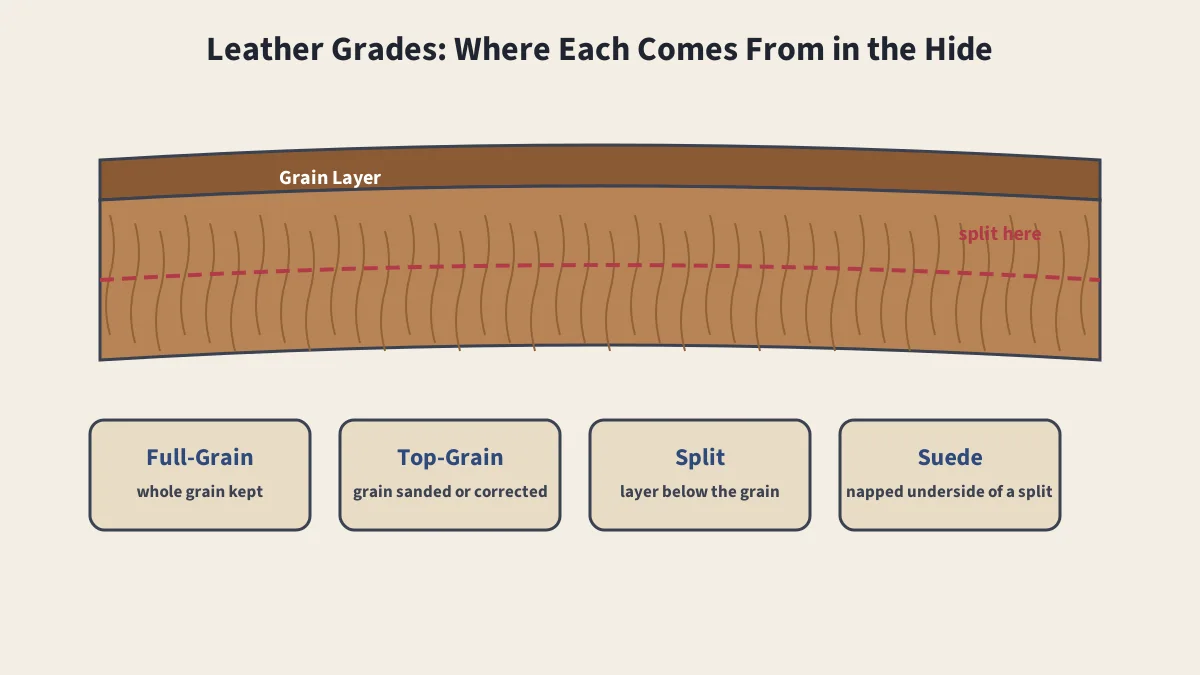
A hide has a tough outer grain layer and a looser fibrous layer beneath, called the corium. Thick hides are often split into layers, and the layer used decides the grade.
| Grade | What It Is |
|---|---|
| Full-grain | The entire grain layer kept; usually considered the highest quality, and develops a patina |
| Top-grain | Includes the grain layer; corrected grain is sanded or buffed to hide flaws |
| Split | Made from the corium left after the top grain is separated |
| Suede | The underside of a split, finished to a soft nap |
| Nubuck | Top-grain leather sanded on the grain side for a velvety surface |
| Bonded | Shredded leather scraps bonded onto a fiber mesh; 10% to 90% leather |
Faux Leather
Artificial leathers usually have a polyurethane or vinyl coating applied to a cloth backing, and are sometimes called pleather. They are cheaper and more uniform than leather, but they do not breathe or age the same way, and the coating can crack or peel over time.
Sewing Leather and Faux Leather
- Use a leather needle, which has a cutting point, for real leather, and a microtex or sharp needle for faux leather; see sewing machine needles and hand needles.
- Use clips, not pins, because every hole is permanent; see closures.
- Lengthen the stitch so closely spaced holes do not weaken the seam.
- Use a walking, roller or non-stick foot so the foot does not stick; see the presser feet guide.
- Use strong thread, such as polyester or nylon; see types of thread.
- Do not backstitch heavily; tie off threads instead to avoid extra holes.
- Press with care: use a dry iron on low heat with a pressing cloth, or flatten seams with a mallet or glue.
Sources
- Leather, Wikipedia
- Artificial leather, Wikipedia
Frequently Asked Questions
What is the highest grade of leather?
Full-grain leather, which keeps the entire grain layer, is usually considered the highest quality. It develops a patina over time.
What is suede?
Suede is leather made from the underside of a split, the inner layer of the hide, finished to a soft nap. It is often made from younger or smaller animals.
What does 'genuine leather' mean?
It is not a specific grade. The term is often used for heavily processed split leather, and in some places it simply means the product contains leather.
What is faux leather made of?
Artificial leathers usually have a polyurethane or vinyl coating applied to a cloth backing. They are sometimes called pleather.
Keep Reading
Technical and Outdoor Fabrics
Membranes, ripstop, DWR and aramids explained.
Pile Fabrics
Velvet, velveteen, velour, corduroy, chenille and terry compared.
Sewing Machine Needle Sizes and Types
Needle sizes, types, color codes and when to change them.
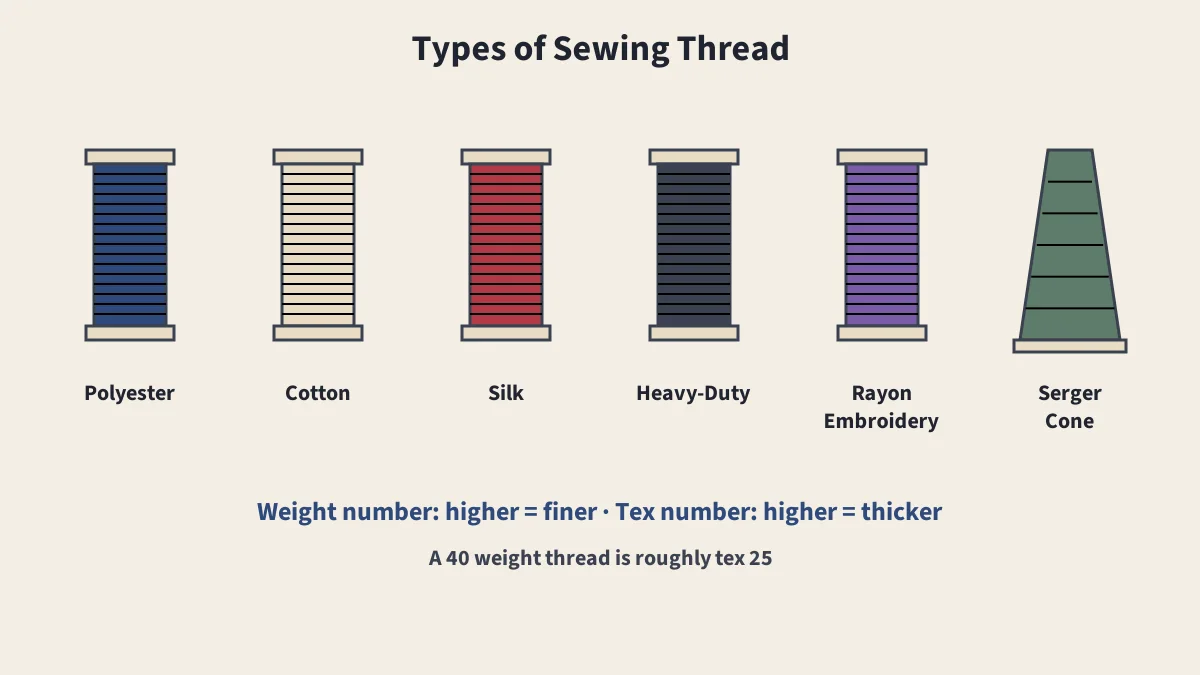
Types of Thread
Thread fibers, uses, and weight, tex and denier explained.